As we begin season two, I share what you can expect from this next chunk of narrative and then take a look at the story so far to refresh our memories and prepare us for what comes next.
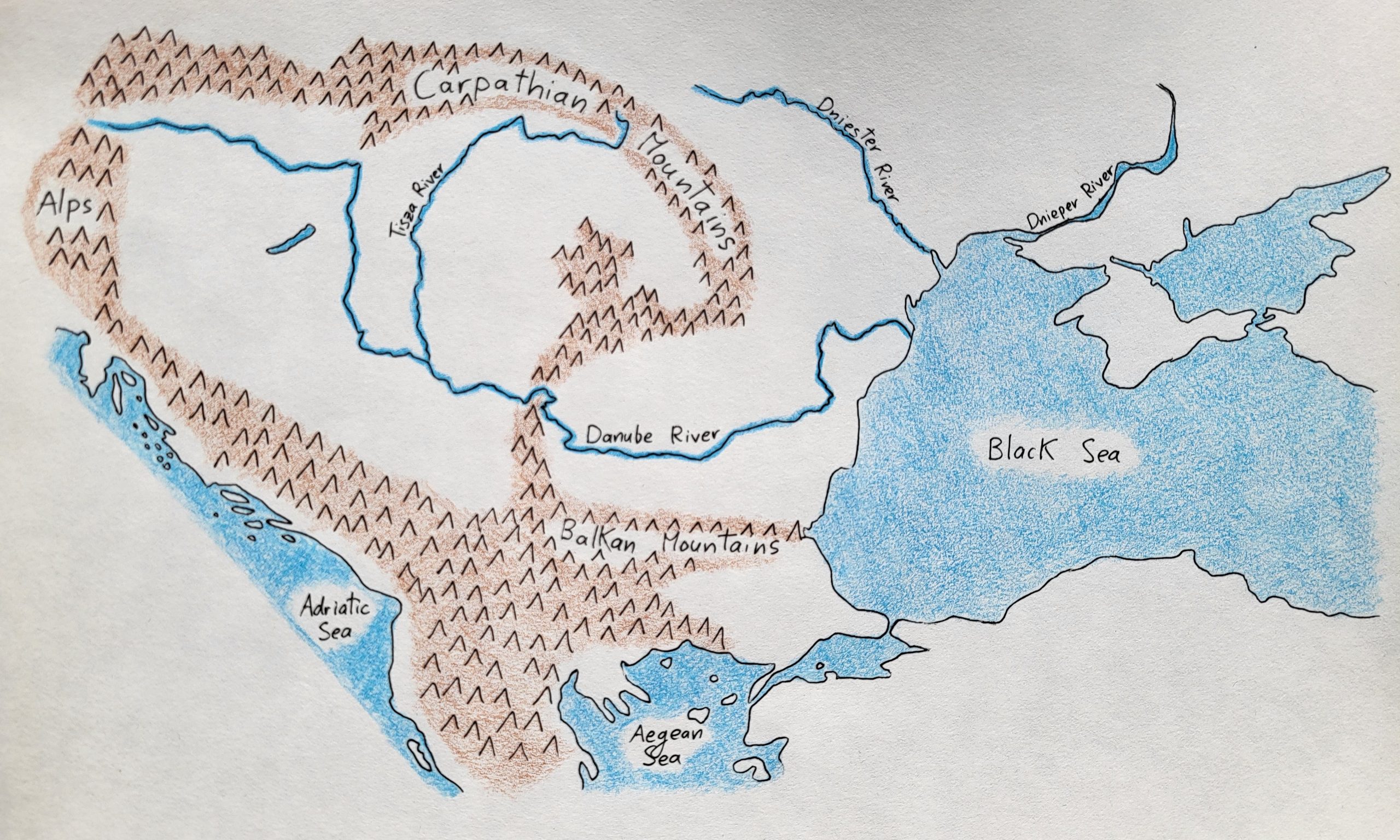
You can easily find Romania on a map by looking at where Europe meets the Black Sea. Its territory has three main features: the Carpathian Mountains, the Danube River, and the Black Sea.
The Carpathian mountain range is shaped roughly like a question mark. The top of the question mark stretches west towards the Alps, while the lower part bends southwards and intersects with the Danube River.
From that point, the Danube flows eastwards along great fertile plains until it empties into the Black Sea.
Transcript
Hello and welcome to A history of Romania.
Season 2, Episode 1: The legacy of Antiquity
Thank you to everybody for tuning in, both returning listeners and those of you who are joining us for the first time. As some of you already know, I took some time after the first season to rest, recharge, and get a head start on the research for our next chunk of narrative.
In this second season, we’ll see the exploits of the Avar khaganate, the rise of the Bulgarian empire, the arrival of the Hungarians, the resurgence of the Roman empire, the adventures of the Crusaders, the conquests of the Mongols, and of course, the emergence of the Romanian people.
When I first sketched out the podcast, this second season was supposed to run from the year 602 to the year 1774. But I gathered so much information during my research that I realized we need to tackle a shorter period to be able to get into all the details. So, the second season will instead cover events up to the year 1396, and the third season will pick up the story from there up to 1774.
Before we begin the story, though, we need to set the stage. I’ll use this episode to recap the narrative so far, and the next three episodes to explore the situation in the region in the year 602.
Our story is set on the territory of present-day Romania, which you can easily find on a map by looking at where Europe meets the Black Sea. This territory has three main features: the Carpathian Mountains, the Danube River, and the Black Sea.
The Carpathian mountain range is shaped roughly like a question mark. The top of the question mark stretches west towards the Alps, while the lower part bends southwards and intersects with the Danube River. From that point, the Danube flows eastwards along great fertile plains until it empties into the Black Sea. I’ve drawn a map of these features and linked it in the episode’s description if you want a visual aid.
We began season one by following the first humans to venture into the region nearly forty thousand years ago. For hundreds of generations, their descendants lived as nomads who gathered fruits and nuts, hunted game, caught fish, and tended plants. Only recently—some five thousand years ago—did these communities decide to rely on growing crops as their main food source. And over the following few millennia, they learned to work copper and iron, and developed a unique and vibrant spiritual culture.
By the time we get to our first written sources, the people living on the plains on either side of the Danube were known as the Getae. The written sources come to us from the Greeks who had begun to trade with these communities in the 7th century BCE, offering manufactured goods like amphorae and olive oil in exchange for raw goods like grain and honey. Within a few decades of first contact, several Greek city-states founded colonies on the coast of the Black Sea to expand this trade, and close links soon developed between the colonists and the natives; Greek culture diffused inland while some Getae moved into the coastal settlements to live alongside the foreigners.
This prosperous relationship between the Getae and the Greeks was set back in the late 6th century BCE when the Persians crossed the Bosphorus and expanded their empire into Europe. The Getae tried to maintain their independence and resisted the Persian army, but their warriors were defeated and their communities were forced to pay tribute to the King of Kings.
The Persians maintained a foothold in Europe for a few decades before the Greeks forced them back across the Bosphorus. As Persian control collapsed, a tribe from Thrace called the Odryssians took the opportunity to subjugate both the Getae along the Danube and the Greeks living in the rich Black Sea colonies. The Odryssians thus created a powerful and prosperous kingdom which ruled the region for nearly a hundred and fifty years.
Its downfall came in the form of Philip of Macedon, who conquered the Balkans up to the Danube in the middle of the 4th century. His son Alexander pushed the conquests even further and created an immense empire that spanned the Orient; but though his gains were impressive, they were also unstable. When Alexander died, his empire fell into civil war, and the Getae north of the Danube successfully rebelled against Macedonian rule and gained their independence.
For the next two centuries, the Getae were mostly left to themselves as the various powers of the Mediterranean had other priorities. That was great for the Getae as well as for their cousins the Dacians, who lived further north in the Carpathian Mountains. During this period of relative peace, the Getae and Dacians established larger settlements, united into confederacies to facilitate trade and defense, and even began minting coins.
By the middle of the 1st century BCE, the tribes north of the Danube had united under the Dacian leader Burebista to protect themselves from Celtic tribes to the west and the growing power of the Romans to the south. Burebista was a contemporary of Pompey and Caesar, and when war erupted between these two men, the Dacian leader backed Pompey.
But before Burebista could march out with his army, Caesar had already won in a lightning strike. Right afterwards, he wanted to punish the Dacians for supporting his enemy, but Caesar was assassinated before he could invade. The Republic once again fell into civil war, and the Roman threat dissipated. Now, the Dacian and Getae tribes who had united under Burebista for common defense saw no reason to subordinate themselves any longer; they too assassinated their leader to regain their independence, and Burebista’s kingdom disintegrated into its constituent confederacies.
It took another century for the Dacians to once again join under a single leader. The impetus for unity was the renewed threat of Rome; by the 1st century CE, it had become an empire, annexed the Greek colonies on the coast of the Black Sea, and garrisoned soldiers along the southern bank of the Danube. To maintain good relations with this behemoth on the border, the Dacian king made a deal with the emperor: his warriors would protect the empire from barbarians beyond the frontier in exchange for subsidies.
The alliance worked well for decades, until a profligate emperor rose to the throne and spent so much money that he had none left for subsidies. You can understand that the Dacians weren’t too happy to have their pay cut, and they invaded the empire to force the emperor to reinstate the deal. But the war didn’t go well for them at first; the Dacians suffered several defeats and quickly lost faith in their king. To turn the situation around, they elected another man to lead them, one named Decebal. This new king outmaneuvered the Roman army, annihilated an entire legion, and finally forced the emperor to negotiate. In the resulting deal, the emperor reinstated his alliance with the Dacians, increased their subsidies, and even sent them skilled artisans for construction projects.
As you can imagine, the Romans saw this peace as a humiliation. The next emperor, Trajan, decided to conquer Dacia to wipe away the shame of defeat, remove the threat posed by the Dacians, and capture their rich gold deposits to boost the imperial economy. Trajan assembled two fifths of the entire imperial army on the shores of the Danube, and though Decebal tried to appease him, nothing would divert the emperor from his plan.
In the spring of 101 CE, Trajan invaded the kingdom of Dacia unprovoked. The next five years involved brutal battles, temporary truces, desperate defenses, and harsh reprisals. In the end, the Romans won. Dacian forces were defeated, Decebal committed suicide so as not to be captured, his kingdom was dismantled, its treasury seized, and the Dacian people were left at the mercy of their conquerors.
Immediately after his victory in 106 CE, Trajan began to colonize the territory he had seized. The kingdom of Dacia was annexed as a province of the empire, its best land was given to Roman veterans, the state began extracting gold from its mountains, and settlers from across the empire were encouraged to come make it their home.
This colonization effort was highly successful because of strong state support. By the middle of the 2nd century, the province of Dacia had four cities; hundreds of villages and agricultural estates; dozens of mines to extract gold, silver, lead, iron, and copper; and customs stations to trade with the peoples beyond the borders. It’s worth noting that, like in the rest of the empire, this economy largely relied on tens of thousands of enslaved people; though the Romans made Dacia more prosperous than ever before, they also brought a tremendous amount of suffering to its lowest social classes.
Besides imperial settlers, the province of Dacia was also home to a great number of native Dacians. Though many had died during the conquest, the majority of them had survived and adapted to the new order. Some natives came to sell agricultural and artisanal goods to soldiers and colonists, while others moved near garrisons to find employment as servants or labourers. Economic and social ties developed between the natives and the colonists, and it soon became common for Roman men to enter relationships with Dacian women.
The emperors who followed Trajan had a conciliatory stance towards the Dacians and encouraged them to join the auxiliary forces and adopt Roman ways. Even outside the army, Dacians conducted business in forums, used coins with the emperor’s face on them, learned Latin to interact with settlers, attended shows at amphitheatres, saw gladiators fight wild animals, took part in traditional Roman festivities, and some even adopted Latin names. In short, the Dacians became Romanized over several generations.
At the beginning of the 3rd century, this Romanization was enshrined in law when all free inhabitants of the empire were granted citizenship. At this point, the province of Dacia was wealthier than ever and was particularly urbanized compared to its neighbours. Dacia had six colonies, while Moesia and Pannonia had three put together. A colony was the highest status a settlement could attain and operated under Italian law, meaning that its land was considered Italian soil, and it was as if its inhabitants lived on the Italian peninsula.
Though Dacia was more prosperous than ever at the start of the 3rd century, it was also about to face its greatest challenges yet. By this time, the Goths had migrated to the plains north of the Black Sea, and soon initiated a series of unrelating campaigns against the empire. During the middle of the 3rd century, the Goths devastated the Balkan provinces and even killed an emperor in battle — which was the first time one had fallen to a foreign enemy. At the same time, measles ravaged the empire, affecting farmers in fields, workers in cities, and soldiers in forts. People suffered for weeks, and each passing day, fewer and fewer of them left their lodgings. Within months, every corner of the Roman world was infected, and death swept over 15% of the population.
Meanwhile, the state was disintegrating: a commander in the East carved himself a kingdom that ran from the Anatolian plateau to the Sinai Peninsula, while a commander in the West declared himself emperor of Germania, Britannia, and Hispania. Dacia was left isolated as internal trade collapsed and reinforcements stopped coming. Yet the people of Dacia remained defiant in the face of these calamities; though barbarians crossed the mountain passes and made it inside the Carpathian Basin, local soldiers successfully defended all of Dacia’s cities, and their inhabitants celebrated Rome’s thousandth anniversary alongside the rest of the empire.
When the province of Dacia did fall, it did so not because it was overrun, but because it was abandoned by the Roman state. You see, as the crisis in the middle of the 3rd century hit its peak, emperor Aurelian sent orders to the governor of Dacia to evacuate the province and move his soldiers south of the Danube. Aurelian needed to consolidate his remaining forces to retake lost lands in the West and East, and to overcome the barbarian invasions. The Dacian legions would be an integral part of this plan, and once the empire was stabilized, they could return to their homeland to recover what was lost.
And so, in the year 271, the army, the administration, the magistrates, the landowners, and their servants left Dacia. Yet the majority of the population, the poor in the countryside and in the workshops, the enslaved on farms and in mines, and those who laboured for others in forests, valleys, docks, and households — they remained in place. By doing so, they escaped their former obligations and had a chance to gain a piece of land for themselves as well as whatever the rich weren’t able to carry with them.
Aurelian’s efforts did indeed stabilize the empire, but his successors had other priorities besides retaking Dacia, and the people of the region were left to their own fates. It didn’t take long for the Goths to notice that the legions had left, and they soon migrated on the territory of the former province. When Gothic clans encountered Roman settlements, their warriors took the best land and gave it to their own families, and convinced the Roman communities to pay them tribute.
All over the former province, Roman workers continued to live near the villas which their employers and masters had abandoned, while those in cities and near forts moved into public buildings or the houses of their richer neighbours who had left. As the decades passed, the provincials who had decided to stay behind established a working relationship with their new migratory neighbours. At the same time, they also traded with their brethren in the empire, travelling the old imperial roads they knew so well and returning north with valuable goods to sell to the Goths.
When Aurelian had ordered the evacuation, he had maintained a few fortified bridgeheads across the Danube. These positions allowed the empire to exert influence north of the river, but Roman troops didn’t venture much beyond them because the empire was undergoing a great and violent period of change. After the crisis in middle of the 3rd century, emperor Diocletian completely restructured the empire to enable it to face the new world in which it found itself. Diocletian’s reforms touched on every aspect of life, from the administration to the army, the laws, the economy, and religion. His greatest reform, though, was a change to the succession system: having ruled alone for years, he would now abdicate and let a college of four emperors jointly govern the empire. It was a logical system, but the Romans weren’t ready to give up sole rule; Diocletian’s abdication led to a 20-year civil war which culminated in the coronation of a single emperor, a man named Constantine who had championed the cause of the Christians to help him win.
Constantine didn’t want to govern the empire from Rome. He needed to be close to the Persians as well as to the Germanic tribes along the Danube to quickly respond to threats. He also needed a capital that was untainted by the Roman pantheon, since he wanted a Christian metropolis for a Christian emperor. So, Constantine decided to build a new capital outright and chose the western coast of the Bosphorus as its location. Inaugurated in 330, his capital came to be called “Constantine’s city,” or Constantinopolis.
The city was only a three-week march from the Danubian frontier, so to ensure that no barbarians would barge in, the emperor reinforced the border and campaigned north of the river to create a buffer between those barbarians and his capital. Thus, the Romans subjugated the Goths and other peoples who had settled on Dacian land, and created a new province called Gothia between the Danube and the Carpathians.
Constantine commissioned a stone bridge across the river to connect Gothia to the rest of the empire, the first such permanent bridge since Trajan’s days. Everyone in the region was put under the empire’s administrative system, whether they were Romanized individuals descended from former provincials or Gothic barbarians who had settled near them. Communities north of the Danube sent their young men to the imperial army while their village elders provided goods as taxes.
With the empire once more present north of the river, Christianity began spreading in the area at a rapid pace. Missionaries headed into the Carpathian Mountains while believers from Gothia travelled to imperial churches for baptisms and marriages. A Goth of Roman descent named Ulfilas was appointed as the bishop of Gothia and even invented a Gothic alphabet to translate the Bible. It was an immense achievement, since for the first time, a Germanic language received a written form.
However, Christianity wasn’t embraced by everyone. The entrenched Gothic aristocracy rejected this imperial religion and opposed Gothic converts and Romanized communities who worked with the empire. As these two sides fought for influence in the province of Gothia, they were both taken completely by surprise by the arrival of the Huns.
This nomadic people from the steppes to the East ravaged the lands north of the Danube, and the Goths who had collaborated with the empire sought refuge south of the river. These refugees were ferried to safety, but a local Roman commander tried to kill their leaders to destroy their cohesion. The Goths understandably took up arms in revolt, and they posed such a threat that emperor Valens had to come subjugate them himself. But in a decisive battle, the Goths defeated the Roman army and killed Valens, forcing the next emperor to let them settle on imperial land in exchange for their military support.
Meanwhile, north of the Danube, the Goths who had refused to migrate to the empire struck deals with the Huns. The nomads demanded absolute loyalty from the leaders of foreign peoples under them. In return, these leaders could participate in raids and take a part of the loot for themselves. As for the Romanized communities of the region, they didn’t have a military aristocracy which could serve the Hunnic confederation, so they were instead forced to provide tribute to their overlords. Some Romanized communities abandoned their exposed settlements on the plains and relocated to forests and mountains to escape these obligations, while others sought the protection of Gothic chieftains who collaborated with the Huns.
The Huns had settled on the plains of the Carpathian Basin, and then, in the early 5th century, they began expanding outwards. As they subjugated more people, the Huns sometimes raided the empire and sometimes even served as mercenaries for the emperors.
By the middle of the 5th century, the Hunnic confederation came under the control of a single man—Attila—and he had bigger ambitions than mere periodic raids; he wanted to threaten the empire into giving him regular subsidies. So, Attila led a devastating attack against the eastern half of the empire, and though the Romans stopped his advance near Constantinople, they agreed to pay him a huge sum every year to maintain the peace.
Having extorted the East, Attila then turned to the West. This time, though, the Romans knew what to expect and were better prepared; Attila’s forces were halted in Gaul, and as the Hunnic ruler was getting ready to retaliate, he unexpectedly died during a feast. His sons immediately turned on each other to gain their father’s throne, and the subjects of the Huns used the opportunity to revolt. The most powerful subject people, a Germanic tribe called the Gepids, led a coalition against their overlords and successfully defeated them, thus freeing everyone who had participated.
As the leaders of the rebellion, the Gepids took the Hunnic heartland for themselves. In the latter part of the 5th century, they used the momentum of their victory to march to the banks of the Danube and up to the Carpathian Mountains, thus gaining control over the entire territory of the original province of Dacia.
The Gepids even captured the old imperial city of Sirmium south of the Danube. Their king set up his court there to be close to the empire and also appointed a Christian bishop to sit in the city and minister to his people, since the Gepids were largely Christian by this point. Centered on the old territory of Dacia, the Gepid kingdom prospered and became a dependable neighbour of the empire, receiving subsidies in exchange for military support. Gepid warriors were even employed by the Romans as frontier troops in the Balkans and Crimea, where they brought their families and influenced the local culture.
Yet in the 6th century, the Gepids were faced with a slate of new threats: regular attacks by the Slavs who had recently migrated southwards, an outbreak of bubonic plague, and an exhausting, decades-long conflict with the Lombards. And then, in 567, a nomadic people from the steppes called the Avars attacked them from the East. The Gepids were unable to resist their advance: their army was defeated, their king was killed, their kingdom collapsed, and their communities were left adrift.
The Avars established their hegemony over the Carpathian Basin and then raided the empire relentlessly. After decades of warfare, the Romans finally managed to secure their Danubian frontier and, in 602, they inflicted a devastating defeat on the nomads. The Avar khagan was thus forced to stop raiding imperial land and to recognize that his realm ended at the Danube.
So that’s where we ended the story of season one, with the Roman Balkans secured and the Avars as the hegemonic power beyond the Danube. In the next episode, we’ll take in-depth look at this fearsome nomadic people, their way of life, and the khaganate they established to rival the empire. See you in two weeks.
Leave a Reply