The siege of Constantinople is over, with the emperor victorious over the khagan and the shah. Yet as all these combatants slink away from each other to lick their wounds, new dangers threaten to bring all three of them down – along with their realms.
The Avar khaganate in 635 was much reduced compared to what it had been a decade earlier. The Slavic clans in the West elected Samo as their king and established an independent realm along the Morava River, while in the East, Kubrat led his Bulgars to freedom, bringing the steppe lands north of the Black Sea and the various nomadic peoples who lived on them under his authority.
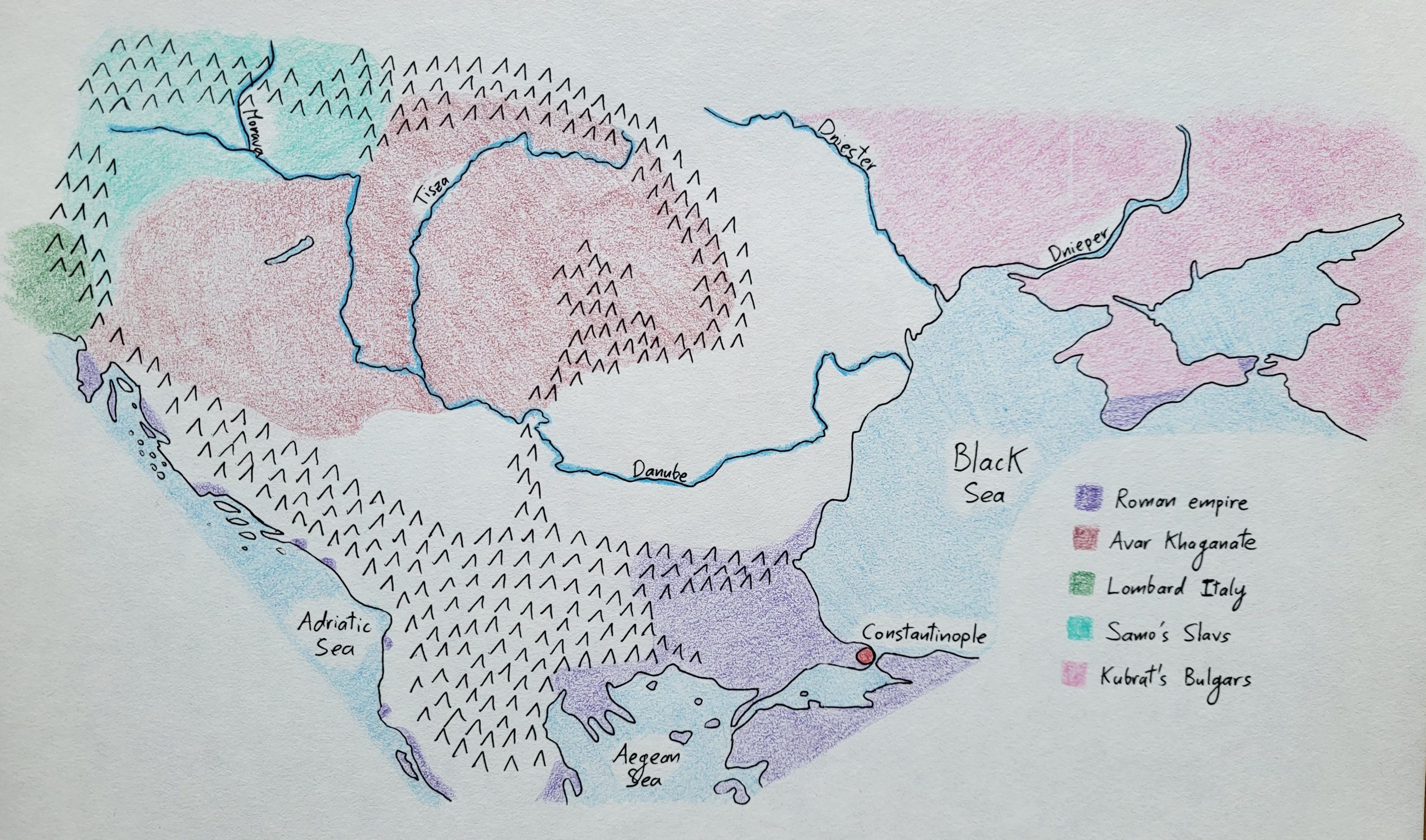
If we look at the previous map from episode two, we can also note some important changes that had occurred outside the Carpathian arc and in the Balkans since the start of the wars between the Avars and the Romans.
The Roman empire had lost its holdings in much of the Balkans outside of Thrace and the coast of the Aegean and Adriatic seas. Slavic communities settled on land abandoned by fleeing Roman refugees, and those former provincials who remained in place negotiated with the new arrivals to work out land and trade agreements on a village-to-village basis.
Meanwhile, as the Bulgars on the steppes of the eastern khaganate asserted their independence, the Avars could no longer project their authority beyond the Carpathian mountain passes. At the same time, the Bulgars themselves didn’t have the strength to assert their authority west of the Dniester, and so the communities between the Carpathians and the Dniester – Romanic and Slavic alike – were able to live in their village communities more or less free from the tribute demands of nomadic warlords.
Transcript
Hello and welcome to A history of Romania.
Season 2, Episode 8: No respite
Last time, we saw the Avars and Persians besiege Constantinople. The khagan had brought all his might to the fight, drawing on his own riders, his Bulgar allies, his Slavic vassals, and even his Gepid and Romanic subjects. But his repeated frontal assaults against the walls achieved nothing, and as food was running out, he gambled on a final naval attack. When this too failed, he exploded in rage and slaughtered the Slavic sailors who’d survived the ordeal, which cratered his support amongst his troops. He was thus obliged to withdraw, and only the threat of force kept his subjects marching alongside him as they retreated.
But news travels faster than armies, and even before the main host made it back across the Danube, accounts of the defeat at Constantinople had already reached the far western edges of the khaganate. Here where the plains of the Carpathian Basin meet the foothills of the Alps, lived numerous Slavic communities, and their members had close contact with the Avars. Sources tell us that Avar riders sometimes coerced Slavic villagers in the region to quarter them during the winter, and some of them abducted Slavic women and forced themselves on them. When spring arrived, the Avar aggressors rode off, leaving these women pregnant, and the children who were born a few months later had much more sympathy for their Slavic mothers than their Avar fathers.
And so, when news reached these communities of the khagan’s defeat and cruelty towards his Slavic subjects, the resentment built by years of oppressive treatment finally burst forth; the sons of these Slavic women took up arms, and young men banded together to openly defy the khagan. By the late summer of 626, only a few months after the siege of Constantinople, rebellion had spread through all the Slavic communities at the western edge of the khaganate. The Avar ruler of course sent detachments to put down these insurgents, but surprisingly, the rebels managed to repulse them and maintain their positions; and their success attracted the attention of their foreign neighbours.
You see, to the west of the khaganate lay the Frankish kingdom of Austrasia. Its ruler, king Dagobert, saw an opportunity to use the Slavic rebellion to weaken the Avars while consolidating his authority along their shared frontier. And so, as the insurgency was still finding its footing, Dagobert sent a man named Samo to strengthen the rebels. Samo was a Frankish trader who had extensive contacts in the communities of the region, and he now came to them with plenty of weapons – and a good number of adventurous followers. Samo quickly allied himself to the Slavs and fought alongside them. Over the following few months, he performed so well as a military leader and was so trusted by the rebels that they soon chose him as their king.
It might seem strange that the Slavs would elect a foreigner to lead them, but there were good reasons to do so: it defused any threat from Dagobert since his man was now in charge, and it also balanced the interests of the various clans in the rebellion, since none would be predominant over the others. In fact, Samo married twelve Slavic women, probably one from each of the leading regional clans, to secure his position.
After their initial failure, the Avars sent more detachments to crush this rebellion. We have very little information about this war, but it seems that the conflict spread to the rest of the western Carpathian Basin. For instance, we have evidence of fighting in the Romanic community on the coast of Lake Balaton, which we explored in episode three. If you’ll recall, this community of Roman descendants lived around an ancient imperial fort and traded with other Christians in the Frankish and Lombard kingdoms; they carried on their long-distance commercial activities with the tacit approval of the khagan, who benefitted greatly from their ventures; in exchange for giving this community some autonomy to manage their own affairs, they brought him goods from faraway lands to which he would otherwise not have access. The deal worked for both sides, and the Romanic community at Lake Balaton became quite prosperous.
But in the aftermath of the siege of Constantinople, this mutually beneficial relationship broke down. We lack written sources for this event and only have archeological evidence, so we can only speculate as to the reasons of this breakdown: maybe the community cut ties with the khagan since they sensed weakness and wanted to chart their own course; maybe they allied with Samo to gain his protection and easier access to western markets through his lands; or maybe they stayed loyal to the khagan but failed to provide as much support as he expected, and so were punished. Whatever the true scenario, what we do know is that, sometime around 630, the ancient Roman fort at the center of the settlement was destroyed. The Avars didn’t massacre the community, but focused on the elite and their fortified holding. People continued to live in the settlement, but after this sack, we find no more goods from beyond the khaganate’s borders within the town; trade with the outside world ceased, and they became just another settlement subject to the Avars, with no more autonomy nor prosperity than other Romanic communities.
Although the Avars crushed the power of this prosperous Romanic community, they were less successful against Samo’s Slavs; we don’t have a detailed account of the war, but it seems that the rebels found continued success, because by the third year of the rebellion, they were living independently of the khagan, with Samo as their unifying king.
Dagobert’s gamble had paid off handsomely, and he was now in a better position than ever before. By 630, he’d succeeded his father as the sole king of the Franks, and added the kingdoms of Neustria and Burgundy to his crown; his goal now was to bring Samo’s realm into the fold as well, since Samo was, after all, his agent. And so, Dagobert sent an envoy to Samo, telling him that, since he owed him service, he should formally become his vassal and bring his Slavic kingdom under the Frankish crown. Samo was willing to become a subject, but he was no longer just an armed merchant; he had become a king, and wanted to be respected as a peer. So he replied to the envoy that his land and people of course belonged to Dagobert, as long as the Frankish king maintained friendly relations with them. The envoy was outraged that a servant of the king would demand anything of his ruler and said: “It is impossible for Christians and servants of the Lord to live on terms of friendship with dogs.” As you can imagine, Samo immediately threw him out, and this, of course, meant war.
A year later, in 631, Dagobert marched three armies into Samo’s realm: a Frankish one which he led himself, an Alemanni one, and a Lombard one. The Alemanni and Lombards overcame the Slavs they encountered and captured numerous prisoners, but that’s because the main Slavic force was concentrated on the Frankish king. Samo faced Dagobert in battle directly and won a resounding victory, forcing the Frankish king to retreat and abandon the whole war. Samo exploited his momentum by raiding into Thuringia, and his prestige was such that a Slavic dux in the region even abandoned his allegiance to Dagobert to join him. The goal of these raids wasn’t to gain territory, but to decisively push Dagobert’s forces away from his borders. The extent of those borders is still debated, but it seems that the center of Samo’s kingdom lay along the Morava River. And so, by the early 630s, a western chunk of the Carpathian Basin had fallen away from the khagan’s control.
Part of Samo’s success was due to the skill of his warriors, but another was due to the fact that the Avars couldn’t fully focus on his rebellion, since they were facing another mutiny at the same time. You see, the khagan’s legitimacy hit an all-time low after his defeat at Constantinople, and a good number of his closest commanders – Avar and Bulgar alike – wondered if they would make a better leader. If you’ll recall, the Bulgars were steppe riders who had a similar lifestyle to the Avars; they were nomads renowned for their fighting skills, and they were the Avars’ closest allies. The khagan allowed them to live in autonomous clans and even to undertake raids of their own, and if a Bulgar warrior was particularly successful, he could be inducted into the Avar ruling class.
In fact, the Bulgars were so close to the seat of power and shared so many similarities with the Avars that it wasn’t out of the question for a Bulgar to become the supreme leader of the khaganate. And so, as the Avar host returned from the siege, a prominent Bulgar leader – whose name we don’t have – gathered his followers and rebelled to gain the throne for himself. Again, we have almost no information about this conflict, but we know it was incredibly bloody, as close allies turned on each other and steppe riders rode against one another for the first time in living memory. In the end, the khagan’s loyalists defeated the contender sometime around 630, and nine thousand Bulgar warriors, along with their families, fled to Bavaria in the West.
That duchy, of course, belonged to king Dagobert. The Frankish ruler initially welcomed these exiles and organized winter quarters for them across Bavaria. But after Samo defeated him in battle, Dagobert’s calculations changed; his authority in the region was weakened, and these experienced Bulgar warriors could pose a serious threat; if they rose up – or worse, allied with Samo – he could lose the whole duchy of Bavaria. At the same time, the khagan probably protested that Dagobert was giving refuge to rebellious Bulgars and was threatening to attack.
And so, Dagobert took a drastic decision: he ordered his warriors to kill every Bulgar in his realm. Thousands of men, women, and children were cornered and slaughtered in an ethnic massacre. Only one Bulgar commander survived, along with seven hundred of his warriors and their families, and they fled south to seek refuge with one of Samo’s commanders.
The Bulgars in Bavaria had suffered a horrendous fate; thankfully, though, not all rebels had gone West; after the failed coup, some Bulgars had escaped to the steppe lands north of the Black Sea. Here roamed the nomadic Onogurs, Cutrigurs, and the Bulgars who had stayed behind in their original homeland; all these peoples were subjects of the khagan, but in reality, they were quite autonomous, since the Avar ruler couldn’t effectively project his authority over this peripheral region. Nevertheless, the khagan had no intention of letting a group of rebellious Bulgars flee to safety and create a rival power centre on the border of his realm; so, following his initial victory, he assembled an army and sent it to assert his authority over the steppe lands north of the Black Sea.
The leader of the Onogundur Bulgars of the region, a man named Kubrat, could have cooperated with the Avars and hunted down the fleeing rebels; but instead, he decided to bolster his own position and throw off the khagan’s yoke entirely. In 635, he united the Onogurs, Cutrigurs, and Bulgars of the region and successfully led them in battle against the Avars. The result was that Kubrat carved out an independent realm for himself that extended across the whole northern coast of the Black Sea. To secure his position, he negotiated an alliance with the Romans, and the empire recognized the Bulgars as their main partner to the north – and the hegemon of the eastern European steppe.
So it was that within a decade of their defeat at Constantinople, the Avars lost the western mountains of their realm to Samo’s Slavs and the eastern steppes to Kubrat’s Bulgars. The khagan’s authority was now limited to the interior of the Carpathian Basin, and I’ve included a map in the episode’s description for you to visualize the situation.
You might wonder: where were the Romans in all this? Why didn’t they take advantage of this decade of chaos to push back against the Avars after their victory at Constantinople? Well, the Romans were dealing with their own turmoil, as a new and unexpected danger threatened to undo all their victories.
Let’s return to where we were at the beginning of the episode, just after the khagan abandoned the siege of Constantinople. At this point, emperor Herakleios was fighting Persian armies in Anatolia, and he needed all the help he could get, so he initiated talks with the Göktürks of the Western Turkic Khaganate. These nomads lived on the great Eurasian steppe and also saw the Persians as an enemy, so Herakleios hoped to persuade them to agree to a joint attack.
In mid-August 626, news reached them of the victory at Constantinople, and the triumph convinced the Turks to support the Romans; the two combined their forces and pushed deep into Persian territory. Roman soldiers and Turkic riders headed down the Tigris, destroyed a Persian army, plundered the shah’s palaces, and freed all Roman prisoners they encountered. With Khusrow obviously unable to protect the Persian empire, a conspiracy emerged amongst his senior officers and his son aiming to depose him. The conspirators contacted Herakleios and told him of the plan, and the emperor stopped the offensive to let the conspiracy play out. In the spring of 628, Khusrow’s son deposed and killed him, along with dozens of his own brothers, and crowned himself shah. Immediately afterwards, this new King of Kings agreed to withdraw his troops from Roman territory and to free all remaining Roman captives.
The war was turning decisively in the Romans’ favour. The only problem was Egypt. You see, Shahrbaraz, the general who’d besieged Constantinople alongside the khagan, had refused to bow to Khusrow’s son, and made Egypt his base of power. In an unexpected turn, though, Khusrow’s son died of a plague only a few months after gaining the throne, and Shahrbaraz immediately became the most powerful man in the Persian empire. And so, in the autumn of 628, he made a deal with Herakleios to vacate Egypt in return for the emperor’s support in taking the Persian capital.
Shahrbaraz did indeed become shah shortly afterwards with Herakleios’ help, and the two men met a year later to solidify their alliance by betrothing their children to one another. Shahrbaraz also returned the True Cross to Herakleios, allowing the emperor to personally restore this holiest of Christian relics to the Church of the Holy Sepulchre in Jerusalem. Combined with the victory over the Persians and Avars, the restoration of the True Cross to its rightful place was a clear signal to every Roman that God still favoured them despite all the hardship they’d endured.
When the emperor returned to Constantinople, he inaugurated weeks of festivities to celebrate this immense triumph; after three decades of continuous war, the Romans had prevailed. All their suffering, all those deaths, all that destruction, had not been in vain; they had won. It’s true, much of their empire was smouldering ruins, but Herakleios now had absolute legitimacy as a successful Christian ruler favoured by God. That popular support would allow him to effectively tackle the massive challenges ahead: resettling the hundreds of thousands of citizens who had been displaced, rebuilding hundreds of plundered cities, reorganizing the army, and resetting the state’s revenues. A time of rebuilding lay ahead.
But there was one challenge which the triumphant emperor couldn’t have foreseen, one which emerged in the deserts of Arabia. In a mountainous region along the Red Sea called the Hijaz, clans and tribes made their living from pastoralism and trade, with occasional help from raiding. The Hijaz housed a mix of believers – Jews, Christians, and polytheists – and in the early 7th century, a prophet appeared amongst them: Muhammad of the Quraysh tribe of Mecca. Muhammad had received a series of divine revelations in a cave, and he returned to town to tell what he’d learned. He accused the Jews and Christians of corrupting the true religion of God, and preached for a return to an original, pure belief. Muhammad accepted many traditions that were found in the Bible, but also combined them with local Arabian lore and ritual, and offered a new set of religious rules to properly worship the one true God, Allah. His followers later collected and compiled his sayings into a sacred text, the Quran, meaning “Recitation”.
These followers were originally called the “faithful” or “believers,” but eventually they became known as “those who submit to God,” or Muslimun in Arabic. In 622, the Messenger of God and his Muslims were forced to leave Mecca by those who were hostile to his teachings. The prophet led his people to the town of Medina in a journey called the Hijrah, which was later chosen to mark Year One of the Muslim calendar. Leaving Mecca didn’t resolve the tensions caused by Muhammed’s preaching, and the years after the Hijrah were marked by intermittent fighting between converts and those who maintained their old faiths. After eight long years, the balance of power shifted towards the Muslims; Muhammed marched a large army back to Mecca, and conquered the city where his original revelations had occurred.
The prophet died shortly afterwards in 632. His companion, Abu Bakr, was chosen to lead his army and so became the “Commander of the Faithful” as well as “Successor of the Messenger of God,” which in Arabic is khilāfah. Caliph Abu Bakr initiated a series of campaigns across the Arabian Peninsula and quickly conquered the whole of Arabia. This was unlike any previous conflict on the peninsula, because the new religion, called Islam, meaning “submission to God,” allowed the usually disunited tribes of the region to set aside their rivalries and to unite into a larger movement.
Immediately after the conquest of Arabia, the Muslims turned their attention towards Rome and Persia, who just happened to be exhausted after three decades of war. Their armies lacked soldiers, weapons, and supplies, and were not positioned to face a threat from the deserts. Accordingly, Abu Bakr’s disciplined and impassioned armies were able to surprise, outmanoeuver, and repeatedly defeat the worn out Roman and Persian forces; and when Abu Bakr died, his associate ‘Umar succeeded him without a break in fighting.
After the initial shock of these attacks passed, the Romans realized that they weren’t dealing with regular Arab tribes raiding out of the desert; no, this was an invasion backed by religious zeal. If Herakleios was to keep control of the lands he had just liberated, he needed to destroy this threat – and quickly. So, the emperor gathered whatever battered units he could muster and marched them to meet ‘Umar’s army. In 636, Herakleios met the invaders near the Yarmuk River with his one remaining army; he couldn’t afford to lose, but amidst the heat and dust of the desert, the Romans were routed.
Herakleios had thrown all his strength into this one engagement, and it had not been enough. What’s worse, the defeat weakened the Roman army such that it could no longer defend Syria and Palestine, and so the emperor retreated to the Taurus Mountains guarding Anatolia. It was a grievous strategic and psychological blow, especially since the Romans once again lost Jerusalem. But there was nothing they could do at the moment; they simply didn’t have the soldiers and resources to stem the Muslim advance. For now, the Taurus Mountains would be their shield, and Herakleios put all his energies in regrouping his army. I imagine that the emperor, now in his sixties, ached at the task before him – at fighting another war while at a disadvantage – but as always, he would not back down.
In the years following the battle of Yarmuk, Muslim troops overran the eastern provinces of the Roman empire. Some cities resisted, and some made deals with the invaders, but in the end, they were all subjugated. Caliph ‘Umar didn’t want his Muslim soldiers to mingle with the local population, so he didn’t give them conquered land to administer. In order to preserve the Faithful as a distinct military class, ‘Umar instead placed them in separate settlements and paid them a salary himself from the proceeds of the conquests. As to the conquered peoples, the caliph agreed to let them keep their lives, property, and religion as long as they paid tribute; this arrangement became known as the Pact of ‘Umar, which enshrined the legal superiority of Muslims as well as the right of non-Muslims to live within their realm.
In 639, three years after the defeat at Yarmuk, Herakleios was ready to start his counteroffensive. He marched his army into Syria, faced the Muslims, and was again defeated. Though he was a seasoned general and his army was filled with hardened veterans, the Romans just didn’t have enough soldiers, weapons, and supplies to overcome the Muslim forces. The Persian war had completely drained them.
The emperor was thus forced to abandon his campaign, and consequently, the Muslims could focus their efforts elsewhere, which allowed them to capture Egypt that same year. The situation was disastrous; in six short years, from 634 to 640, the Faithful had conquered all the Roman provinces of the Orient outside of Anatolia, and they were having similar success against the Persians further East. A new power was rising, and no one could seem to stop it.
Herakleios died a year later, in 641, after leading the Romans through some of their darkest moments. A succession crisis followed, and as the Romans reshuffled their leaders, the Muslims continued to advance. Raiders rode into Anatolia, destroyed villages, plundered cities, killed thousands, and took thousands more captive back to their lands. Though these raiders weren’t in a position to conquer territory, they did disrupt both rural and urban life in Anatolia, and their attacks became a constant aspect of life on the plateau.
The Romans were thus once more on the defensive. If they wanted to secure the lands they still held and regain the provinces they’d lost, they would have to make immense efforts and sacrifices, similar to all the work it had taken to defeat the Persians. But the Romans at this point were much weaker than they’d been at the start of that conflict; they had by now endured forty years of bloodshed and burnt homes, of hunger and pestilence, of anger and grief. The generation that had lived through the Persian war and was now the mainstay of the workforce and army must’ve known that the road ahead would be long; their losses to the Muslims wouldn’t be avenged in a mere few years, but could take decades, generations even. It was a challenge unlike anything the Romans had faced before.
Next time, we’ll return to the khaganate to see how the Avars readjust to their own defeats and reforge their realm to tackle a new era.
Leave a Reply