An age of missionary activity dawns in the Carpathian Basin as Roman clerics venture beyond the borders of the empire to spread the word of Christ. The duke of Moravia and the Bulgar khan wonder how best to address the increasing number of converts in their realms—and if they could even benefit from it.
The map for this episode shows parts of Central and Eastern Europe in 855 CE.
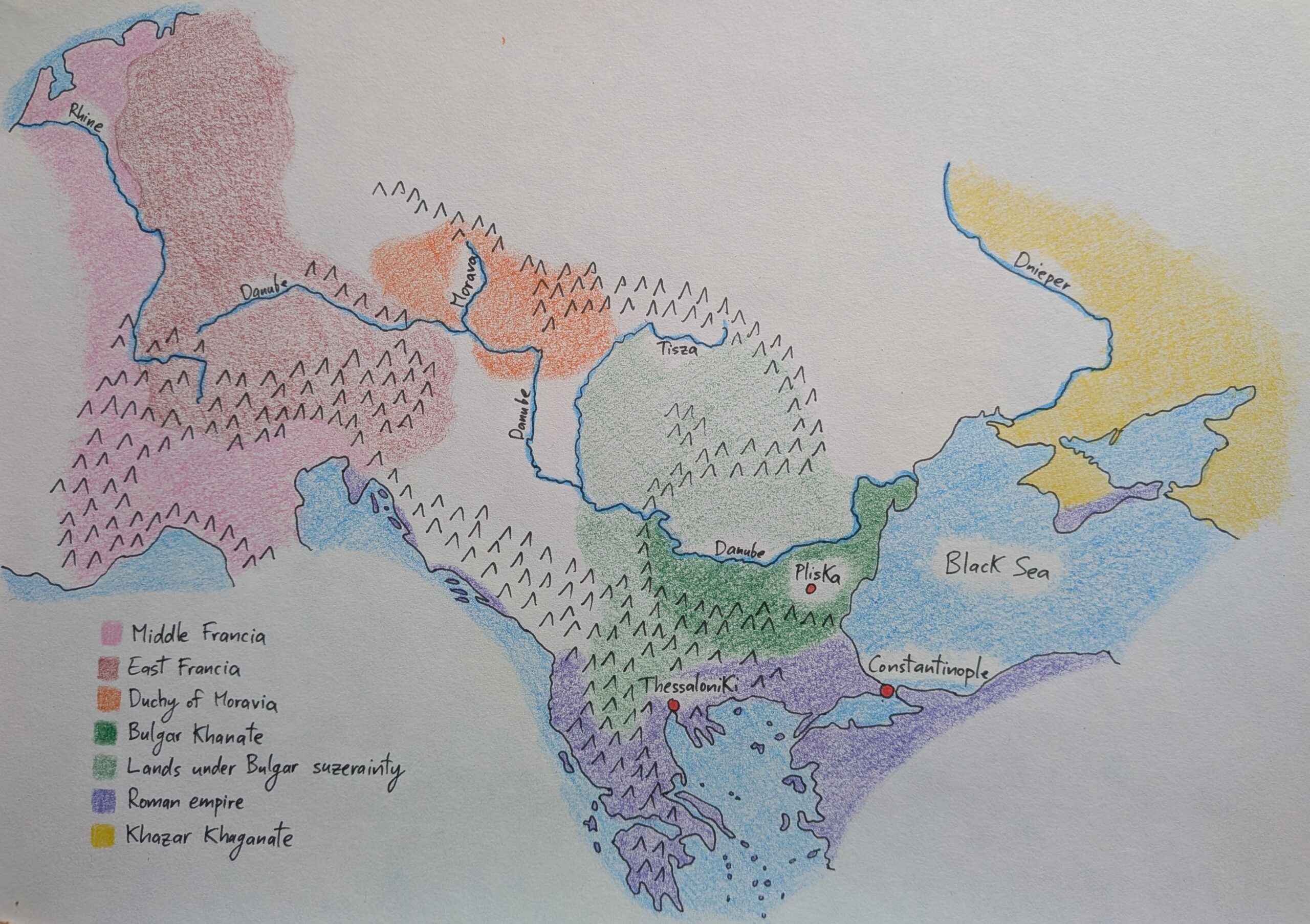
In the West, Charlemagne’s three grandsons partitioned the Frankish lands between themselves, dividing them into a western, an eastern, and a middle portion. The idea was that each brother ruled one part of the land of the Franks, with the king of the middle portion also enjoying the title of emperor to maintain the unity of the realm.
On the border of East Francia lay the duchy of Moravia, a Slavic state which emerged in the early ninth century. The borders of the duchy are still debated, as is the site of its court. However, we know that the Moravians erected several imposing strongholds along Morava valley and that, by the middle of the ninth century, they had even subjugated communities on the plains south of the Danube.
East of the duchy of Moravia lay the Bulgar khanate. In the 840s and 850s, its leaders had undertaken several successful campaigns against the Romans and the Slavs of the southern Balkans. In effect, the emperor lost his hold over the Slavic communities living north and west of Thessaloniki, which were now forced to recognize the khan’s authority.
Yet the Romans were not all at a loss. Though they lost Slavic subjects to the Bulgars in the mountainous interior, they solidified their control over the entire coast of the Balkan peninsula. By the middle of the ninth century, they had subjugated the Slavs who had settled in Thrace, Macedonia, Thessaly, Epirus, Central Greece, and the Peloponnese, and had firmly integrated them into the empire’s administrative system.
At the same time, the empire maintained a presence in Crimea, specifically with the cities of Cherson and Bosporus, which allowed them to monitor threats coming from that direction. The biggest threat was the Rus’, a name for Scandinavian explorers who sailed the rivers of eastern Europe, pillaged the weak, and traded with those who could defend themselves.
The Rus’ had settled on the coast of the Baltic Sea and were actively subjugating Slavic communities along the Dnieper river while raiding imperial cities on the coast of the Black Sea. Their belligerent approach prompted the Khazars and the Romans to ally in a bid to protect themselves.
Transcript
Hello and welcome to A history of Romania.
Season 2, episode 19: The Word
Last time, we saw the Bulgar khan persecute the Christians in his realm in an effort to stop the spread of their faith. At the same time, the khanate clashed with the Roman and Frankish empires, and held its own against its rivals.
When the Bulgars and Franks ended their war, they set their borders at the Tisza and Danube respectively, with a buffer zone in between those two rivers to avoid future frictions. But those were not hard borders; rather, they represented the limits of Bulgar and Frankish influence. Neither the Bulgar khan nor the Frankish emperor had the resources to maintain a direct presence in the Carpathian Basin. Instead, local leaders recognized their authority according to which side of the border they were on and otherwise pursued their own ambitions.
A particularly ambitious leader arose in the Morava valley, a basin which follows a river of the same name from the Sudeten Mountains to the Danube. That valley was inhabited by Slavic communities who, in generations past, had provided troops to the Avar khagan. But when the khaganate fell, they found themselves in a world more dangerous than before and began building hillforts to defend themselves. By the early ninth century, a Slavic tribe called the Marhari, which is better known as the Moravians, had dotted the hills along the Morava valley with several imposing strongholds.
That valley constituted part of the so-called Amber Road, an ancient trade route connecting the Baltic with the Mediterranean Sea. Amber had been transported along that path for thousands of years as far back as the Egyptian pharaoh Tutankhamun, and traders had continued to use it for different commodities ever since. By controlling the commerce that flowed along the river, the Moravians gained considerable wealth; but their affluence also risked drawing the attention of larger powers, notably the neighbouring Frankish empire. To ensure they wouldn’t get attacked, the Moravians recognized the suzerainty of the Frankish emperor and sent him tribute. At the same time, their leader accepted baptism, but this was more of a political than a religious act. There’s no clear evidence of Christian practice in the Morava valley at this time, and in fact, archeologists have found that traditional Slavic worship continued into the middle of the ninth century. As such, the conversion of the Moravian ruling family didn’t alter the spiritual beliefs or customs of their people; it was instead a prerequisite for becoming a vassal of the Christian Frankish emperor. By sharing a part of their wealth and recognizing Frankish supremacy, the Moravians avoided becoming a target, which allowed them to focus on their own affairs. Those affairs mainly involved subjugating nearby communities, and by the 830s, the Moravians had reached the banks of the Danube. I’ve included a map in this episode’s description for you to better visualize the locations we’re discussing.
The situation in the region changed in 840 when the Frankish emperor died. As we know, Frankish custom dictated that the ruler’s realm be divided amongst his legitimate sons, of which there were three in this case. The emperor had long made plans for his succession; he had distributed the different kingdoms which constituted his empire amongst his sons, and in addition, had decreed that his eldest would become emperor so as to maintain the unity of the realm. But the sons were unhappy with their inheritance, each for their own reasons; they thus rebelled to gain better terms and even deposed their father at one point. The emperor eventually regained his throne and made a new inheritance plan, but the tensions between his sons never dissipated. When he died in 840, they immediately set to fighting one another, each convinced that he was owed more than he had.
When the Moravians heard of this civil war, they retracted their allegiance to the Frankish emperor. After all, it wasn’t even clear who the Frankish emperor was, since the three brothers didn’t recognize each other’s claims. And so, the Moravians parted ways with the Franks and kept their resources for themselves.
After three years of civil war, the three Frankish brothers finally concluded a pact to end their fighting. In 843, the lands west of the Rhône and Meuse rivers became Francia Occidentalis, or West Francia; the lands east of the Rhine river became Francia Orientalis, or East Francia, and the lands in between, running from the North Sea down to the Mediterranean, became Francia Media, or Middle Francia. The idea was that each brother ruled one part of the land of the Franks, with the king of the middle portion also enjoying the title of emperor to maintain the unity of the realm. But though the kings of West and East Francia technically recognized him as their overlord, in reality, they didn’t obey his orders, and ran their kingdoms as they saw fit.
What the king of East Francia saw fit to do was campaign against the peoples on his eastern frontier. In 846, this king, named Ludwig, set his sights on the Moravians; he marched an army into their realm, overwhelmed their forces, and deposed their leader. He then appointed a nephew of that ousted leader to be the dux of Moravia and to serve as his vassal. This nephew, named Rastislav, was probably already a Christian, but he was rebaptized as part of the ceremony investing him as duke of Moravia. At the same time, he had to accept the presence of Frankish clerics in his realm. Their main mission was to extend conversion beyond the Moravian ruling class, but of course, they also sent reports back to their Bavarian bishops who themselves regularly convened with the Frankish king. And so, beyond their ecclesiastical duties, these clerics were also there to keep an eye on the Moravians on behalf of Ludwig.
Rastislav played the part of a loyal vassal for a few years, but he didn’t intend to remain subservient forever. His chance at freedom came in 853 when war once again erupted between the Frankish brothers. As the conflict heated up, the king of West Francia sent messengers to Rastislav and to the Bulgar khan, Boris. His proposal was simple: help me attack my brother Ludwig, and I’ll give you a nice pile of coin. Khan Boris had just ascended to the Bulgar throne a year earlier, and was happy to accept an injection of funds at the beginning of his reign in return for a little military help. Rastislav, on the other hand, saw the offer as an opportunity to gain his freedom; with the king of West Francia and the Bulgar khan on his side, this was his best chance to overthrow Ludwig’s suzerainty.
And so, both Boris and Rastislav accepted the offer and sent their armies against Ludwig. We have few details on the campaign of 853, but it seems that Boris and Rastislav’s forces were disastrously defeated. The Bulgar khan quickly concluded a peace with Ludwig, since he had no reason to keep fighting. But Rastislav didn’t have the luxury of doing the same; he had rejected Ludwig’s suzerainty and couldn’t turn back; from here on out, he would have to resist alone. Ludwig took two years to gather an army large enough to reassert his authority over the Moravians, and in 855, he marched all the way to Rastislav’s main stronghold. Yet even large as it was, his army was unable to maintain a prolonged siege and was forced to retreat. The war simmered for a few years until 861, when Rastislav allied with Ludwig’s disgruntled son. The two men invaded Bavaria, hoping to gain an advantage, but the expedition failed and Ludwig captured his rebellious son, which left Rastislav alone once more.
The Frankish king couldn’t follow up his success against the Moravians since he had to focus on the West, but everyone knew that, sooner or later, he would strike again. In preparation for that eventual blow, Rastislav sought to strengthen his position. Now Rastislav had been a Christian for decades, but he didn’t enjoy all the benefits of a Christian ruler. You see, a king like Ludwig had literate clerics on his council who wrote decrees, documented laws, drafted treaties, maintained records, supervised tax collection, and adjudicated disputes. On top of that, he had numerous priests in local communities who maintained registers of births, marriages, and deaths, collected tithes to send further up the hierarchy, announced the ruler’s decrees, and distributed alms to the poor. In contrast, Rastislav had to deal with various chieftains, each operating under his own obligations and laws. If he were to implement a centralized, hierarchical structure like the one in East Francia, he would greatly expand his control and power; but to do that, he needed experienced clerics. He of course wasn’t going to turn to the Frankish clergy for help since they were loyal to Ludwig. So who could he turn to? Well, the Roman empire.
To understand why Rastislav sought help from a power a thousand kilometres away, we have to take a step back and grasp the situation in the Roman empire at this time. You see, for the first time since the seventh century when the Avars and Slavs had devastated the Balkans, and when the Muslims had conquered the Orient, the empire was not receding, but recovering.
Internally, the Romans were now emerging from an intense religious struggle: iconoclasm. For over a century, their society had been gripped by a fierce debate on whether religious images, called icons, should be permitted. The reasons why this controversy erupted when it did are still disputed, and we unfortunately don’t have time to get into all the details, but a big part of the answer is the impact of Islam. When Muslim armies conquered the Orient and began raiding Anatolia, the Romans sought answers to their catastrophic defeats. Why would God punish them in this way? The leading theologians of the age were adamant that the Romans had sinned and needed to repent to regain God’s favour. The question was: what exactly was their sin? No one could say for certain, but the veneration of religious icons emerged as a convincing answer. After all, the second commandment clearly stated: “You shall not make for yourself an image in the form of anything in heaven above or on the earth beneath or in the waters below. You shall not bow down to them or worship them.” The Muslims strictly refused to create images of sentient beings, yet in the case of the Romans, images were everywhere. For over a thousand years, the Romans had placed frescoes in homes, mosaics in bathhouses, statues in marketplaces; and when the empire became Christian, those works changed from depicting emperors, gods, and heroes to depicting emperors, God, and saints.
Now imagine you were a Roman farmer in Anatolia whose fields got burnt by Muslim raiders one year and your house got ransacked the next. This year, as the snows melt and the mountain passes become accessible once more, you’re filled with dread for what’s to come. You want to ask God for mercy and protection—but God is so powerful, so far away, will he even hear your message? Maybe your local saint could intercede on your behalf. Surely, a holy person in heaven has a better chance than you to connect with God. Your village church is lucky enough to have a painting of your local saint, and when you gaze at it, you can imagine all the paths he’s walked and all the suffering he’s endured; you feel that you understand him, and that he understands you. And so you kneel in front of the image, look to the saint, and pray to him for help.
That year, a Muslim raiding party comes through the region once more, and as your family flees for the shelter of the nearby hills, an arrow strikes down your only daughter. The grief is unimaginable, and you ask yourself: why would God allow her to die? Did you do something wrong? Did your prayer not reach him? And then a wandering preacher gives an answer: the Roman people have sinned, for they have gone against God’s second commandment not to venerate images. Of course, you think, that must be it—it’s so clear now—and so you go to your local church and rip the image of the saint off the wall, then march with your neighbours to the next village to bring the news: the Romans must repent, and you’ve found the way to do it.
But when you get there, the priest stops you. The Romans have always revered the saints, have always had images of them in churches, and holy men of ages past have even approved of such icons. To destroy them would be an insult to the divine—it would be blasphemy. Antagonizing God and the saints would only bring more suffering. And so fighting breaks out in the church: people shout, grab each other, punch, kick. Both sides feel they need to win. The brawl concerns more than the fortunes of the Roman people; it concerns the fate of your soul.
Fights like these erupted all across the empire and at every level. From carpenters to soldiers, bureaucrats to bishops, generals to emperors—everyone had an opinion, and the ensuing disagreements brought a series of civil wars which paralyzed the empire for five generations. Eventually, the defenders of icons gained the advantage for various reasons, including theological arguments, the resilience of monks, and the fact that images were a core part of Roman culture. A synod in the middle of the ninth century reaffirmed that believers could and even should create images of Christ and the saints, since God had been incarnated in human form and could thus be represented in a material way. But while believers could honour these icons, they should not worship them; that was intended for God alone. The synod’s decision gave official approval for what most of society had already decided, namely that religious icons were part of how they practiced their faith and that they were here to stay.
The end of iconoclasm energized the church and allowed it to turn its focus outwards; monks, priests, and bishops felt they had finally found how to regain God’s favour, and the most zealous and adventurous amongst them set out to spread the word of Christ to as many people as possible. An age of missionary activity was unleashed.
This religious fervour was coupled with a renewed military attention on the Balkans. You see, by the late eighth century, the Romans had stabilized the frontier with the caliphate along the Taurus Mountains. Though the two sides still sent huge armies and fleets against each other in their contest to control the eastern Mediterranean, the empire and the caliphate were now on equal footing, trading blow for blow.
With their eastern frontier holding firm, the Romans were able to divert more troops and resources westwards to recover some of their European lands. Imperial forces mustered in the coastal cities along the Aegean, Adriatic, and Ionian seas which the empire still controlled, and then marched into the interior of the continent along its river valleys. Through repeated campaigns, the Romans subjugated the Slavic communities which had settled in Thrace, Macedonia, Thessaly, Epirus, Central Greece, and the Peloponnese, and integrated them into the empire’s administrative system. From the beginning to the middle of the ninth century, the Romans established six themes which formed a continuous edge around the Balkan peninsula. What this integration meant in practice is that the Slavs in these regions no longer answered to their own chieftains; instead, they were under the authority of Roman officers and had to pay dues, perform labour services, and enroll in the army.
A key aspect of their integration was their conversion to Christianity. As each theme was established, so were bishoprics designed to serve the needs of their inhabitants. Missionaries, monks, and priests filled with religious fervour set out from these sees and preached to the local Slavs—and they did so in Greek. Indeed, the imperial church operated in Greek, and that was also the language of civil service, the armed forces, and polite society; the spread of the Greek language was inseparable from the resurgence of the empire. Imagine that you’re a recently subjugated Slavic chieftain and want to maintain the social status to which you’re accustomed. In the new order, you could become an administrator or an officer, but that means you need to learn how to speak Roman Greek, how to properly worship as a Christian, and how to move through Roman social circles, with all the associated customs and habits that come with it. You thus come to embrace Roman language, religion, and culture, and you pass them on to your children as well.
That process eventually extended beyond the Slavic elite to all social classes; over the course of generations, the Slavs of the southern Balkans gradually converted to the Roman way of life. Though pockets of resistance persisted for a while—particularly in mountainous regions—the momentum of assimilation never ceased. In effect, after a few generations, the Slavs living in the empire became Romans. We’ve seen this process play out in other eras as well, like in the case of the Dacians, who were Romanized over several generations and eventually became indistinguishable from other Romans from elsewhere in the empire. Now centuries later, the Romans still understood the power of Romanization. Writing in the early tenth century, emperor Leon VI said: “… the emperor of the Romans prevailed upon [the Slavs] to renounce their ancient customs and, having made Greeks of them and subjected them to governors according to the Roman model and bestowed baptism upon them, he freed them from bondage to their own rulers and taught them to make war on the nations that are hostile to the Romans.”
The Romans also used Christianization as a way to gain allies in regions where they couldn’t extend their direct influence. Take, for instance, the lands north of the Black Sea. In June of 860, a fleet of two hundred unknown ships sailed into the Bosphorus. The imperial fleet was engaged against the Muslims in the Mediterranean at the time, such that Constantinople was taken completely by surprise.
These strange ships rammed into the shoreline and unleashed a stream of warriors who attacked everyone and ransacked everything outside the city walls. The patriarch of Constantinople huddled in the Hagia Sophia and gave a sermon urging the Romans to resist and repent for their sins: “What is this grievous and heavy blow and wrath? … A people has crept down from the north, as if it were attacking another Jerusalem … the people is fierce and has no mercy; its voice is as the roaring sea…. Woe is me, that I see a fierce and savage tribe fearlessly poured round the city, ravaging the suburbs, destroying everything, ruining everything, fields, houses, herds, beasts of burden, women, children, old men, youths, thrusting their sword through everything, taking pity on nothing, sparing nothing …. 0 city reigning over nearly the whole universe, what an uncaptained army, equipped in servile fashion, is sneering at you as at a slave!”
That fierce people was the Rus’. You see, at this point in the ninth century, Scandinavian sailors known as Vikings were exploring and ravaging coasts all across Europe; the subset of Vikings who travelled into eastern Europe were given the name of Rus’, which derives from a Norse word meaning “rowing”. These Rus’ established settlements on the Baltic coast and began to make regular trips along the Volga River, acting as traders between the Baltic and the Black and Caspian Seas. In their quest to extend their commercial reach, they penetrated into territory held by the Khazar khaganate, that Turkic state which covered a huge swath of the Eurasian steppe. The Rus’ subjugated the Slavic communities they encountered, and were now building a power base for themselves along the major rivers of eastern Europe.
Their attack on Constantinople in 860 was part of their opportunistic approach to commerce in which they pillaged the weak and traded with those who could defend themselves. Of course, the Rus’ couldn’t take the city, but they still left with a good deal of plunder; and when the Roman emperor returned to Constantinople, he needed to take immediate action to prevent another attack. The solution proposed by his advisers was to ally with the Khazars who were also threatened by the Rus’ advance. The idea was to convert them to Christianity, since that would ensure both their political and religious subservience, as was happening with the Slavs of the southern Balkans.
For this delicate mission, the emperor chose a renowned theologian and linguist, a man named Konstantinos. He was in fact the professor of philosophy at the Pandidakterion, or “House of universal teaching,” in Constantinople—basically one of the world’s oldest universities. His skill in rhetoric and religious matters would be key to convincing the Khazar khagan to convert to Christianity and to support the Romans.
Konstantinos headed for the Khazar khaganate before the end of 860, travelling by sea to the Crimean peninsula, which was still under imperial control. The two Roman cities of the region, Cherson and Bosporus, were located on the southern coast of the peninsula and were protected by a chain of mountains from the plains to the north. On these plains lived Goths who had stayed in place when their brethren had migrated westwards centuries ago. Though they were subjects of the Khazars, these Goths were also Christians and had their own bishop who had maintained ties with the patriarch in Constantinople. As such, Crimea was a natural entryway into the Khazar khaganate for a Roman.
Konstantinos spent the winter in Cherson learning Hebrew. The reason is because the Khazars had recently converted to Judaism, making them one of just a few peoples in history to ever do so. The motives and the scope of their conversion is still debated amongst scholars, but the Khazars probably chose Judaism in order to remain culturally independent from both the Roman empire and the Muslim caliphate.
When spring arrived, Konstantinos travelled to the khagan’s summer residence in the foothills of the Caucasus. There, he used his knowledge of Hebrew to debate theological issues with Jewish rabbis, hoping to convince the khagan of the superiority of Christianity. While he did persuade about two hundred elites at court to convert, that number did not include the khagan; the Khazar ruler maintained his Jewish faith. However, he declared his sympathy for the Christians and pledged to support the Roman emperor. In this way, Konstantinos still achieved his goal, as the Khazars would henceforth act as a buffer between the Rus’ and the Romans.
When Konstantinos returned to Constantinople, he didn’t have time to get back to teaching; the emperor had another mission for him. That year in 862, envoys had arrived from the Moravians seeking help. Their ruler, Rastislav, had asked for preachers who could speak the local language, and had reached out to the Romans because of their missionary work amongst the Slavs. The emperor was happy to help and could think of no better person for the task than Konstantinos. He had proven himself an able diplomat willing to travel into foreign lands, and just as important, he had a unique knowledge of Slavic. You see, Konstantinos had been born in Thessaloniki, a city which had a substantial Slavic population living within its walls, and an even greater one in the surrounding countryside. He was perfectly bilingual, and in fact, he and his older brother Methodios had been working on a Slavic alphabet for some time.
The idea of a Slavic alphabet was not new. Both Frankish and Roman missionaries working amongst the Slavs had tried to devise a written language which reflected Slavic speech. In the preceding decades, Frankish missionaries had transcribed a few basic Christian texts into Slavic using Latin characters. The Romans had done something similar by transcribing religious terms into Slavic using the Greek alphabet. Yet these were not workable solutions, because neither the Latin nor Greek scripts were suited to Slavic sounds.
Konstantinos and Methodios, on the other hand, had more imagination. Along with several collaborators, they invented an entirely new alphabet specifically created to reflect Slavic speech. This was the Glagolitic alphabet, its name deriving from the term “utterance” or “word.” This script was based on the dialect spoken around their native city of Thessaloniki, but Slavic languages were still mutually intelligible at this point, such that the Glagolitic alphabet could be used well beyond the Balkans.
And so, before leaving on his Moravian mission, Konstantinos took the time to translate part of the Gospels, meaning the sections of the Bible which contain most of Jesus’ story and form the heart of Christian teaching. He then set out on his journey with his brother Methodios, whose experience as the abbot of a monastery would be crucial for this mission.
The two brothers arrived at their destination in the autumn of 863 and were warmly welcomed by Rastislav. Once at his court, they immediately set to work and translated the daily prayer cycle and the proceedings of Mass, basically the fundamental rituals of the Christian faith. The goal was to offer the local clergy the essential texts of Christianity in their own language.
The Slavic words and formulations used in these translations were intelligible to the Moravians, but they also differed from everyday speech. Just as the Greek used in liturgical services was different from the language used amongst regular Romans, the language used in these translations was of a higher register, with a clear literary and ecclesiastical character. To scholars, it’s known as Old Church Slavonic, but to keep things simple, I’ll just refer to it as Slavonic.
Besides translating the essential scriptures and liturgy of Christianity, Konstantinos and Methodios also taught the local Moravian clergy to read and write Slavonic, and to preach the tenets of the faith. These local priests had some experience with foreign missionaries; the Franks had sent clerics to baptize the population and to instruct them, but they had worshipped in Latin, a language which was wholly unfamiliar to the Moravians. Now, Konstantinos and Methodios were literally speaking their language and giving them the tools to understand the Christian faith and to minister it amongst their compatriots themselves. It was an entirely different approach from that of the Franks.
Yet those western missionaries didn’t give up their efforts and in fact appealed to the king of East Francia to intervene. Ludwig hadn’t abandoned his quest to subjugate the Moravians, and he now felt a renewed urgency to do so; the Slavonic liturgy which the Romans were implanting with the support of the Moravians directly challenged the monopoly of his Frankish clerics and their Latin liturgy.
And so, in 864, only a year after the arrival of the Roman missionaries, Ludwig ordered his army to march once again. We have few details on the subsequent campaign, but it seems that Ludwig’s army took Rastislav completely by surprise and trapped him in his main fortress. Seeing no way to escape, the Moravian duke decided to surrender; he swore an oath of fealty to the Frankish king and offered hostages as a guarantee of his pledge.
Konstantinos and Methodios were now in a precarious position. The Franks didn’t have the forces to directly control Moravia, but their clergy could now freely operate within the realm. Would the two brothers have to halt their translation and teaching efforts? Would their mission to create a native Slavic church come to an end? Would they be expulsed from Moravia?
As Konstantinos and Methodios pondered over their future, messengers brought incredible news: the Bulgar khan had converted to Christianity. Yes, the leader of the Bulgars, who had been staunch enemies of Christianity for generations and who had just recently undertaken murderous persecutions against them—their leader had become a Christian himself. How did this momentous event come about?
Unfortunately, we have very little information about the khanate in the 840s and 850s. What we know mostly concerns military campaigns, and while the military angle is important, it’s only one aspect of events. It doesn’t tell us about the culture, economy, politics, and society of the khanate before this crucial moment—which is really what we need in order to understand why the khan converted. But we have a few clues which can help us piece together an answer.
Boris’ grandfather had been passed over in the succession to the throne probably because of his Christian leanings, and his sister had been baptized in Constantinople, so there were clearly already Christian sympathies within his family. Plus, the events of the following decades suggest that Boris was a true believer. Beyond the personal lens, it might be that, like Rastislav, Boris understood the advantages of having a royal administration staffed by literate clerics. A final aspect of his conversion is that Boris governed a realm with two classes: the ruling Bulgars and the subject Slavs. The Bulgars had staunchly defended their culture but hadn’t been able to impose it on the Slavs; yet if both groups converted to Christianity, they would form one united people—with Boris at the top of the hierarchy. All of that meant that conversion would bring him increased control and power, on top of fulfilling his personal beliefs.
And so, Boris asked Ludwig for clerics to set up a church structure. His decision mirrored Rastislav’s: whereas the Moravian duke had turned towards the Romans to counter Frankish influence, the Bulgar khan turned towards the Franks to counter Roman influence. But when the Roman emperor heard the news, he acted quickly to prevent an alliance between Boris and Ludwig. In 864, he moved an army to the Bulgar frontier and sent his fleet along the coast of the Black Sea. Boris’ realm was suffering from a terrible famine at the time, and so his army was in no state to fight. Instead of going to war, Boris sent an embassy to Constantinople, promising to renounce his Frankish alliance and to accept clerics from the Romans. The emperor then dispatched a bishop to Pliska, and in September of 865, Boris was baptized alongside a number of his boyars.
Both the Franks and the Romans understood that, with this act, Boris had acknowledged the sovereignty of the Roman emperor; he had, after all, been invested as a legitimate Christian ruler by Constantinople. But Boris saw things differently. He did implicitly acknowledge the emperor in Constantinople as the overlord of the universal Christian empire, but he had no intention of acting as his subject. The question was, could he convert his realm and still remain independent from the emperor? There was no roadmap to guide him. Boris would have to navigate a path fraught with danger.
Next time, the stories of Konstantinos, Methodios, Rastislav, and Boris will converge as the character of the Carpathian Basin changes forever.
Leave a Reply