After nearly a decade of bloodshed, the Bulgars and Romans agree to a peace which leaves the khanate strengthened and expanded. The new Bulgar khan then initiates several ambitious building projects to secure his realm and, most importantly, to display his enhanced position with a completely refounded capital.
The map for this episode shows the Balkans in 816 CE following the conclusion of the thirty-year peace between the Bulgars and Romans.
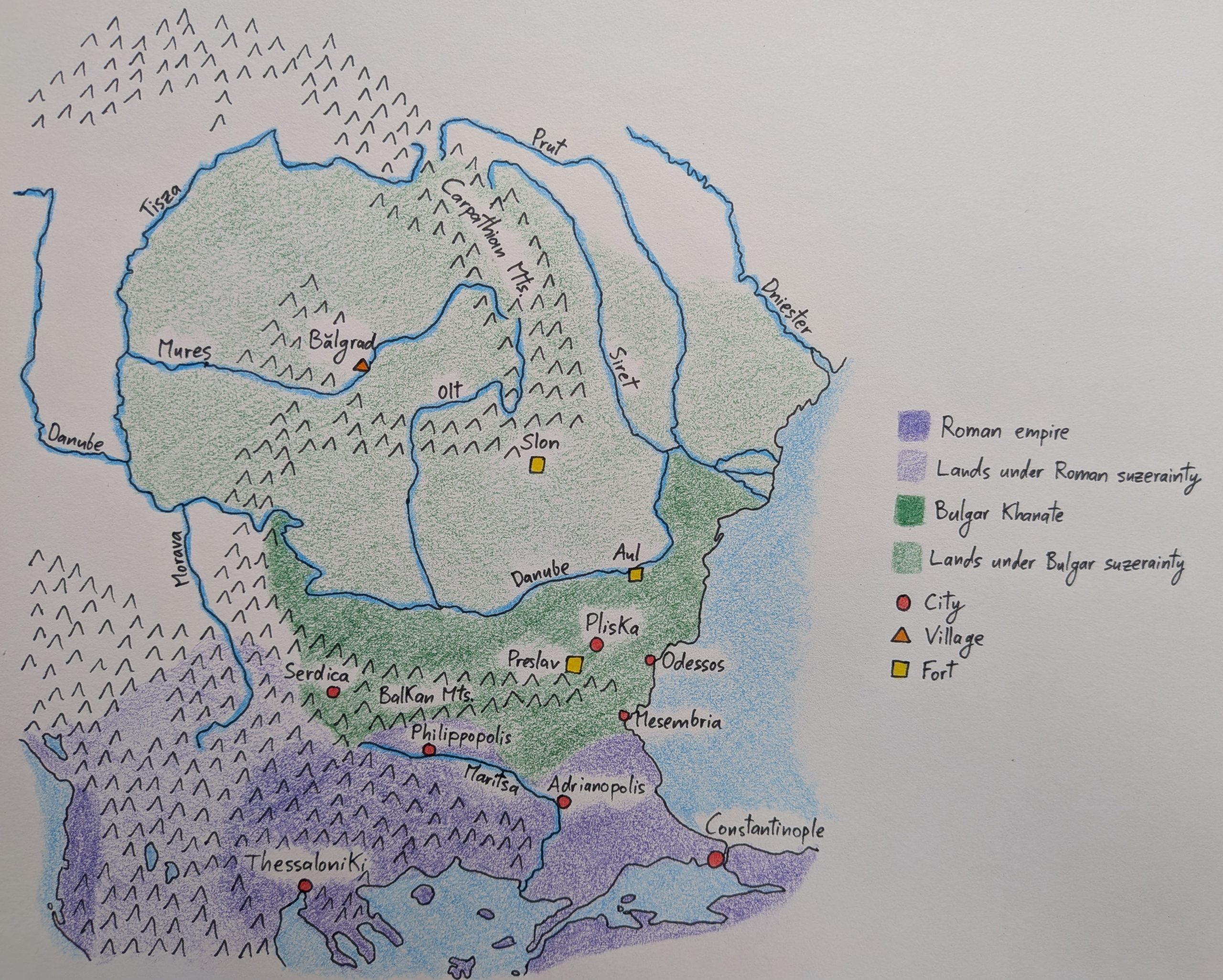
In terms of territory, the Bulgars gained the cities of Odessos and Mesembria on the Black Sea coast, as well as that of Serdica in the Balkan Mountains. To more clearly see their gains, you can compare this map with the previous one showing the khanate in 805.
The treaty of 816 stipulated that, at some point in the future, the Romans were to hand over the city of Philippopolis and its environs to the Bulgars, though we don’t know after how many years. To ensure the Romans upheld their promise, the Bulgars maintained garrisons near Adrianopolis, which were to leave only when the transfer was completed.
The Bulgar khan Omurtag secured his frontier with the Roman empire by building a long fortification running from the Black Sea to the Maritsa River, consisting of a trench and earthen wall punctuated by wooden and stone structures. He also built a fort south of Pliska, called Preslav by the Slavs, to stop any future Roman advance on the capital.
To the north of Pliska, Omurtag built another fort at a crossing on the Danube to defend against incursions from steppe raiders—such as the Magyars who lived beyond the Dniester River. We don’t know what the Bulgars nor the Slavs called this fort, so I’ve labelled it as “Aul,” which is the term used for a Bulgar fortified palace.
Before any enemy would get to the Aul, though, they’d have to contend with the Roman captives which had been settled north of the Danube to defend the khanate’s border. Omurtag’s father had forcefully relocated all the inhabitants of Adrianopolis to the region after he’d captured the city. Archeologists haven’t been able to identify where exactly these Roman captives were settled, but they generally agree that it was near the curvature of the Carpathian Mountains; on the map, that would be between Aul, Slon, and the Siret River.
Slon itself was another Bulgar fort, located at the entrance of a mountain pass through the Carpathians. It represents the northernmost Bulgar presence. Indeed, the Bulgars didn’t have garrisons in the Carpathian Basin; rather, they extracted tribute from the communities of the region.
The largest and most well-documented community inside the Carpathian Basin is Bălgrad, a rural settlement in the ruins of the ancient Roman city of Apulum. Archeological evidence shows that its inhabitants sent tribute to the Bulgars—possibly through the fort at Slon—and also traded for luxury goods while in the khanate.
Archeological evidence also shows that the majority of the inhabitants of Bălgrad and of the surrounding settlements along the Mureș river were Christian. We know of only two Christian groups in the eastern Carpathians, namely the Romanians and the Gepids, and so they must’ve made up a substantial part of these communities.
Moreover, these Christians were in regular contact with Christians in the Roman empire, as evidenced by crosses made in the empire and by the presence of contemporary Roman burial fashions in Bălgrad.
As such, the communities of the Carpathian Basin—many of which were Romanian—recognized Bulgar suzerainty and had ties with communities south of the Danube, all while directing their own affairs.
Transcript
Hello and welcome to A history of Romania.
Season 2, episode 17: From a field of ashes
Last time, the Avars were engulfed by the Franks from the west and the Bulgars from the east. The Franks took their half of the Carpathian Basin and created a tributary Avar state to defend their borders, while the Bulgars enrolled the Avars they had defeated into their army. Using the momentum of this victory, the Bulgar khan Krum attacked the Romans and devastated the Balkans. Although the Bulgar capital of Pliska was burnt to ashes, Krum’s forces killed the Roman emperor and thereafter besieged Constantinople.
But Krum died suddenly while camped outside the city, and his momentum immediately evaporated. His son and successor, Omurtag, didn’t want to get dragged into endless campaigns; he wanted to consolidate what his father had conquered and to realize the potential of his enlarged realm. Khan Omurtag thus sent envoys to emperor Leon to open negotiations, which lasted over the winter of 815 into 816. In the end, the two sides agreed to a peace treaty lasting thirty years, with renewals every ten.
The first point of the pact set the border between the khanate and the empire. The Bulgars didn’t gain all the lands which had been conquered under Krum’s leadership, but they still made significant gains. I’ve drawn a map and included it in this episode’s description if you’d like to follow along visually. To start, the Romans abandoned their cities on the Black Sea coast—namely Odessos and Mesembria—which had previously been surrounded by Bulgar territory but which had nevertheless survived as part of the empire. Now, the khanate came to control the entire Black Sea coast from the Dniester River to the Gulf of Burgas where Mesembria was located. From there, the frontier went westwards up to the Maritsa River, and followed it until it the Balkan Mountains, where the Bulgars gained the city of Serdica. The only exception to this frontier was the city of Philippopolis, located on the northern bank of the Maritsa River. We lack the exact details, but it seems the Romans agreed to give Philippopolis to the Bulgars at some point in the future, though we don’t know after how many years. As a guarantee of this eventual handover, Omurtag maintained garrisons in the forts surrounding Adrianopoulis, which the Bulgars had captured during the war. Essentially, when the Romans would withdraw from Philippopolis, the Bulgars would withdraw from the environs of Adrianoupolis.
The second point of the treaty concerned a prisoner exchange: Slavic warriors captured by the Romans were to be traded one for one for Christians captured by the Bulgars. Additionally, the Bulgars were to release any Roman soldiers they had captured in exchange for two oxen each, on the condition that these soldiers wouldn’t return to their posts, but to their villages. In this way, the Bulgars ensured a reduction in the number of soldiers garrisoning imperial fortifications along the frontier.
The pact included two other articles, but they unfortunately haven’t been preserved in any document or inscription. That’s a great shame, because they would’ve given us a more detailed understanding of Bulgar and Roman relations—and the Balkans as a whole—during this period. But if look at what we do know, the picture that emerges is that of a treaty advantageous to the Bulgars.
The pact was concluded at Constantinople between emperor Leon and Omurtag’s envoys, and the two sides performed each other’s customs to confirm the oath. One Roman chronicler decried that the emperor debased himself by participating in barbarian rites. “It was possible to see the Roman emperor making a libation with his hands by pouring water from a cup upon the ground, personally overturning horse saddles, taking hold of triple-braided straps, lifting grass upward, and through all this drawing a curse upon himself; while the pagans touched with their impious hands our divine symbols [meaning, the Cross and the Gospel] and swore by their power.” This description reveals just how eager Leon was to conclude a peace; no emperor had ever performed barbarian rites, but he now felt compelled to do so to end the devastation of his realm. Getting the emperor to participate in their rites was also a symbolic victory for the Bulgars since, in this way, they put themselves on the same level as the Romans.
Once the peace was concluded, Omurtag reinforced his border with the Romans, hoping that the thirty-year peace would hold, but prepared in case it wouldn’t. He ordered the construction of the so-called “Great Fence,” a trench 131 kilometres long augmented with an earthen wall and wooden and stone structures. This massive fortification ran from the Black Sea to the Maritsa River, and was meant to secure the khanate’s border with the empire once and for all.
In my research, I’ve uncovered lots more information about the khanate and the empire than I could include in this episode. That actually happens quite often, and I post the information that doesn’t make it into the episodes on the podcast’s social media pages, with accompanying images. You’ll find things like a Christian cult from the East brought by the emperor to reinforce the frontier which ended up rejecting all state authority; or the laws which Omurtag’s father had implemented to prevent the Bulgars from sharing the fate of the Avars. If you want interesting tidbits like that, check out the podcast’s social media pages; there’s links in this episode’s description.
Getting back to our story, one of Omurtag’s top priorities was his capital. At this point, Pliska was still a barren field, having been burnt by the Romans during his father’s reign. And so, Omurtag had nowhere to settle his court; instead, he had a choice to make about where he would make his capital. He could’ve chosen one of the Roman cities which he’d gained, transform one of its imposing buildings into his palace, and repair its existing walls without the need to start from scratch—but he didn’t. In fact, the Bulgars made a conscious choice not to move into the Roman cities which they’d captured. Don’t get me wrong, Bulgar warriors did garrison Odessos, Mesembria, and Serdica, since they were important locations to control, but these cities lost their urban character. When their Roman citizens abandoned them as part of the treaty, there was no one to take their place; most of the inhabitants of the khanate were farmers who wanted to work fertile fields and saw no way to make a living amidst cramped streets. What few artisans there were worked for the boyars and the khan, and were attached to their households. And the Bulgar ruling class, for their part, had never lived in urban centres and weren’t interested in crowding themselves between brick buildings and temples to the Christian god. And so, Odessos, Mesembria, and Serdica transformed from vibrant urban centres to fortifications holding vacant homes, empty workshops, and abandoned marketplaces.
So if the khan didn’t want to build his capital on Roman foundations, where did he settle his court? Well, Omurtag wanted a capital that would reflect Bulgar culture, and he found no better candidate than the original Pliska. The site had been the Bulgar seat of power ever since they’d migrated to the Danube, and so held great symbolic meaning for him and his boyars. And since it was now a barren field, Omurtag had a blank slate to reimagine what the khanate’s heart could look like, and he chose to refound Pliska as a proper city, one which would never again fall to an enemy.
The centre of his revived capital was a square stone fortress punctuated by four bastions at its corners. This citadel held Omurtag’s palace, an imposing structure sixty metres wide and seventy-four metres long. Now, we don’t have a complete picture of the building since it was mostly made of wood and so rotted away through the centuries. But archeologists have uncovered a limestone foundation with sixty-three rooms; and the palace clearly had upper floors as well, because brick pillars supported a spiral staircase. It’s in this massive home that Omurtag displayed the wealth his father had plundered from Roman churches, villas, and the emperor’s residences outside of Constantinople, things like gold and silver dishes, bronze lions, and marble sculptures. No artisan in the khanate had the skill or resources to produce such works; by flaunting these trophies, Omurtag aimed to not only impress his nobles and guests, but also to remind them that the Bulgars had overpowered the Romans.
Omurtag’s palace was flanked by several other buildings used by the khan and his family, most noteworthy of which was a hypocaust, meaning a Roman-style bathhouse with cold, warm, and hot pools. All the buildings inside the citadel were connected with paved paths and were served by drainage pipes. This complex also had its own water supply in the form of an aqueduct connected to a river four kilometres away. These constructions—namely the hypocaust, pipes, and aqueduct—directly imitated Roman architecture, and could’ve very well been designed and built by Roman prisoners of war.
The city of Pliska itself was demarcated by a huge circuit wall, about four by six kilometres. The area enclosed by these wooden ramparts was actually much larger than necessary to house the population of the city, leaving vast grassy fields between the citadel and the outer walls. Scholars haven’t found a convincing reason why the khan would enclose such a huge area but not put it to use, especially since there’s no evidence of farmsteads or livestock stables on that open terrain. Instead, archeologists have found that most of Pliska’s population clustered around the stone citadel, and mainly consisted of potters, blacksmiths, jewellers, glassworkers, and other such artisans who made luxury goods for the khan and his boyars.
Indeed, Pliska wasn’t a typical city with a broad, self-sustaining populace; instead, it had been artificially built by the Bulgar ruler to serve himself and his court. To understand the unique character of Pliska, let’s take a counterexample: the city of Corinth. The settlement which became known as Corinth was established on the isthmus which links mainland Greece with the Peloponnese peninsula. Corinth was a connecting point between those two regions, and was also surrounded by fertile land, natural springs, and abundant limestone deposits. With such natural advantages, the settlement gradually grew beyond its rural roots; artisans used the local clay to fashion unique ceramic vessels which they sold to traders from the mainland and the peninsula; the presence of travellers spurred the development of service jobs, such as innkeepers and washerwomen; and by the time Corinth became a node of production and trade, more specific professions emerged as well, like judges to adjudicate disputes that emerged over goods and payments. In short, Corinth evolved from a promising village into one of the main cities of the region due to its natural resources, propitious location, and skillful populace. Throughout the centuries, the city sometimes ruled itself, other times joined leagues with neighbouring cities, and was eventually conquered by the Roman empire.
When the Avars and Slavs broke through the Danubian defenses in the early seventh century, imperial authorities found they could no longer defend the city’s walls, and so abandoned it. Some citizens paid to sail away with the departing soldiers; others who had friends or acquaintances in the countryside headed for the mountains, hoping that the Slavs would never reach those remote communities; yet others remained in the city, unwilling to abandon the homes they’d known for generations. Slavic warriors did penetrate the city and raid its villas and churches, but the Corinthians who stayed behind took refuge in the acropolis overlooking the city, and their descendants continued to live there for the next two centuries. Though the city’s population shrank significantly, Corinth still preserved ties with surrounding cities and with the empire, since its inhabitants continued to work their crafts and to trade. It’s only in the early ninth century—where we are now in our story—that Roman authorities were able to send a garrison to the city once more; they thus reintegrated it into the imperial bureaucracy and made it the capital of the thema of the Peloponnese.
What I’m saying is that people kept coming back to Corinth throughout the centuries because of its resources and location, regardless of whatever political structure was placed on top of them. Even when political elites abandoned the city, Corinth was still a meeting place for farmers, fishers, potters, weavers, blacksmiths, and bakers. They didn’t need imperial authorities to tell them what to do; they plied their trades, served each other’s needs, maintained a community, and governed themselves for generations. Corinth was an organic settlement.
Pliska, on the other hand, had a completely different character. The first Bulgar khan to arrive in the region had founded the settlement as a winter camp. Subsequent khans had added wooden walls and earthen ditches to protect the site, but the settlement never evolved beyond an elite residence; situated as it was on a large, open plain, the land wasn’t particularly fertile, there were no stone or mineral deposits nearby, and no established trade routes which passed through the area, and so farmers, artisans, and traders had no reason to congregate there. No, Pliska was a seat of power designed for the khan and his boyars, and was fed by the tribute which they collected from their subjects.
Now, Omurtag amplified Pliska’s position by fortifying it further and bringing in artisans to exclusively serve the needs of his family and followers. If the Bulgar ruler and his boyars were to leave Pliska, the jewellers and glassworkers attached to them would have no one to buy their goods; these luxury artisans wouldn’t be able to maintain a self-sustaining community, and so would disperse to find work elsewhere. Without anything to keep people there, the capital would simply empty out. In the scholarly literature, Pliska is known as a “service settlement,” in the sense of an artificial site built to solely serve a political ruler and his entourage. It was a city unlike anything in the Roman empire, and was a tangible reflection of Bulgar culture.
Refounding the khanate’s capital was only one of Omurtag’s projects. To the south of Pliska, the khan built a small fort to block any possible Roman advance from that direction. This structure was at once a royal residence and a military installation. Behind its sturdy walls, Omurtag displayed more plunder taken from the Romans, including four columns and two bronze statues. We don’t how what the Bulgars called this palace, but it soon came to be known by its Slavic name: Preslav.
Omurtag built a second fortified residence to the north of Pliska at one of the easiest passages across the Danube to protect against any enemies coming from the steppe. This fort was part of a larger defensive network north of the river which included Roman prisoners acting as border guards. If you’ll recall, Omurtag’s father had relocated all the inhabitants of Adrianoupolis—ten thousand men with a further unspecified number of women and children—beyond the Danube to strengthen the khanate’s borderlands. We don’t know where exactly they were settled since archeologists haven’t found sites associated with them, but scholars generally agree that they were moved somewhere near the curvature of the Carpathians. Once again, you can check out this episode’s map for a visual. To prevent these captured Romans from coalescing into a unified force, the Bulgars probably dispersed them in various villages, with the men entrusted with the defense of their communities and of the border itself.
Omurtag was paying so much attention to his eastern border because just on the other side of the Dniester River lay the Khazar khaganate. You might remember that some hundred and fifty years earlier, the Khazars had attacked the Bulgars, which had prompted them to migrate south of the Danube. Since that conflict, the Bulgars had built earthen dikes to protect against possible Khazar incursions; for their part, the Khazars had amassed a huge khaganate running from the Caspian to the Black Sea, with its centre in the northern Caucasus. By controlling the trade routes of the region, they amassed great wealth—and a variety of subjects. Around the year 820, a violent civil war erupted within the Khazar khaganate, though no sources mention the reason behind it. What they do say is that the khagan won the struggle and that the rebels fled westwards; they eventually found refuge with the khagan’s westernmost subjects, the Magyars, who lived between the Don and Dniester rivers.
We unfortunately know very little about the Magyars before this point in the early ninth century. They weren’t a Turkic people like the Khazars, but rather part of the Finno-Ugrian linguistic family, meaning that their language was in the same group as that of the Finns. Besides that fact, we don’t know where exactly they originated, though it must’ve been somewhere on the steppes of Eurasia; and we don’t know how long they had been subjects of the Khazars, though the Magyar language has about two hundred words borrowed from Turkic, which suggests that they cohabitated with the Khazars for multiple generations.
Now in the 820s, the Magyars welcomed the rebels who had fought against the khagan, and refused to recognize his suzerainty any longer. The Khazar ruler was too weakened by the civil war to march into their lands and restore his authority, but the Magyars didn’t feel entirely safe from retaliation either. Around this time, they sent bands of warriors westwards beyond the Dniester River and raided the communities they encountered; their aim may have been to simply gain plunder, but the timing suggests that the Magyars could have wanted to migrate out of the Khazars’ reach.
Of course, the people west of the Dniester which they robbed and killed were subjects of the Bulgar khan. Omurtag had to respond, and so he assembled his army and marched towards the raiders. The only information we have about this campaign is an inscription mourning a Bulgar commander who drowned during the conflict. But we know that, in the following years, no further raids are recorded, and we also know that the Magyars didn’t migrate elsewhere; as such, historians assume that the Bulgar army defeated the Magyar raiders, forced them to stay on the eastern side of the Dniester, and secured the border.
While he was overseeing this defensive war against the Magyars, Omurtag received news that a coup had taken place in Constantinople. On Christmas morning of 820, as emperor Leon was attending matins service, several assassins disguised as members of the choir drew their swords, hacked him to death before the communion table, and threw his remains in the snow outside. The orchestrator of this brutal murder was Mihail, known as the Amorian, a close friend of Leon’s who had turned against him when Leon divorced his sister-in-law, thus reducing his access to power. After the assassination, Mihail was quickly crowned emperor, but his violent coup inspired another ambitious man to try his luck too. That was Thomas, known as the Slav, a commander in Anatolia who had been a comrade-in-arms of both Leon and Mihail. Thomas refused to acknowledge the new emperor, took up arms to avenge Leon’s murder, and declared himself his rightful successor. Most of the provincial governors and generals of Anatolia sided with Thomas, while Mihail had the support of those in Europe.
Thomas knew there was only one way to be recognized as emperor by all, namely, take Constantinople and be crowned by the patriarch. As such, he spent the better part of the year consolidating his position in Anatolia, assembling troops, amassing supplies, building siege engines, and forming a fleet. Then, in the autumn, Thomas’ army crossed the Bosphorus, and by December, his forces surrounded Constantinople. Over the following months, the two sides fought on both land and sea, with Thomas’ forces launching attacks against the walls, and Mihail’s men sallying out against the besiegers. Though Thomas had more soldiers, Mihail had the defensive advantage, and so neither one could gain the upper hand.
Omurtag followed this unrest with unease. He wanted stable, peaceful neighbours so he could focus on internal affairs. But now the Romans were fighting amongst themselves, and who knew if the victor would honour the thirty-year peace he had concluded with Leon? If the pact fell apart, the Balkans might once more get engulfed in chaos. To prevent events from degenerating, Omurtag got involved in Roman affairs. One version of the story states that the khan reached out to Mihail, offering his help in exchange for concessions; another version holds that the besieged Mihail asked the khan for help, which historians consider much more likely.
Omurtag accepted his overture and, in the autumn of 822, mustered his army and crossed into imperial territory. Omurtag’s intervention was framed not as an attack, but as the Bulgars fulfilling their obligation to help the Romans in need, as per the thirty-year treaty. Regardless of the official explanation, the fact was that Omurtag was heading straight for Thomas, who had to lift the siege of Constantinople to face this new enemy. The two sides met on the coast of the Sea of Marmara, and the ensuing battle saw thousands die on both sides, though Thomas’ forces eventually won the day and compelled Omurtag’s troops to retreat into the khanate. But this was a pyrrhic victory for Thomas. The battle had so severely weakened his army that he couldn’t return to besiege Constantinople, and when Mihail marched out to confront him, he couldn’t face him in battle. Thomas was forced to retreat behind the walls of Arcadioupolis. Mihail promptly surrounded the city and cut it off from the world. Supplies slowly dwindled, and after several months, Thomas’ followers resorted to eating the hides of their starved horses; seeing no hope of winning, they eventually handed their leader over in exchange for pardons. Thomas was bound in chains and brought before Mihail on a donkey, where he was sentenced to have his hands and feet cut off, and his corpse impaled.
We lack information about what Omurtag received in return for his help. Archeologists have found a column dated to 823 which speaks of a treaty between Mihail and Omurtag. Unfortunately, the inscription is so heavily damaged that we can’t make out any of the terms, but it’s clear that Mihail extended the thirty-year peace. Beyond that, we have clues about one particular concession Omurtag might’ve bargained for.
You see, after Thomas’ rebellion, Omurtag started using the title “ek theou arkhon,” which in Greek means “ruler from God.” The khan also struck several commemorative gold medallions which he distributed to his supporters. Interestingly, these medallions showed the khan bearing Roman imperial insignia, and the contemporary Roman writer Theophanes Continuatus referred to the khan not as arkhon, as was usual until that point, but as basileus. Now, Omurtag never called himself “emperor,” but all these clues suggest that he asked Mihail to officially recognize him as God’s appointed ruler for the territories he controlled. Of course, both sides meant a different god—Tengri for the Bulgars and the Christian god for the Romans—but in both cases, the idea was that the khan answered to no one but the divine.
Before this point, the Romans had always considered the Bulgars as squatters on imperial land, and had, at best, tolerated and collaborated with them, and at worst, hated and attacked them. Whatever the approach, the assumption was that the Bulgars lived on former Roman lands at the emperor’s discretion. But now, the title of “ruler from God” completely changed that relationship. The Romans acknowledged that the khan was not symbolically subordinate to the emperor; he was instead an independent ruler who governed those former Roman provinces with God’s blessing. In effect, the Romans gave up their claims to the territories the Bulgars controlled, which removed a potential source of conflict between the two sides—all while increasing the khan’s prestige.
Having successfully secured his realm, Omurtag turned to reviewing how it was run. The khan appointed ten governors to administer the khanate, each accompanied by a retinue. Unfortunately, we don’t know who these governors were or which areas they were assigned, but the positions were undoubtedly filled by Bulgar boyars. The capital itself had a special status ruled by the khan himself, whereas the rest of the realm was delegated to his followers, from the Roman border to the Carpathian Mountains.
Inside the Carpathian Basin, the situation was quite different; the Bulgars had subjugated the communities of the region, but had never settled in it. Archeologists haven’t found any artefacts which can be attributed to a Bulgar presence during the early ninth century, meaning that there were no Bulgar warriors in the Carpathian Basin enforcing the khan’s authority; instead, it seems that local leaders recognized Bulgar suzerainty by paying tribute. I imagine that when Omurtag’s father had marched through the area in 805, the communities which he encountered swore to help him for the sake of their own safety, and so gave him supplies and gifts. Once the Bulgars left the region, the leaders of these communities might’ve contemplated no longer sending them tribute, but then news reached them that that the khan had killed the emperor, so it was best not to get on his bad side. When Omurtag succeeded his father, these local leaders must’ve reaffirmed their service to the khan, such that their tribute obligations continued into the present.
I’m using expressions like “might have” and “must have” a lot because the early ninth century is notoriously lacking in written sources, and so there’s a lot we don’t know for certain; instead, scholars have to look at the available evidence and propose possible scenarios for what happened. Thankfully, archeological excavations in the Carpathian Basin can give us a good bit of information to work with. The most studied site in the region is the ancient city of Apulum, which had been the largest urban centre in Roman Dacia and the seat of the legion XIII Gemina. As we’ve seen in season one, when imperial authorities retreated from the province, some citizens stayed behind, but not enough to maintain the dynamics of urban life. In effect, Apulum became a village in the ruins of a city, with its inhabitants living in the southwestern corner of the fort and farming the surrounding countryside. The descendants of these Romans later became Romanians and were joined by groups of Goths, Gepids, and Slavs. By the early ninth century, the original name of the city had fallen out of use, and its Romanian inhabitants took up the Slavic name for it: Bălgrad, meaning “white city,” which referred to the still-standing white walls of the Roman fort. Archeologists have unearthed sunken-floor buildings in the settlement dated to the ninth century. These dwellings contained metal jewellery similar to pieces found south of the Danube as well as transport jars analogous to Roman amphorae. The implication is that the inhabitants of Bălgrad traded with communities in the khanate and even further away in the empire.
We get a clearer picture of these inhabitants from their burial remains. More than half the graves dated to the ninth century in Bălgrad have the head placed to the West and the feet pointing East, which is characteristic of Christian burials. Some of these graves even have pendants with crosses which reflect contemporary Roman styles. On top of that, archeologists have found several stone coffins made from pieces of ancient Roman sarcophagi and tiles from Roman buildings, a type of tomb which is also documented in the empire at this time. All of these findings suggest that more than half of the population of Bălgrad was Christian and that they had connections with Christians in the empire, from which they took inspiration. We don’t know how the inhabitants of Bălgrad identified, but the only Christian groups of which we know in the eastern Carpathians are the Romanians and the Gepids, so they must’ve made up a substantial portion of the settlement. The remainder of the population of Bălgrad would’ve been Slavs who had maintained their own traditional polytheistic faith, and the descendants of Avars who had come to the region to control the salt trade.
Interestingly, archeologists have found Christian burials and cross pendants in other settlements too along the Mureș River valley, which means that Bălgrad isn’t an isolated case; it’s simply the largest and most documented settlement, but the conclusions we draw from it can apply to the surrounding area as well. Now, in the absence of written sources, we can’t say much for certain, but by considering the archeological evidence from Bălgrad and nearby settlements, we can offer a probable version of events. It goes something like this:
Omurtag, like his father, didn’t feel the need to directly control the Carpathian Basin. The closest Bulgar presence was on the southern slopes of the Carpathians at the curvature of the mountains. Here, at a location known as Slon, the Bulgars built a wooden fortress to guard the entrance to a mountain pass which had been used by the Dacians and later, by the Romans, who paved it. Archeologists have dated the remains of the fort at Slon to the early ninth century, which suggests that the Bulgars built it to control the flow of tribute from the Carpathian region into the khanate.
Indeed, Omurtag didn’t have to station any garrisons in those northern lands because he had an understanding with the local leaders: send me tribute and I’ll let you govern yourselves. In the communities of the Mureș valley, these local leaders probably consisted of elders from different families who took decisions together, like assigning arable land, resolving disputes, and organizing festivals. Their interaction with the Bulgars limited itself to sending them a regular tribute; they’d put salt or grain or wool in carts and send them southwards to Bulgar commanders, possibly at Slon. These convoys could’ve also carried goods meant to be traded. When they stopped in the khanate, these travellers bargained for luxury goods like metal earrings crafted by local artisans or even pendants with crosses made in the empire. And while they were there, they caught up with the latest news and trends, and brought back ideas like the current Roman burial fashions. In short, the people living in Bălgrad and the surrounding Mureș valley—many of whom were Romanians—were closely connected to the Lower Danube, all while maintaining their autonomy.
But not everyone in the Carpathian Basin was happy with Bulgar rule. On the western border of the khanate along the Tisza River, the Bulgars themselves were seldom seen, whereas Frankish agents regularly marched on the nearby plains. And so, just as Omurtag was reorganizing his realm, several Slavic tribes in the region figured that they could get better terms from another overlord. They thus renounced their allegiance to the khan and submitted to the Frankish emperor. It was an open act of rebellion, and Omurtag couldn’t let it go unpunished.
Next time, we’ll look at the ensuing clash between the Bulgars and Franks, and see if Omurtag can withstand the might of Charlemagne’s heir.
Leave a Reply