The Bulgar khanate’s position as a great regional power is challenged by both the Frankish and Roman empires, which leads to war on distant fronts. All the while, the khan must face an even more pervasive and resilient threat: the Christian faith spreading through his realm.
The map below for the episode shows the Carpathian Basin and the northern Balkans in 837.
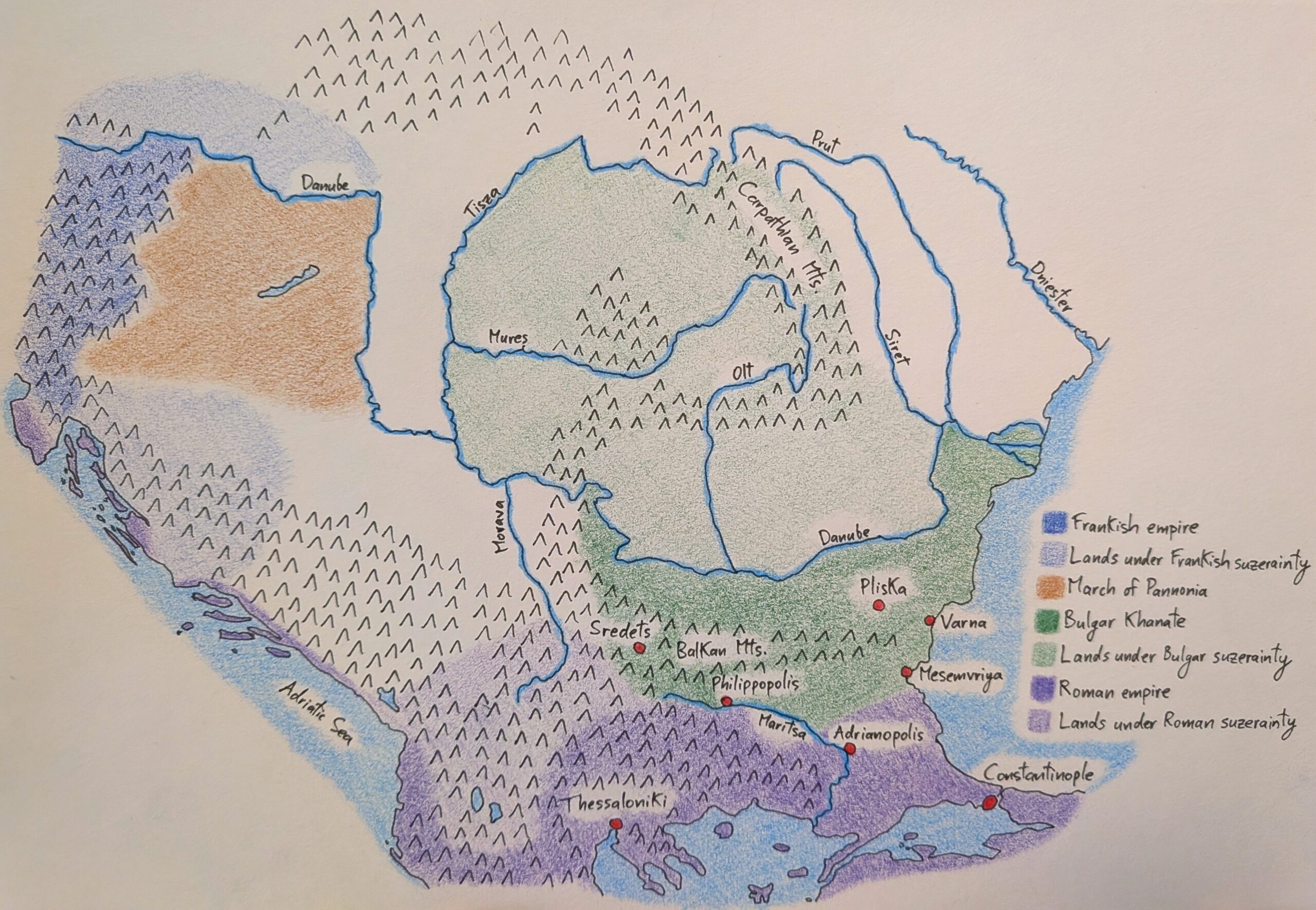
The Bulgar khanate held the eastern half of the Carpathian Basin while the Frankish empire had suzerainty over the western half. In 822, some Slavic tribes along the middle Danube switched allegiance from the Bulgar khan to the Frankish emperor, which brought up the question of just where the exact border between their two realms lay.
The two sides tried to reach an agreement, but when negotiations failed, they turned to blows. The Bulgars and Franks fought over several campaign seasons from 827 to 829 until a treaty was reached: the Bulgar khanate was to have the lands east of the Tisza, while the Frankish empire was to have those to west of the Danube, with the plains between those two rivers acting as a buffer zone.
During the course of the conflict, in 828, the Frankish emperor Ludwig abolished the tributary Avar khaganate established by his father Charlemagne and created the March of Pannonia in its stead. This realm ran from the Alps to the Danube and was officially part of the duchy of Bavaria. With this change, the Frankish empire extended its reach eastwards, while the Avars lost the last remnant of their state.
Nearly a decade later, another territorial change took place as the Bulgars came into conflict with the Romans. A previous treaty stipulated that the Romans had to hand over the city of Philippopolis to the Bulgars, but when the time came to do so in 836, they refused. War followed, and the Bulgars soon captured the disputed city.
A treaty concluded the following year in 837 officially handed them Philippopolis and its environs. The southern border of the Bulgar khanate thus came to follow the Maritsa River.
However, during the course of the war, the Bulgars also lost some land. The khan’s forces had previously captured the city of Adrianopolis and displaced all of its inhabitants north of the Danube to protect his eastern frontier. But while the Bulgar army had been preoccupied near Philippopolis, these exiled Romans rebelled, fought their way to the Danube, and met up with an imperial fleet which took them to Constantinople.
Their departure left a void on the khanate’s eastern frontier, and the Magyars who lived to the east took advantage of the vacuum. After 837, they migrated westwards from the Dniester to the Danube. Their communities thus came to directly border the Carpathian Mountains.
Transcript
Hello and welcome to A history of Romania.
Season 2, episode 18: In their fathers’ footsteps
Last time, we saw the Bulgar khanate flourish in the early ninth century. Khan Krum won some spectacular victories against the Avars and Romans, and his son Omurtag built on what he had achieved. He secured the khanate’s borders, refounded its capital, and gained recognition from the Romans as God’s appointed ruler over his lands.
Those lands were quite extensive and included the entire eastern half of the Carpathian Basin up to Charlemagne’s realms. If you’ll recall, Charlemagne had destroyed the Avar khaganate and, out of its remnants, had created a new, tributary state called Avaria. This polity ran from the Alps to the Danube and was run by a khagan handpicked by the Frankish emperor.
The issue was that this khagan had been plucked from the East—from lands which had been conquered by the Bulgars—and so he had no base of support in the West where he ruled. That was good for the Franks, since it meant that he was completely dependent on them for his position and was thus less likely to revolt, but there was also a downside, namely that he had no legitimacy. Some Avar nobles from the region with local connections thought they would make a better khagan, whereas the Slavic chieftains who provided most of the troops for the army wondered why they should listen to this foreigner at all. And so, shortly after this new khagan was appointed in 805, his subjects refused to recognize his authority. Sources are scant on the details, but we know that fighting soon erupted within Avaria and that the khagan was unable to impose his will; Charlemagne had to intervene to save his vassal—and the stability of his eastern frontier—and so sent an army to restore order.
In 811, Frankish forces marched through Avaria, intimidated the warring factions into laying down their arms, and convinced them to come before Charlemagne to resolve their disputes. In November of that year, the Frankish emperor received the khagan, Avar nobles, and Slavic chieftains at his palace in Aachen. We don’t have an account of the meeting, but it seems that Charlemagne confirmed the khagan’s authority over his subjects, though he probably also made some concessions to them. This judgment was more or less a return to the status quo and didn’t actually offer a lasting solution; the khagan still didn’t have the forces to assert his authority on his own, and the Avar nobles and Slavic chieftains still felt they had no reason to listen to him. No one was particularly happy with Charlemagne’s judgment, but it would’ve been suicide to reject his orders.
You see, Charlemagne was now at the apex of his power. The following year in 812, even the Romans officially recognized his title of emperor. At that point, the Romans were at war with the Bulgars, and Charlemagne used their moment of weakness to attack Venetia and the Dalmatian islands, communities which owed allegiance to the eastern emperor. Yet his invasion failed, and he had to turn to diplomacy. Charlemagne agreed to stop his aggression, and in return, the Roman emperor agreed to call him basileus and imperator, which are the words for “emperor” in Greek and Latin. But there were two catches.
The first was that Charlemagne wasn’t recognized as “emperor of the Romans,” as the pope had crowned him. No, the emperor in Constantinople reserved the term “emperor of the Romans” for himself, whereas Charlemagne was only recognized as an “emperor.” The implication here is that barbarians could attain an imperial title, but they could never hold imperium over the Romans; the Roman emperor was above all other potential emperors.
The other catch was that recognition of the title was only granted to Charlemagne personally, not to his heirs as well. The Romans had actually done something similar a century earlier when they’d granted the title of kaisar to the Bulgar khan Tervel. That had been a pretty huge deal, since kaisar was the third most prestigious title in the empire, but it had been given to Tervel as an individual, not to his dynasty, and so it was not carried on by future khans.
Charlemagne accepted both of these concessions and styled himself “Karl, most serene Augustus, crowned by God, great peaceful emperor governing the Roman empire, and who is by the mercy of God, king of the Franks and the Lombards”. Note that he didn’t claim to be the Roman emperor, but rather the emperor governing the Roman empire. It was a clever play on words that was palatable to Constantinople while also maintaining his prestige amongst his subjects.
But here I have to stop a second and note that Charlemagne’s empire wasn’t Roman in any sense of the word. Yes, it covered some of the same territory as the former western Roman empire, its elite wrote in Latin, and its religion was Christianity, but that’s where the similarities end. No one in it thought of themselves as Roman except the inhabitants of the city of Rome; but they made up only a tiny fraction of the overall population: about thirty thousand out of the empire’s ten million people. These millions identified variously as Franks, Basques, Saxons, Genoese, and more, and didn’t have a common identity binding them together. If we look at the eastern Roman empire at the time, you could take a citizen from Thessaloniki on the Aegean coast and one from Trapezous on the coast of the Black Sea, and they would both speak the same language, worship the same god, live under the same laws, and navigate the same institutions. But in Charlemagne’s empire, a Basque living in the foothills of the Pyrenees had almost nothing in common with a Saxon on the banks of the Elbe—except that their overlord was the same person.
In fact, Charlemagne’s empire didn’t revive a lost Roman past; it arose out of Germanic customs. Charlemagne had conquered various peoples with different languages, traditions, and laws, and fused them to himself personally through bonds of loyalty with their leaders. His empire was not a res publica, or “public thing,” like the eastern Roman empire, in which the emperor was the steward of the realm and in which bureaucrats outlasted rulers; no, his empire was his personal possession, and he ruled it as its lord.
During Charlemagne’s lifetime, official documents refer to his realm as “the Roman empire” or “the empire of the Romans and Franks,” whereas more colloquial contexts use the terms “the Christian empire,” “the universal kingdom,” or “the Frankish kingdom.” Each of these terms bring out a different aspect of Charlemagne’s realm. In our story, I’ll use the term “the Frankish empire” to avoid confusion with the actual Roman empire in the East and to highlight the importance of Frankish customs and of Charlemagne’s dynasty.
Indeed, one way to look at the Frankish empire is as a family holding, one which would have to be divided between Charlemagne’s sons according to Frankish custom. Now, Charlemagne had at least eighteen children, but only three of those were legitimate sons, and two of them died as adults, which only left one heir: Ludwig. And so, when Charlemagne died in 814, he didn’t have to divide his realm into three: everything went to his sole surviving legitimate son.
Of course, the Romans never recognized Ludwig as emperor; in their correspondence with him, they used the term rex, meaning “king.” But that didn’t stop him from calling himself imperator. After all, his nobles acclaimed him and the pope crowned him as such—he didn’t need anybody else’s approval.
It was a pretty smooth transition from father to son, but the installment of a new leader is always an opportunity for change, and when the nobles of Avaria heard that there was a new emperor, they sought to renegotiate their conditions. You see, the settlement imposed by Charlemagne on the khagan and his subjects hadn’t resolved the underlying issues which had led them to fight, namely that the khagan had no legitimacy and that his subjects were more powerful than him. And so, fighting broke out again, with each party looking to gain an advantage and see just how many concessions they could get from the young Ludwig.
Unfortunately, we have almost no details about their struggles, but we know that, in 822, Ludwig summoned the Avar and Slavic dignitaries of Avaria to his court, most likely to stop their fighting and to impose a new settlement on them. It’s probably no coincidence that, in the same year, a number of Slavic tribes under Bulgar suzerainty sent envoys to Ludwig to offer their submission. These tribes, namely the Timociani, Abodrites, and Praedenecenti, lived on the very western edge of Bulgar control near Avaria, more specifically on either side of the Danube between the Tisza and the Sava. Their envoys asked the Frankish emperor to take them under his authority on the same conditions as the Slavs of Avaria enjoyed. Evidently, Ludwig imposed fewer obligations on his subjects than the Bulgar khan Omurtag, and these Slavic tribes sought the best terms they could get.
Of course, as soon as Omurtag heard of the treachery of the Timociani, Abodrites, and Praedenecenti, he sent messengers ordering them to once again recognize his authority. But they refused. Now, Omurtag wanted to avoid a conflict with the Franks, so instead of reacting with force, he sent an embassy to Ludwig in 824; its mission was to settle the border between their two realms and to agree which clans belonged under Frankish suzerainty and which under Bulgar one. Ludwig hadn’t expected Omurtag to reach out—this was in fact the first direct contact between the Bulgars and Franks. When the envoys arrived, he listened to them and then sent a trusted agent back with them to discuss the matter with the khan in Pliska.
A potential pact was quickly reached and the embassy set out on its return journey in the autumn; but they were stalled in Bavaria for several months and only received permission to go to Ludwig’s court the following spring. When they finally had their audience with the Frankish emperor, he refused their proposal, saying it needed further tweaks. The embassy thus had to trek back across the Carpathian Basin, confer with Omurtag, and then do the trip all over again. Ludwig was clearly delaying the negotiations; he didn’t have much regard for the Bulgars and wasn’t interested in concluding a treaty with them; he wanted to keep his options open, like his father had done when the Avars had wanted to settle the border between their two realms. But Omurtag had had enough of these interminable delays; at the beginning of 826, he sent an envoy to Ludwig saying that the frontiers should be demarcated immediately, or he would demarcate them himself with his warriors. Ludwig sent back the envoy without a letter, which was a clear answer onto itself.
The following year, Omurtag gathered his Bulgar riders and Slavic warriors, and told them to build boats to sail the Danube. Not since Charlemagne had assembled a fleet to invade the khaganate had such a force been seen on that river. Their destination was the villages of the Timociani, Abodrites, and Praedenecenti who had disavowed the khan. The Bulgar army soon appeared on their shores and easily overpowered them; their fighters were killed, their homes torched, and their stores looted, after which the khan appointed Bulgar commanders to oversee their communities.
Ludwig had to respond, but before sending out his army, he set the table for the upcoming campaign by reorganizing his eastern territories. You see, over the past two decades, the khagan had failed to maintain order in the region, and the resulting unrest had forced the Franks to get involved directly, which diverted troops from other theatres. The current structure clearly wasn’t working, and Ludwig decided to do away with it; in 828, he abolished the tributary Avar khaganate which his father had established and created the March of Pannonia in its stead. This fief covered basically the same territory as Avaria, but instead of being governed by a foreign vassal, it was integrated into the duchy of Bavaria. In practical terms, the duke divided the march between four counts whose mission it was to prevent revolts and to defend the frontier. In this way, the March of Pannonia became a direct extension of the empire and could receive support from its heartland.
The abolition of the tributary Avar khaganate marks the end of the Avars as a distinct people. To be clear, the individuals who identified as Avars didn’t disappear; it’s just that they now gradually stopped identifying as Avars. As we’ve seen, the identity of the Avars depended heavily on their political structure. They had become a distinct group when they’d fled from the Khazar khagan and chosen a khagan of their own to lead them. Ever since that point in the sixth century, to be an Avar meant you served the Avar khagan. Of course, there were also social, cultural, and religious aspects to their identity, but the political one was key; if you left the Avar khaganate, you were no longer considered an Avar.
But then, towards the end of the eighth century, the Franks shattered the khaganate, and some Avar nobles, such as the tudun and kapkhan, struck out on their own with their followers. The Avars thus splintered, their unity gone. So the question arose, could you still be an Avar without a khagan and a khaganate?
The generation who had come of age before the Frankish invasion might’ve answered yes; they had grown up as Avars, and those values and customs would forever be a part of them, regardless of who they now followed. But the generation who came of age in the chaos following the invasion had never known political unity; had never seen the khagan dispense favour by handing out lavish gifts; had never gathered around a massive burial mound as shamans sang to Tengri. In short, they had never experienced the traditional Avar lifestyle; the old order was gone, and the new generation now had to ask themselves who they were. Unfortunately, we don’t know their answer.
The last time the Avars are mentioned by a contemporaneous source is in 822, when the nobles of Avaria pledged allegiance to Ludwig. Nearly fifty years later, in 871, the archbishop of Salzburg wrote a history of the region called Conversio Bagoariorum et Carantanorum. In it, he relates that some of the inhabitants of the Carpathian Basin were “the people that remained of the Huns,” with the Huns in this case referring to the Avars. The crucial point here is that the archbishop of Salzburg, who was well acquainted with the region, couldn’t find a definite name for the descendants of the Avars. They had not developed into something new, but neither were they free from their roots; their identity was still vague, the remnants of an old group.
We don’t know what happened to them over the course of the ninth century. Some of them could’ve offered their martial services to Frankish counts or Bulgar commanders; others could’ve married into the families of neighbouring Slavic chieftains. What’s clear is that the descendants of the Avars didn’t form a new ethnicity; they became members of other groups and gradually adopted their identities.
And so, it’s now time to say goodbye to the Avars. They’ve been with us for the past twenty episodes, from the late sixth to the early ninth century. They had amassed the greatest nomadic state since Attila’s, and their arrows had even struck the walls of Constantinople itself, but times were now changing, and their role in our story has come to an end.
There’s a lot we could still say about the Avars, but now is not the time to do it. Towards the end of the season, when we finish with this narrative period, we’ll have some thematic episodes to discuss the themes, trends, and impacts of the era we’ve covered. It’s in those thematic episodes that we’ll talk about the influence of the Avars on the region, what they can teach us about this period, and how generations of historians have overlooked their role in the Middle Ages. For now, though, I want us to stay focused on current events to really get into the mindset of the people at the time and to understand why they did what they did. So let’s get back to our story.
The year is 828. The tribes of the Timociani, Abodrites, and Praedenecenti defected from the khan to follow the Frankish emperor. Omurtag sent forces to subjugate them, and in response, Ludwig sent his own army to avenge them.
Details are scarce, but we know that, during the campaign season of 828, Frankish forces successfully repelled the Bulgars from the settlements of the Timociani, Abodrites, and Praedenecenti. Yet the situation reversed the following year; in 829, the khan’s army returned and successfully drove the Franks from the region. This conflict occurred at a slow pace because the opposing forces had to march several months to reach the disputed area. The huge distances involved also meant that there was no danger of the war spiralling into a wider conflict; the main concern was the prestige of the competing rulers. But of course, the people who suffered most were the local Slavic farmers whose homes and fields were looted and burnt, and whose families were mistreated, broken up, or killed—one year by the Bulgars, then the next by the Franks.
While these two powers skirmished on their frontiers, Ludwig faced unrest from his sons. You see, the Frankish emperor had recently announced how he would divide his empire upon his death, and each son was dissatisfied with his inheritance. Ludwig needed to wrap up this eastern escapade before his sons picked up swords to show their discontent; and so, after the campaign season of 829, he finally agreed to Omurtag’s proposed frontier. The border of the Frankish empire was set at the Danube, while that of the Bulgar khanate ended at the Tisza, with the plains between those two rivers acting as a buffer zone. The khan regained the Timociani, Abodrites, and Praedenecenti as subjects, but more importantly, he now had a treaty with his Frankish counterpart which could diffuse future tensions, as both sides knew just how far their influence was supposed to reach.
By winning this war, the khanate had proven itself to be a great regional power alongside the Frankish and Roman empires, able to stand on its own between these two rivals. But one key difference with those two states was that the Bulgar khanate emphatically rejected the Christian faith; in the khan’s eyes, all the Christians in his realm were potential traitors, since the viceroy of the Christian god on Earth was the Roman emperor, and if war came, they would surely side with him.
Unfortunately for Omurtag, his realm had lots of Christians. There were, of course, numerous Romanians in the Carpathian Mountains and in the forests along the Danube. On top of that, Omurtag’s father had displaced the Roman inhabitants of Adrianopolis north of the Danube to protect the khanate’s border. An unintended effect of this forced migration was that Roman priests from this community began to preach to their Slavic neighbours, and they found a receptive audience. Christianity had a similar allure now compared to when it first spread through the Roman empire: You didn’t have to make lavish sacrifices or join a secret society to secure the favour of the divine. You simply had to believe that god’s son had died for humanity’s sins and then rose from the dead, and had to love god as well as your neighbour. If you held those views, you would receive eternal life. It was a faith as accessible to a mighty general as it was to a servant girl—and it quickly found converts across the khanate.
The threat was much more resilient and diffuse than any army Omurtag had ever faced, so, in collaboration with his closest boyars, he began a campaign to convert or kill the Christians in his realm. The sources tell us that Omurtag ordered all his subjects to eat meat during Lent, an act which was forbidden to Christians; those who obeyed were allowed to live, while those who resisted were killed. The Roman exiles from Adrianopolis were torn; some broke their religious customs and ate meat, hoping that they could later repent and return to their faith. Others refused. The bishop of Adrianopolis, which was the highest-ranking Roman Christian in the khanate, refused to renounce his faith and was murdered. He was only one of numerous Romans who resisted, including military commanders, priests, deacons, artisans, and farmers—all of whom were tortured and killed. Through this persecution, Omurtag was trying to force everyone to show their obedience to him in public—to do as he ordered without question.
We know most about the fate of Romans during this persecution because our sources for this period are all Roman, but also because the former inhabitants of Adrianopolis were a potential threat to the khan; they had been given the military task of defending the border, and so Omurtag needed to ensure they were entirely loyal to him. But the khan’s focus on such a specific target belies the fact that he didn’t have the resources to go after all the Christians in his realm. We’ve already seen how Christian communities thrived in Bălgrad and other settlements in the Carpathian Basin. In all probability, these practitioners were left in peace, as there were no Bulgar garrisons inside the Carpathian Basin and they were too far away to pose a threat to the regime.
The real threat came from conversions within the Bulgar aristocracy. You see, some boyar families had begun to intermarry with those of Slavic chieftains, and such connections even took place within the khan’s family. Omurtag had three sons, namely Enravota, Zvinitsa, and Malamir. Enravota’s second name, Voin, and the names of his brothers, Zvinitsa and Malamir, are Slavic, which could indicate that the khan had Slavic wives. And while the Bulgar ruling class was staunchly attached to their traditional customs, their Slavic counterparts were increasingly turning towards the Christian faith; in a family context where the father worshipped Tengri while the mother followed Jesus and raised their children, well, those children had a good chance of being receptive to Christianity.
And indeed, the faith was spreading even in the highest circles. Sources relate that Omurtag’s eldest son Enravota was sympathetic to the Christians and had even talked with an imprisoned Roman preacher. For Omurtag, his son’s flirtation with Christianity was a mortal threat. Enravota was his heir, the man who needed to continue his work into the next generation, and yet here he was, on the cusp of rejecting his people’s traditional beliefs and embracing those of his enemies. Once he died and power passed to his son, would Enravota get baptized? Would he do as the emperor in Constantinople commanded? Would the khanate become a vassal of the empire? Omurtag needed to remove this threat at once. And so, with the support of his boyars, he cut Enravota from the inheritance and proclaimed that the throne would pass to his youngest son, Malamir. Given that Omurtag skipped over his second son, Zvinitsa, he too was probably removed from power for his Christian sympathies, though we have no information on him whatsoever.
When Omurtag died in 831, his youngest son Malamir was still underage, and so the state came to be governed by a regent; that was a man named Isbul, who held the title of kavkhan, the second most powerful position after the khan himself. We know little about the following few years, but it’s clear that Isbul continued Omurtag’s persecution of the Christians. When Malamir’s eldest brother, Enravota, refused to renounce his Christian faith, he was put to death.
Isbul’s regency also brought conflict with the Roman empire. We don’t know why hostilities broke out, but we can make an educated guess. If you’ll recall, Omurtag had concluded a thirty-year peace treaty with the Romans in 816, to be renewed every ten. One of the conditions of the treaty was that, at some point in the future, the Romans would give the city of Philippopolis to the Bulgars. It might very well be that this transfer was to happen at the second renewal, in 836. But with the khanate in a regency and with the Bulgar ruling family tearing itself apart, the Romans might’ve felt confident enough to refuse to honour the deal. What we know is that, in 836, they attacked the khanate, but they didn’t get very far.
Isbul rallied the Bulgar army, repelled the initial attack, and pushed into imperial territory. He made significant gains against the Romans, capturing two fortresses and even taking the city of Philippopolis itself. During the course of this war, in 836, the young Malamir unexpectedly died and was succeeded by his middle brother’s son. Yet this new khan was underage too, and Isbul maintained the actual power in the realm.
The Roman exiles from Adrianopolis who lived north of the Danube were closely following news of this war. With the throne in transition from Malamir to his nephew and with the Bulgar army preoccupied far to the south, they saw a chance to gain their freedom. By this point, a whole generation had passed since the population of Adrianopolis had been transferred to the forests north of the Danube. But even though they had been dispersed in various villages and lost many of their prominent members during Omurtag’s persecutions, these exiled Romans nevertheless maintained their cohesion. Their unity is best illustrated by the fact that they banded together and elected a single person to lead them: a man known as Kordylas.
We know nothing about Kordylas personally, but he clearly had military experience, since he gathered the Roman men of fighting age from those communities and organized them into a unified fighting force. At the same time, he sent messengers hundreds of kilometres away to Constantinople to inform the emperor that his people were ready to fight for their freedom; all he asked for was a fleet to come take them home.
And so, in 837, as the Bulgar army was engaged in the south, the Romans north of the Danube packed their belongings and started marching towards the river. The Bulgar commander for the lands beyond the Danube quickly mustered his forces to stop their flight—but when they faced off in battle, the Roman exiles triumphed. The Bulgar commander then sent messengers to the Magyars to hire them as mercenaries. If you’ll recall, the Magyars lived on the eastern border of the khanate beyond the Dniester River, and their men were experienced horse archers. The Magyars accepted the offer and rode to intercept the Roman exiles. What really attracted them about this mission was the prospect of plunder, and if they could enrich themselves without having to fight, then all the better. So the Magyar commander demanded that the Roman exiles surrender all their belongings in return for mercy. But Kordylas wasn’t intimidated; he readied his forces for battle, and the Romans emerged victorious once again. Clearly, this new generation of Romans which had grown up north of the Danube had been well trained in the art of war by their parents—and were now led by competent commanders.
After defeating both the Bulgars and the Magyars, Kordylas’ Romans finally made it to the Danube, where they saw an imperial fleet sailing its wide waters. Constantinople had answered the call. These imperial ships had faced no resistance on their way to the Danube since the khan had no fleet of his own. While the Bulgars had captured the Roman seaside cities of Odessos and Mesembria, their docks stood empty, since the Bulgars had never sailed the sea and had no reason to do so now.
As such, the original inhabitants of Adrianopolis and their children completed their daring escape and sailed away to Constantinople. Their departure left a void on the khanate’s eastern frontier; they had been its border guards, and the Bulgar commander in charge of the region didn’t have the forces to replace them. The Magyars took advantage of this vacuum and, around this point in the late 830s, they migrated westwards from the Dniester to the Danube.
When the Bulgar regent Isbul heard the news, he decided to end the war against the Romans. He needed to ensure the Magyars wouldn’t push further into the khanate, and in any case, he had already gained Philippopolis, which had been his main goal. And so, in 837, the two sides agreed to a peace treaty, in which the city of Philippopolis and its environs were given to the Bulgars. It was, in effect, the same thing Omurtag had negotiated for twenty years earlier; it just took thousands of deaths to finally secure it. You can check out the changes in territory in this episode’s map.
The escape of the Roman exiles from the khanate reduced its Christian population significantly—but the threat of Christianity didn’t dissipate. In fact, in the following years, the word of Christ was heard more and more throughout the region. Roman preachers increasingly set out on missions beyond the empire’s northern frontier: to the Slavs of the Pannonian Plain, the Khazars north of the Black Sea, and everywhere in between. New ideas were discussed and debated in communities across the region; some held firm to their traditional beliefs while others embraced new convictions. The world beyond the Danube was changing.
Next time, we’ll look at the spread of Christianity in the Carpathian region and see how local leaders responded to the faith and how some even sought to gain from it.
Leave a Reply