Khan Asparukh had fled from the Khazars with his followers, found refuge between the Danube and the Balkan Mountains, and in 681, he forced the Roman empire to allow his people to settle in the area.
Over the following two decades, he expanded his realm westwards towards the Iron Gates – the point where the Carpathians intersect the Danube – and northwards, going beyond the river to subjugate the communities living between the Danube and the Carpathians.
Asparukh also fortified his realm against possible Khazar and Roman attacks by ordering his Slavic and Romanic subjects to build several dikes – some as long as 122 kilometres.
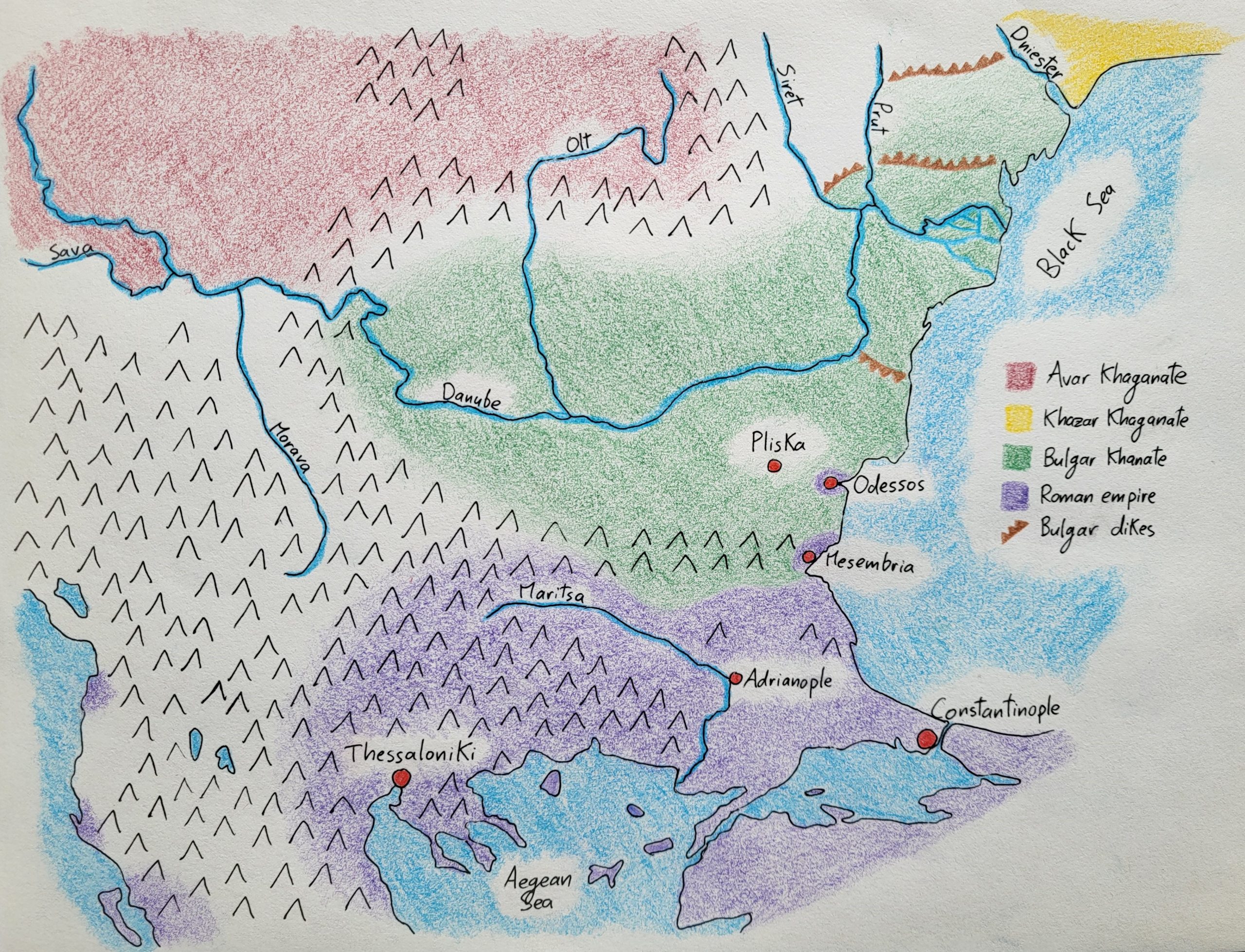
Asparukh’s successor, Tervel, helped Justinian II regain the Roman throne in 705. One of the concessions he received in return was territory south of the Balkan Mountains. Note that in the previous map which shows the situation in 681, the Bulgars were relegated to the north of that mountain range; now in 705, their control extended south of it as well.
The Roman city of Mesembria became an isolated enclave surrounded by the Bulgar realm, like the city of Odessos further north.
A decade later, after the Bulgars helped them in the 717 Muslim siege of Constantinople, the Romans began to refer to the Balkan Mountains as belonging to the Bulgars. While they still recognized the Danube as the frontier of their empire, the Romans saw the Bulgars as holding the Balkan Mountains in their name, similar to how they had granted Germanic foederati land to defend imperial territory in centuries past.
Indeed, by the beginning of the eighth century, the Bulgars came to be seen not as enemies, but as allies of the empire.
Leave a Reply