The Bulgars fortify their new homeland, wary that the Romans may try to reclaim what they’ve lost. Yet the khan has a chance to reset relations with them when a noseless emperor comes calling for aid, and an ambitious caliph assembles all the might of the Muslim world to take Constantinople once and for all.
This episode’s map shows the extent of the Bulgar realm around the year 705.
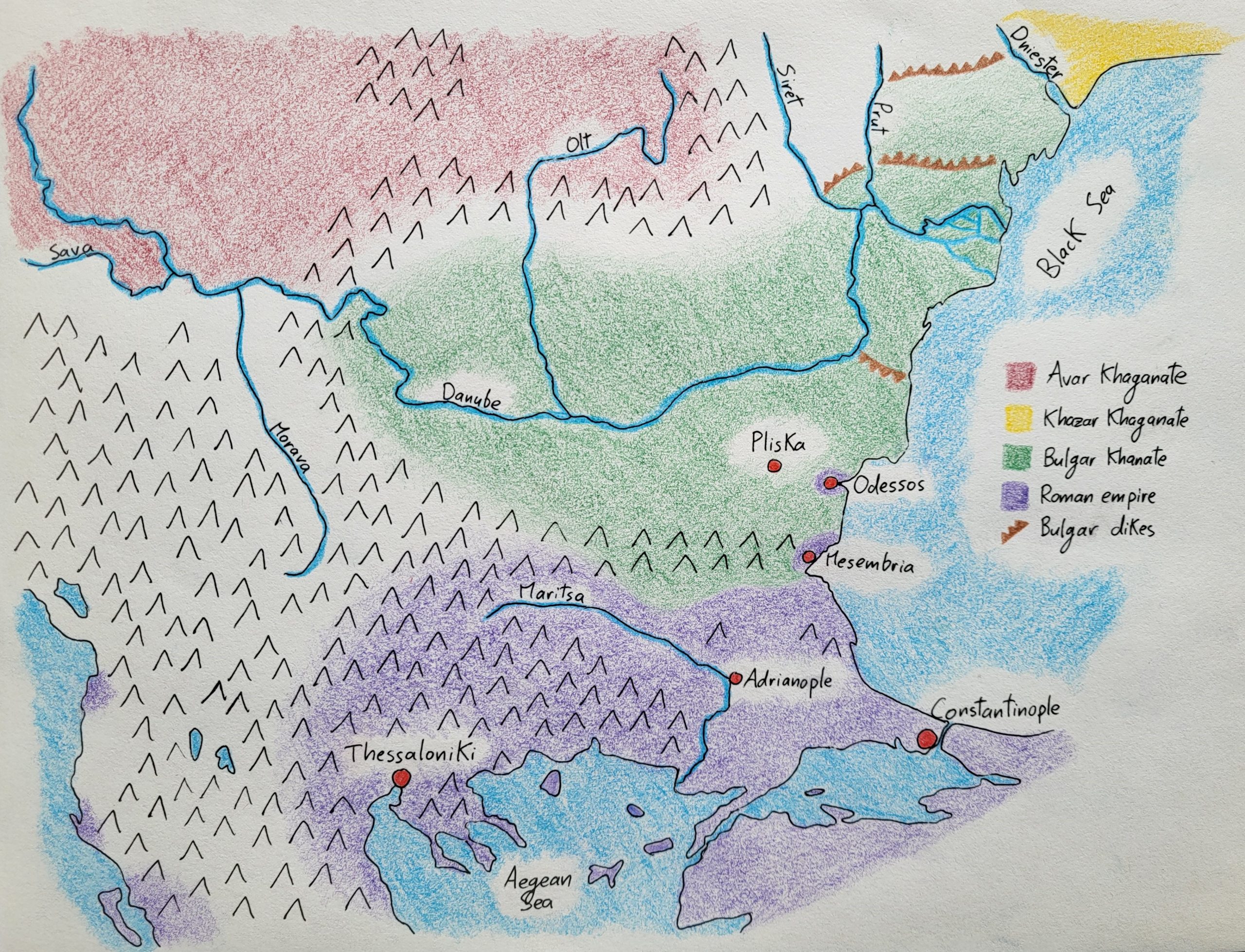
After gaining permission from the empire to settle in Dobrogea in 681, khan Asparukh spent the next two decades expanding his realm. He drove his riders westwards towards the Iron Gates – the point where the Carpathians intersect the Danube – and northwards, going beyond the river to subjugate the communities living between the Danube and the Carpathians.
Asparukh also fortified his realm against possible Khazar and Roman attacks by ordering his Slavic and Romanic subjects to build several dikes – some as long as 122 kilometres.
Asparukh’s successor, Tervel, helped Justinian II regain the Roman throne in 705. One of the concessions he received in return was territory south of the Balkan Mountains. Note that in the previous map which shows the situation in 681, the Bulgars were relegated to the north of that mountain range; now in 705, their control extended south of it as well.
The Roman city of Mesembria became an isolated enclave surrounded by the Bulgar realm, like the city of Odessos further north.
A decade later, after the Bulgars helped them in the 717 Muslim siege of Constantinople, the Romans began to refer to the Balkan Mountains as belonging to the Bulgars. While they still recognized the Danube as the frontier of their empire, the Romans saw the Bulgars as holding the Balkan Mountains in their name, similar to how they had granted Germanic foederati land to defend imperial territory in centuries past.
Indeed, by the beginning of the eighth century, the Bulgars came to be seen not as enemies, but as allies of the empire.
Transcript
Hello and welcome to A history of Romania.
Season 2, Episode 11: Kaisar khan
Last time, we explored the melting pot that was the Balkan peninsula in the late seventh century, with Romanic and Slavic communities influencing each other and with the Bulgars just newly arrived in the region. We ended with the Bulgar khan Asparukh scoring a decisive victory over the Romans which allowed him to settle his people in Dobrogea.
After this triumph in 681, Asparukh looked to see what other communities he could bring under his control. His southern border had been fixed through a treaty with the Romans, while the lands to the north were dangerously close to the Khazars from which he had fled. Thus, the only direction in which he could safely expand was west, in the former Roman province of Moesia between the Danube River and the Balkan Mountains. Moesia’s cities and forts had been breached and devastated by the Avars and Slavs in the early seventh century like the rest of the imperial holdings in the Balkans. Its Roman inhabitants had fled from urban centers into the countryside while Slavic migrants had settled on abandoned land. The empire had no practical influence over the area, such that Asparukh’s advances drew no response from the Romans.
And so, Bulgar riders galloped westwards to subjugate the Roman descendants who had remained in the region and the Slavic tribes which had migrated near them. Asparukh forced some of these Slavic tribes to pack their belongings and resettle near the Balkan Mountain passes as a buffer against Roman attacks, while he sent others to the plains north of the Danube River to prevent Avar incursions. Indeed, the Bulgars made inroads on the grasslands between the Danube and the Carpathians, an area which had once been part of the Avar khaganate, but which had fallen out of their control after the damaging rebellions of the 630s. Now, Bulgar horsemen rode in the region and told any communities they encountered – Romanic and Slavic alike – that it was better for their health to pay them a tribute.
As Asparukh expanded his realm, he also sought to better defend it. We saw last time how he’d ordered the construction of an earthen rampart around his main camp at Pliska. Now, in the 680s and 690s, the Bulgar leader decreed that several dikes be built to slow down any invaders. In Dobrogea itself, a 60-kilometer ditch was dug going from the Danube to the Black Sea, facing south towards the Romans. Two other dikes were built north of the river – one stretched for 22 kilometers, and the other, 120 kilometers – both of which were meant to protect against possible Khazar attacks. Evidently, the Bulgars saw the Romans and Khazars as the two main threats to their safety, and they put in a lot of work to secure their new homeland. Their massive fortification works would’ve required the coordination of thousands of people, and of course, the Bulgars didn’t do the work themselves; rather, they compelled their Slavic and Romanic subjects to dig, haul, and build. I’ve drawn a map and included it in this episode’s description for you to see the expansion of the Bulgar realm as well as the location of their defensive works.
For their part, the Romans secured their northern border by establishing the thema of Thrace. This administrative division was meant to defend the approaches to Constantinople against Bulgar incursions; it had as its capital the city of Adrianople and as its northernmost port, the city of Mesembria. The Romans took a defensive stance towards the Bulgars because their active attention was needed in the Orient.
As you’ll remember, after the latest failed Muslim siege of Constantinople, the caliphate had signed a thirty-year peace treaty with the empire in 680. The caliph died soon afterwards and a succession crisis followed which plunged the Muslim world into civil war; the Romans took the opportunity to strengthen their position in the eastern Mediterranean by demanding more concessions from the weakened caliphate. Yet after a decade of bloodshed in the Muslim world, a victor eventually vanquished all other contenders, and their internal strife came to an end. The Roman emperor at the time, Justinian II, knew that the new caliph would surely restart raids on the empire as soon as he’d consolidated his position. And so, he decided to strike first, because the caliphate had far more soldiers and resources than the Roman empire, so catching it unprepared was the best chance he had to stun its advances.
Accordingly, in 692, Justinian broke the peace treaty his predecessor had signed and ordered his armies to attack the caliphate. Unfortunately for the Romans, even with the element of surprise, they suffered repeated battlefield defeats, and the Muslims soon took the lead and attacked Anatolia and Africa.
These military defeats tarnished Justinian’s reputation, which only added to his domestic troubles; you see, the emperor had prevented the aristocracy from buying land from peasant freeholders so as to have recruits for his army, but that made the nobles hate him; at the same time, he had increased taxes to pay for the war as well as for several expensive building projects, and that made the common people hate him. This swirling discontent created the perfect conditions for a coup, and in 695, one of Justinian’s generals detained him in the imperial palace, brought him to the Hippodrome, and cut off his nose. Roman tradition held that disfigured individuals couldn’t rule as emperors, and so by mutilating Justinian, this rebellious general delegitimized his rival while keeping some semblance of Christian piety, since he didn’t go as far as killing him.
Justinian was thereafter exiled to Cherson in Crimea where the empire still had a presence. He never stopped plotting his return to power, and he married a daughter of the Khazar khagan to gain a powerful ally in his quest. Unfortunately for him, his new father-in-law soon accepted a bribe from a Roman official to murder him. Justinian survived the assassination attempt but knew he had to flee Cherson if he were to survive. With the Khazars having betrayed him, Justinian saw only one other group which could help him regain his throne – the Bulgars – so he sailed across the Black Sea to speak with their khan, Tervel, who had just succeeded Asparukh.
Tervel agreed to lead his army in support of Justinian, but for a steep price. Once the emperor was back on his throne, Tervel wanted to receive increased subsidies, some more territory along the Balkan Mountains, Justinian’s daughter in marriage, and the title of kaisar. This last demand might seem surprising, but by this point in Roman history, the title kaisar no longer designated the heir apparent, as it had during the reign of Constantine, for instance; rather, from Herakleios onwards, the ruling emperor was termed basileus, meaning “monarch” in Greek, his heir was augustus, and the term kaisar came in third, as an honorific which granted prestige on those favoured by the emperor. As such, Tervel didn’t seek an actual position within the Roman hierarchy, but a symbolic one to increase his prestige and elevate the status of the Bulgar realm in relation to the empire’s other neighbours.
Justinian had little choice but to accept if he wanted to return to the throne, and in the spring of 705, he and Tervel marched to the walls of Constantinople with an army of 15,000 Bulgar riders and Slavic warriors. Justinian of course knew that he couldn’t take the city by force – the caliphate itself had twice tried to do so with many more troops. So instead, the deposed emperor found a defunct aqueduct that ran under the walls and crawled through it with a few loyal companions. Once inside the city, Justinian rallied his remaining supporters and ousted the surprised defenders. He thereafter donned a golden nose to replace the one that had been cut off and had the sitting emperor executed in the Hippodrome, after which he exacted brutal revenge on all those who had opposed him.
Now back on the throne, Justinian kept his bargain with Tervel – for the most part. He gave Tervel gold, silver, and silks, some land which included a part of northern Thrace, and the title of kaisar; Tervel was in fact the first foreigner in Roman history to be granted that honour, and he travelled to Constantinople for the ceremony. While in the city, Tervel struck a lead seal to display his new position, and back in his realm, he ordered a huge rock carving of himself on horseback with a Greek text recounting his assistance to the “slit-nosed emperor”.
Why I say Justinian only kept his bargain with Tervel “for the most part” is because he never followed through on his promise to marry his daughter to him. She was still a child at the time, so Justinian told Tervel he’d have to wait a few years, but the emperor never actually intended to send her, because he didn’t want to be lifelong allies with the khan. In fact, three years after returning to the throne, the emperor felt strong enough to turn on his former ally, and he attacked the Bulgars to regain the lands which he’d given away. Yet as Justinian and his army camped near the borders of the khanate, the Bulgars managed to ambush them, and a great many Romans died fighting or fleeing in the confusion, with the emperor himself barely escaping. It was a tremendous victory for the Bulgars, and this single battle put an immediate end to the war; Justinian ceased hostilities, reaffirmed the ceded territories, and increased Tervel’s subsidies.
Three years later in 711, Justinian’s vengeful ruling style brought on another coup, and this time, he wasn’t exiled, but executed along with his son. This marked the end of the dynasty started by Herakleios a hundred years earlier, and a Roman civil war ensued as powerful men tried to seize the throne.
This internal chaos was a godsend for the caliphate who hadn’t ceased attacking the empire ever since Justinian’s declaration of war two decades earlier. By the mid-710s, Muslim armies were constantly raiding Anatolia, and the caliph wanted nothing less than to capture the Queen of Cities itself. He reportedly said that he would “not stop fighting against Constantinople before having exhausted the country of the Arabs or to have taken the city”.
Indeed, the caliph brought all his resources to bear on this expedition, and his forces vastly outnumbered the Romans, both on land and sea. The new Roman emperor at the time needed all the aid he could get, so he approached Tervel to convince him to help. The Bulgar khan didn’t want the Roman empire to collapse; as much as he’d had conflicts with it, the empire recognized his khanate and provided regular tribute; a victorious caliphate, on the other hand, was sure to expand beyond Constantinople and target the Bulgars. And so, Tervel agreed to aid the Romans, but he also got a few concessions in return.
In a treaty signed in 716, the emperor agreed to a yearly payment of skins and silks to the value of 30 pounds of gold, reaffirmed the frontiers between the empire and the khanate, agreed to exchange prisoners and refugees, and allowed merchants accredited with seals to trade freely between the two realms, but only in the city of Mesembria, where exports could be monitored and appropriately taxed. The Romans and Bulgars recognized that many of their interests aligned and that it was better to collaborate than to fight; accordingly, they dealt with the points of friction between them, namely tribute, frontiers, captives, and exiles, and drew closer to focus on defeating the caliphate and to spur trade.
The deal came just in time because a Muslim army entered Anatolia in 716 and stayed there for the winter. By the next summer, this army reached Constantinople and rendezvoused with a huge navy which had been built specifically for this campaign. The Muslim ground forces crossed onto the European side of the Bosphorus and devastated the countryside around Constantinople, sacking towns and gathering supplies. By the month of August, 717, they’d isolated the city by building a double stone wall; one side faced the capital to besiege it, and the other faced outwards to protect against any relief forces, while their camp was set up between the two walls. The caliphate’s forces were here to stay for as long as it would take to breach the city; its soldiers had even brought seeds to plant wheat and harvest the following year so as not to run out of food.
The situation was dire for the Romans, but they were determined to hold out. A small reprieve came when Roman ships destroyed a Muslim squadron by using Greek fire. This terrifying weapon stuck to and burned everything – planks, clothes, even water – which made the caliphate’s sailors reluctant to engage the Roman fleet. No one wanted to be burned alive. And so, the attackers kept their distance and failed to fully blockade the city, which allowed the defenders to bring in supplies by sea. At the same time, the Bulgars held up their end of the bargain and conducted several raids on the Muslim palisade and siege engines outside the city; while they didn’t break the siege, the Bulgars did prevent the attackers from mounting a full assault on Constantinople.
When winter arrived, temperatures dipped far below what the Muslim forces were used to, and snows fell for three whole months. The attackers soon began to run out of food. Soldiers first turned to the livestock they’d brought with them, then their horses and camels, after which they ripped out the green shoots of the wheat they’d sown, and scavenged for bark and roots. But it still wasn’t enough. As famished troops sought to keep themselves fed and warm – all while fighting off Bulgar and Roman raids – the soldiers got desperate; some began to eat feces, while others, their dead comrades. Illness soon mixed with famine, and thousands of Muslim soldiers died over that winter.
When the spring sun finally thawed the snows, it also brought with it a Muslim fleet bearing supplies. Yet a large part of its sailors were Christians from Egypt who had been pressed into service, and as soon as they got close to Constantinople, they defected and shared news that a new army was marching across Anatolia. Seizing the opportunity, the Romans attacked the weakened Muslim fleet and destroyed most of it while capturing the rest. At the same time, they ambushed the army advancing towards Constantinople, while their Bulgar allies launched a major attack against the famished besiegers.
By August of 718 – thirteen months after the Muslim military had arrived in the vicinity of Constantinople – the caliphate’s forces were in disarray, and they had to withdraw. The caliph had thrown all the soldiers and supplies he could muster at the Roman capital – and it still hadn’t been enough. This was the third Muslim siege of Constantinople in sixty years, and the failure of this expedition drained his state. To be sure, the caliphate by no means collapsed; it was still able to mount annual raids of the empire, but its aims now changed. Whereas previous generations had dreamt of capturing Constantinople, the Muslims of the early eighth century no longer sought to conquer territory; they instead looked to enrich themselves by going on pillaging expeditions against the infidel Romans.
The Bulgar contribution to the defense of Constantinople seems to have changed Roman attitudes towards them. Whereas before, the Romans merely tolerated these nomads squatting on their land, it seems that they now came to grudgingly accept them as an allied power on their western flank. Indeed, kaisar Tervel fit into the imperial hierarchy as a foreign leader subservient to the emperor who protected the empire from its enemies, similar to how the Germanic foederati had served imperial interests in centuries past. For his part, Tervel didn’t see himself as a subordinate, but as a partner of the emperor, and was keen to preserve his independence. Although the Romans still recognized the Danube as the frontier of their empire, they referred to the Balkan Mountains as belonging to the Bulgars. It was a compromise in which Constantinople held symbolic control over the region while not having to defend it.
When Tervel died in 721, his successor didn’t inherit the title of kaisar; the emperor hadn’t made it hereditary, but had bestowed the title as a singular honour on a particular individual. Nevertheless, the special relationship which Tervel had built with the empire endured. The next few decades were ones of peace and collaboration between the two polities – and the Bulgar khanate greatly prospered from them.
Indeed, the treaty Tervel had signed with the emperor which regulated commerce between their realms suggests that the Bulgar elite now had enough wealth to buy imperial merchandise while also collecting enough goods from their subjects to sell to Roman merchants. Whereas in 681 the Bulgars were newly-arrived conquerors extracting tribute from Romanic and Slavic villagers, the Bulgars of 721 had had forty years to firmly establish themselves between the Danube and the Balkan Mountains. By this point, the first generation of Bulgars to have grown up in this new homeland had come of age.
A popular assumption is that the Bulgars lived in yurts typical of nomadic people. However, only a few tent dwellings have been found in the territory they inhabited; of course, yurts leave almost no archeological traces, but archeologists have found numerous buildings with sunken floors in their area of settlement. And so, historians assume that while the first generation of Bulgars lived as nomads in tents, subsequent generations adopted the settled lifestyle of the sedentary populations they’d encountered. In the early eighth century, it’s probable that the Bulgars used tents to travel with their herds during the summer, while temporarily occupying earthen dwellings to brave the cold winter months.
Bulgar settlements with earthen homes are in fact indistinguishable from Slavic and Romanic ones when it comes to the buildings or objects they contain; the only way to distinguish them is by looking at their cemeteries. You see, the Slavs practiced cremation, traditionally scattering ashes in the open but, in the second half of the seventh century, increasingly placing them in urns. The Romanics, meanwhile, buried their dead in graves oriented from West to East according to Christian customs. The Bulgars, in contrast, practiced both cremation and burial. When cremated, they placed their ashes in pits often lined with tiles from Roman buildings, while burial graves were oriented from North to South. In both cases, mourners brought offerings of domestic animals – often poultry, and more rarely cattle, horses, or dogs. Sometimes, we also find offerings of pots and jugs, whereas weapons and dress accessories are rare.
The Bulgars had a pantheon with a supreme god called Tengri like other Turkic peoples, and shamans played a key role in their religion. Unfortunately, we know much too little about their faith. One of its most mysterious aspects is the cult monuments called devtaşlar, from the Turkish words for “ghost” and “stones.” Devtaşlar consisted of upright stones set in repeated rows, with as many as 81 pieces in a single group, with the tallest ones reaching up to two meters. Archeologists have found human and animal bones at the base of a few of these stones, which hints at an unknown ritual practice. Some scholars have suggested that each stone was supposed to represent the number of enemies killed by the person entombed therein, whereas others have proposed that the stones were correlated with the participants in the burial ceremony or the members of the family of the deceased. Whatever the case may be, 44 out of 49 known devtaşlar are within ten kilometers of the khan’s residence at Pliska, where Bulgar settlement was densest.
Indeed, the initial group of Bulgar clans who had arrived with Asparukh had settled on the plains surrounding Pliska. The clan leaders were called boyars, a title of Turkic origin simply meaning “noble,” and they wanted to be close to the ruler when they weren’t out collecting tribute for him.
The farther away from Pliska you went, the fewer Bulgars there were. Their khanate was mainly inhabited by Slavs who’d migrated south of the Danube in the late sixth and early seventh centuries. Yet what’s interesting to note is that not all those who lived in Slavic settlements were of Slavic origin; some were Roman descendants who had decided to integrate their communities.
As you know, the lands which were now part of the khanate had once been the Roman provinces of Moesia and Scythia Minor. Even after Herakleios defeated the Avars before the walls of Constantinople, the empire hadn’t been able to regain all of its lost Balkan lands, leaving tens of thousands of provincials outside the imperial fold. The Romanic descendants of these former citizens had to establish relationships with the Slavs who had migrated next to them. As we saw last episode, these communities regularly interacted with one another, which led their members to become bilingual.
In areas where numerous Slavic tribes had migrated, the Romanics were outnumbered by their neighbours and had plenty of opportunities to move within their social circles, like when they went to trade with them or worked alongside them. Such contact allowed the Romanics to see that Slavic society was remarkably lacking in hierarchy. Unlike the Romans, the Slavs didn’t have a warrior caste which lived off the production of others; instead, villages came to each other’s aid when threatened, then returned to governing themselves. In fact, the Slavs were so unused to singular leaders that they used foreign loanwords to describe the position, like the Germanic kuninc, meaning “king”, which they took as knjez, meaning “prince”.
This lack of social differentiation amongst the Slavs was quite attractive to former imperial subjects whose memory of the empire was of paying rent and taxes to some faraway governor who didn’t even protect them. And so, instead of looking fondly towards the empire, many Romanics instead chose to live as free persons in Slavic communities, owning their family’s land and paying heed to no one but their neighbours, who held no more power over them than they did over their neighbours.
Over the course of generations, these bilingual Romanic individuals gradually conformed more and more to the customs and social expectations of their Slavic friends and acquaintances. Eventually, they sought to be accepted as part of their group, adopted their habits and norms, stopped speaking their own language to predominantly speak Slavic, and ultimately, came to think of themselves as Slavs. Accordingly, while most Slavs within the Bulgar khanate could trace their lineage back to those who had first migrated south of the Danube, a sizeable minority were Slavicized Romanics.
Of course, not all Romanic individuals living next to Slavs decided to integrate their communities. In fact, in areas where there were more Romanics than Slavs, the situation was reversed, and it was the Slavs who integrated Romanic communities.
Next time, we’ll look specifically at those Romanic communities who preserved their language and customs in the Balkans, and we’ll see them persevere and transform into a wholly new ethnicity.
Leave a Reply