The Frankish king Charlemagne campaigns relentlessly to expand his realm, bringing him right to the border of the khaganate—with no sign of stopping. The khagan is thus confronted with the most powerful foe his people have ever faced, and must muster all the means at his disposal to maintain their independence.
The map for this episode shows Charlemagne’s realms in 791.
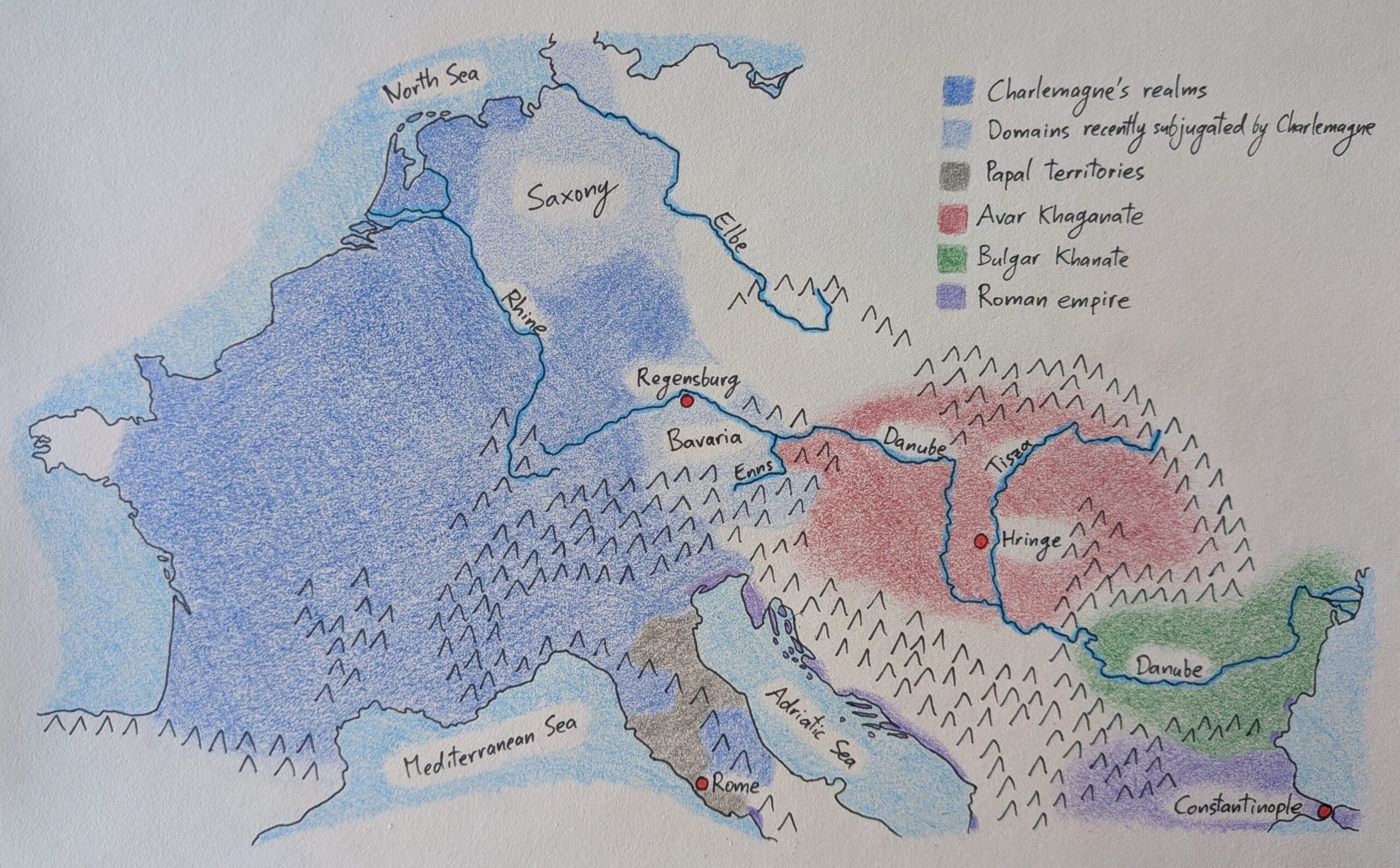
I shifted the perspective westwards when compared to our usual maps in order to fully show the immensity of Charlemagne’s domains. After decades of campaigning, the Frankish king had expanded his dominion from the Atlantic to the Adriatic and became the most powerful ruler in the region in centuries.
Two territories of particular interest for our story are Saxony and Bavaria. Charlemagne had campaigned against the Saxons for years until, in 785, he had defeated their armies and forced their leaders to swear fealty to him. Three years later, in 788, he had orchestrated the deposition of the duke of Bavaria, which allowed him to acquire the duchy for himself. In this way, Charlemagne had consistently pushed the boundaries of his realms further east and, inevitably, came to border the khaganate.
Charlemagne’s realms completely dwarfed the khagan’s. Their common border was the Enns river. Beyond it were forests and plains interspersed with Avar forts which protected settlements further east. In the middle of the realm, between the Danube and Tisza rivers, lay the khagan’s capital; we don’t know how the Avars referred to it, but the Franks called it the hringe, meaning “ring,” which was an allusion to its concentric fortifications.
Also worth noting on the map are the papal territories in central Italy, which had been gifted to the bishop of Rome by Charlemagne’s father. Though the pope administered these territories on his own, he was little more than a Frankish vassal; the pope depended on Charlemagne’s approval for his position as bishop of Rome and was entirely reliant on him for protection against hostile neighbours. As such, Charlemagne had a great deal of influence over the pope and could convince him to support his political ambitions with his religious authority.
Transcript
Hello and welcome to A history of Romania.
Season 2, episode 15: Staring down the colossus
Last time, we explored how the Avar khaganate evolved in the eighth century, diving into its economy, culture, and political structure. We also introduced Charlemagne, the Frankish king who had conquered northern Italy and taken the crown of the Lombards for himself.
Charlemagne was a conqueror at heart. He spent nearly every year of his reign at war to expand his realm, and nothing illustrates his bellicose side better than his campaigns against the Saxons. The Saxons were a Germanic people whose communities lay between the Rhine and Elbe rivers all the way up to the North Sea coast. They weren’t politically united, but were instead governed by several local chieftains of equal rank; what united them was their language, culture, and polytheistic religion. Their westernmost communities bordered the Frankish realm, and sometimes, bands of Saxon warriors ventured beyond the frontier to raid, and in turn, Frankish forces retaliated with raids of their own. As such, this borderland was rife with thefts, murders, and arsons perpetrated by both sides.
Charlemagne’s biographer, Einhard, says that “the Saxons … were a fierce people given to the worship of devils and hostile to our religion, and did not consider it dishonorable to transgress and violate all law, human and divine.” Einhard here gives voice to the Frankish view that the Saxons weren’t just another enemy, like the Lombards had been; they were barbarians who disregarded all customs and laws in defiance of God himself, and who could not be trusted to live as decent neighbours. It was therefore Charlemagne’s duty as a Christian king to stop their transgressions and to bring them into the faith—whether they wanted to or not.
And so, after vanquishing the Lombards, Charlemagne turned his full attention towards the Saxons. He assembled his forces and campaigned against them for several years until, by 777, the Franks had defeated most Saxon forces and destroyed their sacred religious sites. Recognizing that they were beaten, a number of leading Saxons came before Charlemagne, offered him their submission, and agreed to be baptized. Yet one Saxon leader refused to surrender and fled to Denmark to restore his forces. Five years later, he mounted a surprise attack on the Frankish garrisons in Saxony, and in response, Charlemagne ordered the beheading of 4,500 Saxon hostages. That heinous act was the start of a ruthless and relentless three-year campaign against the Saxons. By 785, Frankish forces had prevailed, and the leader of the Saxons surrendered and agreed to be baptized, with Charlemagne as his godfather. Einhard recounts that: “A great many of the Frank as well as of the Saxon nobility, men occupying the highest posts of honor, perished in this war … No war ever undertaken by the Frank nation was carried on with such persistence and bitterness, or cost so much labor”.
But the Saxons were not the only people of interest on the eastern frontier. You see, to the south lay the duchy of Bavaria, a region which roughly covered the eastern Alps and the forests to their north. I’ve included a map in this episode’s description with all the main locations we’re about to discuss.
In the 780s, the duchy of Bavaria was ruled by Tassilo, a cousin of Charlemagne who had been installed as duke of the region by Charlemagne’s father. Tassilo had recognized the Frankish king as his suzerain, but had been allowed to pursue his own internal and external policies independently. For instance, after Charlemagne’s father had left the Lombards in peace to go campaign elsewhere, Tassilo had married the daughter of the Lombard king to strengthen his own position. Two decades later, Charlemagne himself invaded Italy and did what his father could not: fully defeat the Lombard king and claim his crown. But there was one problem: since Tassilo was married to the daughter of the last Lombard king, his sons had a much better claim to the throne than Charlemagne.
The Frankish king felt he could not have anyone competing with him. And so, in 781, he marched his army through Bavaria and demanded that Tassilo swear fealty to him and hand over hostages. Tassilo’s army was much smaller, so the duke had little choice; he swore an oath to support Charlemagne and sent him his eldest son and heir as a hostage. With this act of submission, the duchy of Bavaria was effectively incorporated into the Frankish realm.
That was bad news for the Avars, because Bavaria directly bordered the khaganate. And you see, the khagan and his advisors had been closely following Charlemagne’s advances over the past decade; first, he had vanquished the Lombards to their south, who had been allied to the Avars for over two centuries; then, he had fought relentlessly against the Saxons to their north; and now, he had subjugated the Bavarians to their west. The Avars were seeing a pattern; Charlemagne was keen on expansion and gave no sign of slowing down. If nothing changed, then they might become his next target. And so, the following year in 782, the khagan gathered his co-ruler, the iugurrus, and his senior advisers, and told them to rally their warriors. The Avars needed to show the Franks the might of their men, and that if they were foolish enough to invade, then they would be swiftly defeated.
The khagan saddled his horse and camped his army on the banks of the Enns River, which marked the border between the khaganate and the Frankish kingdom. At the same time, he sent envoys to Charlemagne to negotiate a treaty which would regulate relations between them. In effect, the Avars combined an offer of peace with a threat of war. They didn’t want to attack the Franks; they simply wanted to come to an agreement that kept them on that side of the river. But the sources tell us that when the Avar envoys arrived, Charlemagne merely “heard and dismissed them.” Clearly, the Frankish king wasn’t intimidated by the khagan’s show of strength, and he declined to make a treaty with them. By refusing to be bound by an agreement, he kept the option open to go to war when it best suited him.
Thankfully for the Avars, over the next few years, Charlemagne was preoccupied with the Saxons and affairs in Italy. Only in 788 was he able to turn his attention back to his eastern frontier. The Frankish king was not satisfied with having the duke of Bavaria, Tassilo, as his vassal; he wanted to completely remove him as a dynastic threat and to gain his duchy for himself. And so, Charlemagne accused Tassilo of having made a pact with the faithless Avars. Tassilo probably did no such thing, but Charlemagne wasn’t going to let that scrap his plans. He got the pope on his side and, at an imperial assembly, made sure the duke was deposed and sent to a monastery, after which the duchy of Bavaria went to the king.
The khagan listened to reports of this exchange with deep apprehension. Tassilo had been deposed for the simple crime of associating with the Avars. It was clear that, in the mind of the Frankish king, the Avars were an enemy that would need to be dealt with sooner or later. The khagan realized that it would be foolish to let Charlemagne strike at the moment of his choosing; no, if he were to have any chance against this colossus, he needed to take the initiative. So what were his options? Well, Charlemagne had refused a peace offer and had been unphased by a show of force, so the khagan decided that it was now time to escalate.
In 788, the Avar army assembled again. This time, though, it didn’t camp on the Enns River; one contingent headed for the city of Friuli in Italy, and the other, for Bavaria. The idea was to launch a pre-emptive strike before the Franks had a chance to invade the khaganate; in this way, Charlemagne’s forces would be weakened, and he would be compelled to sign a settlement to avoid further hostilities. It was, in short, a surprise raid to avert a larger war. Unfortunately for the Avars though, neither one of their forces found much success; they did pillage the countryside in Bavaria and northern Italy, but they were unable to take any towns, and were repulsed by local forces on both fronts. Later in the year, they regrouped and mounted another incursion into Bavaria, but they were, once again, defeated. These were not promising signs. Even with the element of surprise, Avar warriors had been bested in battle three times in a row; clearly, they were not the terror their forefathers had once been.
After these defeats, the Avars were unable to mount further attacks, either because they had lost too many warriors or because their confidence was shaken; in any case, they decided not to pursue hostilities, and sent envoys to the Frankish court. In 790, they sought to discern “the borders of the kingdoms and where they ought to be” to secure a lasting peace. But the Frankish elite wasn’t open to negotiations; they sensed weakness and felt it was now time to deal with the Avars once and for all. The recent Avar raids could’ve been a cause for war, but interestingly, they didn’t come up as a point of contention during discussions, suggesting that the Frankish court didn’t see them as noteworthy. Instead, they focused on the borders. Charlemagne claimed that a considerable amount of land east of the Enns River was rightfully his. This was an obvious lie, but that was exactly the point. The Avar envoys predictably refused to hand over any of their territory, and so the Frankish king gained his casus belli.
The following summer, in 791, Charlemagne held court at Regensburg, the capital of Bavaria, and gathered contingents of Franks, Saxons, Frisians, Thuringians, Bavarians, and even Slavs. The king gave a rousing speech arguing that the Avars were faithless, malicious, and had to be punished. You see, the Avars were the ideal barbarians, even more so than the Saxons. Not only did they reject Christianity, but they were one of the many peoples who had, over the centuries, raided the territory over which Charlemagne now ruled—peoples like the Goths, Vandals, and Huns. It was thus Charlemagne’s duty to avenge Christendom and put an end to these barbarian depredations. It didn’t matter that the Avars didn’t actually pose a threat to the Frankish kingdom, nor that they had tried several times to secure a lasting peace with the Franks. No, this was a war of expansion.
In the months that followed, the Frankish king ordered his commanders to prepare their troops, build a fleet capable of sailing the Danube, and bring in the harvest to provision the army. Then, late in the summer of 791, Charlemagne set off on his latest campaign. By September 5, the army reached the mouth of the Enns River, where they spent three days fasting and praying to gain God’s blessing for this great undertaking.
Thereafter, the army divided into two: the main force commanded by Charlemagne moved along the southern bank of the Danube, while a smaller force followed along its northern bank, and the Danubian fleet he had ordered to be built allowed the two contingents to keep in contact. The khagan did not dare to directly oppose this huge force, such that the Franks faced no resistance as they travelled along the river. Only once they were deep inside the khaganate did they encounter two Avar forts, which shows just how far the Avars had moved from their nomadic roots towards sedentary life. Yet the forts didn’t prove to be an obstacle; the Avar garrisons fled since they were far outnumbered, and so the invaders easily captured and burned their fortifications. From here, it wasn’t long until Charlemagne’s army crossed the boundary into the former Roman province of Pannonia and encountered Avar settlements. His forces plundered their valuables, captured their inhabitants, and burned their buildings and fields—yet still, the Avar army was nowhere to be seen.
The only impediment to Charlemagne’s advance was a pestilence that affected the army’s horses. The disease had been spreading and getting worse for weeks, such that, by this point in the middle of October, chroniclers report that “hardly one tenth of all the horses for the troops were said to have remained.” This pestilence had most likely already spread amongst the Avars as well, and since they relied much more on horses than the Franks, it had a much bigger effect on their fighting ability. The impact of this disease might well explain why the khagan had offered no resistance; his army had been decimated at the worst possible moment just as the khaganate was being invaded, and he might’ve judged that it would be suicide to engage in battle. He might’ve thought it better to withdraw and let the invaders deplete their supplies and be sapped by the increasingly cold weather.
On the opposing side, Charlemagne knew nothing of this and still expected to meet the Avar army at some point. But with his own army severely weakened, he decided that it was safer to return home rather than to continue campaigning into the winter. And so, the invaders turned around and made it back on their soil by the middle of November before the first snows fell.
The campaign was underwhelming for Charlemagne since he had not delivered the decisive blow he had imagined; though he had breached the khaganate’s border defenses, the khaganate itself still stood. It was, in a way, a win for the khagan. But that’s not how his followers saw it. The Avar ruler had been unable to stop an invading army from devastating his realm—had not even taken the field to defend his people. The khagan’s prestige thus took an immense blow, and his credibility as a ruler was permanently damaged.
Charlemagne stayed in Regensburg until the end of 793 to prepare another invasion, one that would finally finish the khaganate. But before he could restart operations, the recently subjugated Saxons rebelled, and his eldest son rose in revolt as well. These internal crises forced the Frankish king to postpone his Avar ambitions, but this reprieve didn’t much help the khagan. You see, after the invasion of 791, many Avars had lost faith in him and came to believe that the Franks were too powerful to defeat. They began to wonder whether their leader was still capable of bringing them victory, and their answer seems to have been a decisive, “No.” And so, soon after Charlemagne’s invasion, civil war erupted within the realm as some nobles broke with the khagan and sought to secure their own position.
Unfortunately, we have no details about this conflict; the shroud only lifts four years later in 795, when Charlemagne received envoys from a certain Avar tudun. If you’ll recall from last episode, the tudun was a noble who ruled over his own “populus,” or people, within the khaganate. Now, he offered himself, his people, and his land to the Frankish king, and said that he wished to accept the Christian faith. But this was not a heartfelt conversion. Rather, the tudun understood that it was only a matter of time until Charlemagne could turn his attention back to the khaganate; and with the Avars fighting amongst themselves, they had no chance against him. Instead of waiting to be defeated, the tudun sought to associate himself with the victor immediately to get the best possible terms.
Charlemagne of course told the envoys that he accepted the submission, and he took the tudun’s defection as a sign that the khaganate was disintegrating. His plan now was to destroy the khagan’s capital; by rooting out the core of the khaganate, the whole structure surrounding it would collapse, and he could then walk in triumphantly to arrange the realm as he saw fit. The first thing to do was to actually find the capital, a mission which he entrusted to a certain Woynimir, a Slav who had risen high in the Frankish army and who was intimately familiar with the Avar realm. In the autumn of 795, Woynimir led a group of seasoned warriors across the Enns River and rode at lightning speed all the way to the Avar capital—the khagan’s hringe. This scouting party was even more successful than they had anticipated. The garrison of the hringe was taken completely by surprise, and Woynimir’s warriors were able to breach its defenses and steal part of the immense treasure held therein. If the khagan had seemed impotent before, this incursion sealed his fate.
The following year, in 796, the tudun appeared before Charlemagne in person, swore him allegiance, and accepted baptism. In return, he was given lavish gifts and made a vassal, with his fief being the part of the khaganate west of the Danube. Soon afterwards, Charlemagne ordered one of his sons to invade the khaganate; the idea was to follow in Woynimir’s footsteps, but this time, with a larger army that could actually capture the hringe. This army set out immediately and met no resistance on its march into the khaganate; the lack of response this time wasn’t due to pestilence, but because no one had the forces nor the desire to oppose the Franks.
In fact, as the invaders made camp on the banks of the Danube, a new khagan came to meet them, requesting an audience. You see, the khagan who had originally opposed Charlemagne had come into open conflict with his co-ruler, the iugurrus, and at some point in 796, both men were killed in the fighting. We have no details about their demise, but we know that afterwards, a new man claimed the position of khagan and decided to rule alone. This new leader understood that he could not resist the Franks and that he needed to get on their side immediately. Remember, there was still a full-blown civil war happening between the Avar leadership, and since the tudun had already submitted to Charlemagne, the new khagan would have to fight the tudun as well as the Franks. But if he too submitted to Charlemagne, then the Franks would have to stay neutral, and he’d be on more equal footing with his rival. And so, the new khagan came before Charlemagne’s son with his spouse, family, and followers, and swore to serve the Frankish king.
Yet not all Avar nobles were rushing to bow before the Franks. After all, the invaders had only made it as far as the hringe—they hadn’t even set foot in the eastern regions of the khaganate beyond the Tisza. Plus, they hadn’t won a decisive battlefield victory; the defeat of the Avars came from their own infighting. As such, some Avar nobles figured there was a good chance they could maintain their independence in the mountainous regions of the Carpathian Basin, since the Franks might not ever make it that far. These nobles were probably led by the kapkhan, a high dignitary who officially controlled part of the khaganate even before the civil war, and who now took his followers East beyond the Tisza to wait things out.
At this point, the khaganate practically disintegrated. From its very beginning in the sixth century, the Avar polity had been predicated on the idea that the khagan was the supreme leader ruling a united realm, and an integral part of Avar identity had been loyalty and service to the khagan. Yet now powerful Avar nobles, like the tudun in the west and the kapkhan in the east, were openly defying the authority of the khagan. The once mighty and feared Avar realm split into several principalities, each led by a noble looking to secure his own position.
After receiving the new khagan’s submission, Charlemagne’s son crossed the Danube and occupied the abandoned hringe, where he found the immense treasure accumulated by generations of khagans. After loading it up on carts, he burned the whole complex to the ground, turning it, as contemporary observers put it, into a desert. Gutting the core of the khaganate in this way was the ultimate triumph of the Franks over the Avars. Einhard relates: “Charlemagne’s greatest war, apart from that against the Saxons, was the Avar war; it was conducted with more fervor and greater force of arms than all the others.” That’s quite the praise, especially considering that the Franks had not won any major battles; and they had not even integrated the khaganate into their realm, since the lands west of the Danube were ruled by autonomous vassals, whereas those to the east were still independent. So why was this Charlemagne’s second greatest war?
Well, for two reasons: the first was material. Einhard says: “human memory cannot remember any war that had been waged against the Franks in which these were more enriched and their resources were increased more.” Indeed, the plunder of gold, silver, and silks which Charlemagne’s son had captured filled 15 wagons, each pulled by four oxen. Charlemagne distributed these impressive riches to his nobles, bishops, abbots, even the pope, and used them as diplomatic gifts and to decorate his palace. It was the single greatest injection of wealth Charlemagne had received from any of his conquests.
The second reason why the Avar war was so important is symbolic. In his text, Einhard calls the Avars “Huns,” which is a deliberate choice. He of course knew they called themselves Avars, and indeed, other Latin sources refer to the khaganate as “Avaria,” or the land of the Avars. But Einhard used the word “Hun” because it sprung a powerful image in the reader’s mind, namely Attila the Hun and his ravages. Einhard writes: “So many precious objects were taken in this war, that it might be fairly said that the Franks had justly seized from the Huns what the Huns had unjustly seized from other peoples.” Here, Einhard intentionally combines Attila with the khagan; it’s as if the Avars had inherited the Huns’ treasure and continued their raiding, such that the deeds done by Attila the Hun might as well have been done by the Avar khagan. And what were these deeds? Well, everyone knew that Attila had plundered the lands of the Romans. And now, Charlemagne, who ruled a significant portion of their once great empire, had avenged the Romans by taking back that wealth.
Einhard’s allusion to the Roman empire was no coincidence, because the Frankish court was actively trying to claim the legacy of the Romans. You see, just a few years after defeating the Avars, Charlemagne travelled south of the Alps to the city of Rome to celebrate Christmas mass. At that gathering in the final days of the year 800, as Charlemagne was surrounded by his nobles and bishops in Saint Peter’s Basilica, the pope crowned him Augustus and imperator Romanorum, meaning emperor of the Romans. Now that’s a pretty huge declaration, because there already was an emperor of the Romans, and he lived in Constantinople. Moreover, the office had never been granted by a religious authority; since the time of Augustus to the present moment, it had always been conferred by a previous emperor or the Roman army, and technically, by the Senate and people of Rome. So, on what authority did the pope create a new emperor? Well, as we saw last episode, the pope claimed that, since he governed the city of Rome and its inhabitants, the Romans, he could speak on their behalf as their legitimate representative. It’s how he justified granting Charlemagne the title of “patrician of the Romans,” one of the highest offices in the empire. From there, it was only logical to conclude that the pope could grant any imperial title he wanted, including the highest one.
There had been a time when the empire had two emperors, one governing the West and one, the East. The eastern emperor had always been the senior one in that relationship and, in the last decades of the western Roman empire, had even gained the prerogative of appointing his junior partner. When the western half of the empire finally collapsed, the eastern emperor had simply become the emperor, and had since ruled alone. Charlemagne could’ve approached him to suggest that he be elevated to the imperial rank; the two men would then become partners governing a symbolically reunited empire. But that’s not what happened. There had been no discussions with the court in Constantinople before the coronation, and the pope had not crowned Charlemagne as “western emperor” but as “emperor of the Romans,” the exact title of the monarch in Constantinople. That was a brazen claim. After three centuries with a single emperor, the Romans saw the office as being unique and supreme; the emperor received his mandate from God and technically held sway over all Christians, as had been the case when the empire was still whole. It made no sense to have two emperors, because supreme power could not be divided. And so, by being crowned emperor, Charlemagne didn’t become a partner, but a rival to the emperor in Constantinople. Charlemagne implicitly rejected his legitimacy as God’s representative on Earth and attempted to displace him as the leader of the Christian world.
So how did this momentous event come about? In his biography of Charlemagne, Einhard says that the Frankish king would not have entered Saint Peter’s Basilica if he knew the pope had wanted to crown him emperor. Historians have long debated whether or not this is true; I personally find it hard to believe that he didn’t know about the coronation beforehand. You see, Charlemagne visited Rome only four times in his forty-six-year reign. The first was to confer with the pope after he’d taken the title of king of the Lombards; the second was when his sons were crowned kings; the third was when he was campaigning in Italy; and the fourth was when he was crowned emperor. Only one of these trips was justified by a military campaign; the others were connected to acquiring a monarchic title. And in fact, the last trip was infused with imperial symbolism.
On his approach to the city, Charlemagne met the pope at the milestone where emperors traditionally began their procession into the city. And on the fateful day, the nobles and clerics assembled in Saint Peter’s Basilica did their best to replicate the elevation of the Roman emperors in the East. During such ceremonies, the emperor was crowned by the patriarch of Constantinople and then acclaimed by various dignitaries, who represented the army, Senate, and people of Rome. Now in Saint Peter’s Basilica, the pope placed the crown on Charlemagne’s head in imitation of the patriarch, and thereafter bowed before him, embodying his role as the representative of the Roman people who acclaimed him as their leader.
To me, all of this suggests that the two men had planned the coronation beforehand. As some historians have argued, the probable reason why Einhard said Charlemagne didn’t know about it is to make him look humble. The Frankish court understood that his coronation would be seen as insolent in the East, and so they concocted this story to protect his image, as if he had not even wanted the imperial title, but had only accepted it once it had been thrust upon him.
Of course, when the court in Constantinople heard about this coronation, they outright dismissed the claims of this usurper. In turn, Charlemagne’s court writers gave plenty of intellectual justifications for the move. They argued that the Roman throne was actually vacant since, for the first time, a woman sat on it alone, namely empress Eirene; this argument ignored the fact that the Romans had no issue accepting a woman as their ruler, and had recognized her as their legitimate leader. Frankish writers further argued that the Romans in the East were not actually Romans, but Greeks, since they spoke Greek and had abandoned the original imperial city; this argument conveniently overlooked the fact that Greek had long been spoken in the empire alongside Latin for centuries, and that the first Christian emperor, Constantine, had moved the capital of the empire to Constantinople.
But for all these legalistic justifications, the real reason behind Charlemagne’s coronation was quite simple: he had more power than the title of a king could hold. After decades of near constant fighting, the Frankish king had expanded his territories tremendously, had converted heathens, issued wide-ranging laws, funded cathedral schools, patronized scholars, and sponsored monumental buildings. In short, Charlemagne was acting like an emperor, and he wanted the title that went with it. I also suspect that he might’ve been thinking about his succession plans; Frankish tradition dictated that the monarch’s realm be divided equally between his sons, and Charlemagne must’ve hated the idea of breaking up the immense realm he had amassed over the course of his life. But with a single title holding it all together, one son could continue his life’s work, while his other sons would still get a share of territory within a unified realm.
The title of emperor gave Charlemagne unprecedented prestige and authority, and his past imperialist acts of expansion now gained an ideological justification, namely that he was the true heir of the ancient Roman empire.
Yet even as the Frankish court was celebrating the elevation of an all-powerful emperor of their own, reality didn’t quite match expectations. Already, reports were coming from the East that the Avars had risen in rebellion. The tudun, who had been the first to submit to Charlemagne, now rejected his rule, and his act of defiance soon sparked a general uprising against Frankish rule in the former khaganate.
Next time, the Avars will try to regain their independence, but will have to fight on two fronts, as the Bulgar khan will cross the Carpathians to exploit their moment of weakness.
Leave a Reply