The fall of the Avar khaganate brought immense changes in the Carpathian Basin. By the middle of the ninth century, new powers had emerged and were competing with existing players to secure a place for themselves in the region.
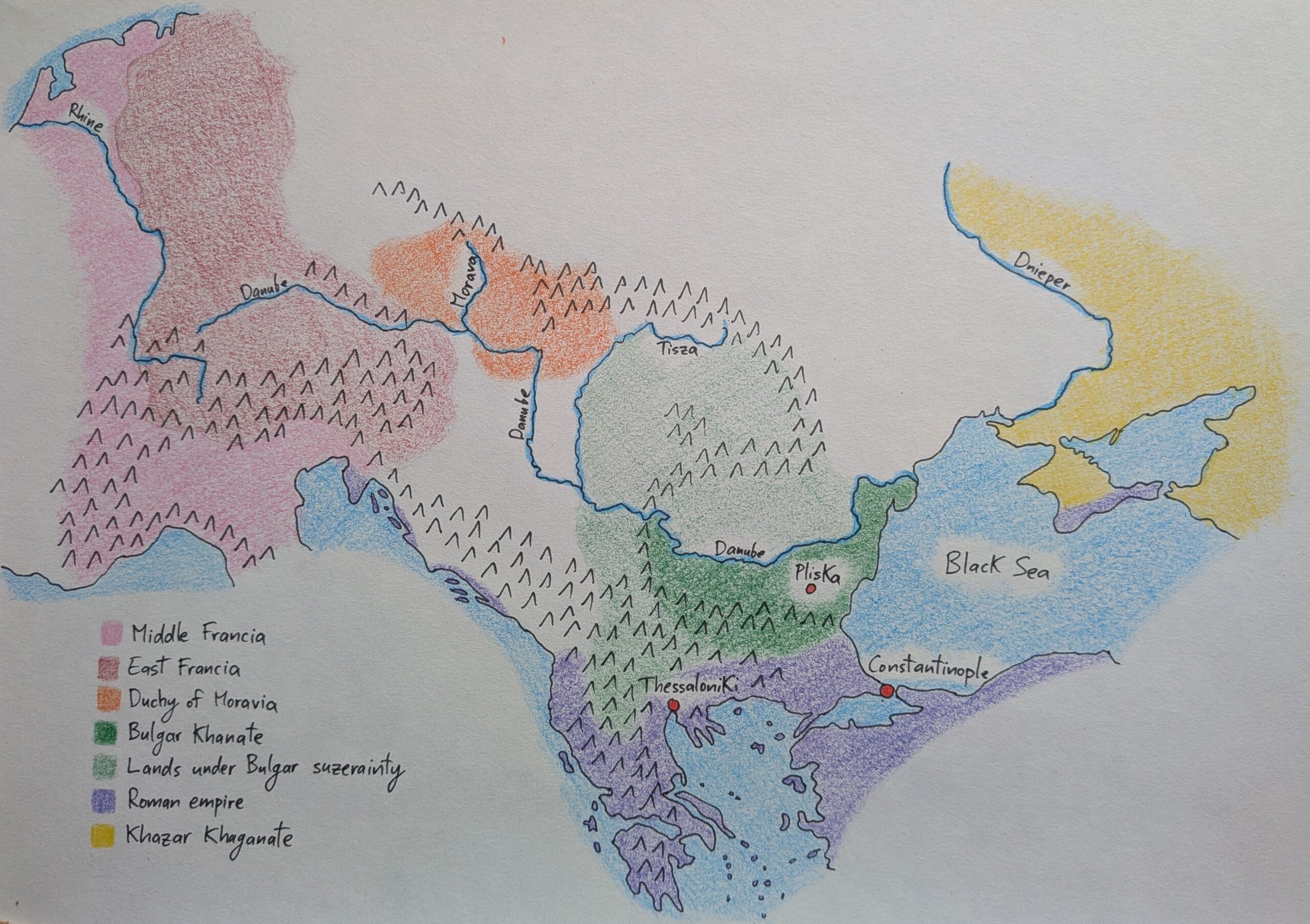
In the West, Charlemagne’s three grandsons partitioned the Frankish lands between themselves, dividing them into a western, an eastern, and a middle portion. The idea was that each brother ruled one part of the land of the Franks, with the king of the middle portion also enjoying the title of emperor to maintain the unity of the realm.
On the border of East Francia lay the duchy of Moravia, a Slavic state which emerged in the early ninth century. The borders of the duchy are still debated, as is the site of its court. However, we know that the Moravians erected several imposing strongholds along Morava valley and that, by the middle of the ninth century, they had even subjugated communities on the plains south of the Danube.
East of the duchy of Moravia lay the Bulgar khanate. In the 840s and 850s, its leaders had undertaken several successful campaigns against the Romans and the Slavs of the southern Balkans. In effect, the emperor lost his hold over the Slavic communities living north and west of Thessaloniki, which were now forced to recognize the khan’s authority.
Yet the Romans were not all at a loss. Though they lost Slavic subjects to the Bulgars in the mountainous interior, they solidified their control over the entire coast of the Balkan peninsula. By the middle of the ninth century, they had subjugated the Slavs who had settled in Thrace, Macedonia, Thessaly, Epirus, Central Greece, and the Peloponnese, and had firmly integrated them into the empire’s administrative system.
At the same time, the empire maintained a presence in Crimea, specifically with the cities of Cherson and Bosporus, which allowed them to monitor threats coming from that direction. The biggest threat was the Rus’, a name for Scandinavian explorers who sailed the rivers of eastern Europe, pillaged the weak, and traded with those who could defend themselves.
The Rus’ had settled on the coast of the Baltic Sea and were actively subjugating Slavic communities along the Dnieper river while raiding imperial cities on the coast of the Black Sea. Their belligerent approach prompted the Khazars and the Romans to ally in a bid to protect themselves.
Leave a Reply