Romanic and Slavic communities both north and south of the Danube continue to influence each other, as neighbours become bilingual and introduce subtle shifts in their respective languages. Meanwhile, as these two cultures mingle, a prominent Bulgar chieftain flees the Khazar threat with his followers, seeking a new homeland — which leads them right to the Danube.
The Balkans welcomed a new player in the late seventh century with the arrival of Asparukh’s Bulgars, who were fleeing the Khazar invasion of their steppe lands. The Khazars ruled a khaganate which ran from the Caspian Sea in the east to the Dniester River in the west, and from the Caucasus Mountains in the south to far along the Volga River in the north.
Asparukh’s Bulgars escaped Khazar attacks and found refuge in Dobrogea, meaning the area bounded by the Danube to the north and west, the Black Sea to the east, and the Balkan Mountains to the south.
The Roman empire sent an army to evict them, but its forces were defeated in the marshes of the Danube delta and were chased all the way to the city of Odessos, with serious losses.
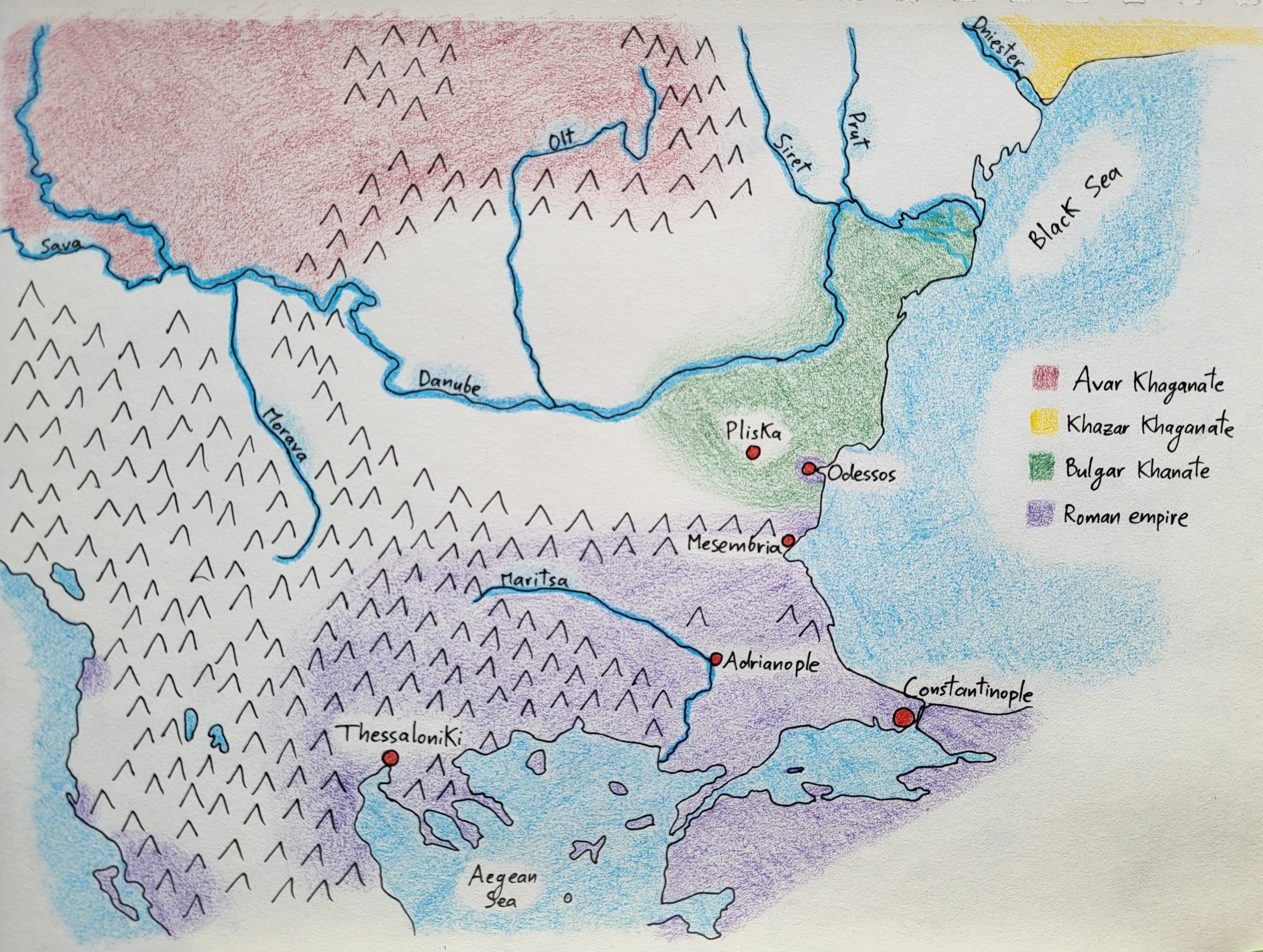
The two sides thereafter signed a pact in 681, which is reflected by the map above. The Roman emperor would pay the Bulgars an annual tribute to keep the peace, as well as recognize their right to settle in Dobrogea. The frontier between their two realms was set at the Balkan Mountains, just north of the Black Sea city of Mesembria.
However, the Romans kept control of the coastal city of Odessos and its hinterland in Dobrogea; though the city was severed from its land connection to the rest of the empire, its port ensured it maintained its links with Constantinople. Meanwhile, the Bulgar leader Asparukh set up his main camp, Pliska, a two-day ride away from the city of Odessos to quickly respond to any threats and also to be near Roman representatives for any potential trade or military negotiations.
Note that, on the map, I haven’t drawn borders as rigid lines; instead, I’ve represented them as diffuse boundaries. The reason is because, especially in this time period and in this region of the world, frontiers weren’t firmly fixed.
We’re no longer in the era of the ancient Roman empire with its limes clearly demarcated by outposts and forts staffed by legionnaires, where the boundary between “empire” and “barbarian” was distinct and enforced. Polities in the seventh-century Balkans didn’t have the resources to closely police their borders. Cities, forts, rivers, and mountains were regarded as boundaries, but in between them, people could move, trade, and interact quite freely, since authorities simply didn’t have the resources or reach to control their actions in these border areas.
And so, on the map, I’ve drawn diffuse frontiers for the Roman empire near Thessaloniki, the Bulgar khanate near Pliska, and the Avar khaganate along the Carpathians as a visual representation of the fluidity of borders.
Transcript
Hello and welcome to A history of Romania.
Season 2, Episode 10: Melting pot
Last time, we saw the khaganate in full transition after the failed siege of Constantinople. With subsidies no longer streaming in and raiding halted to focus on propping up the regime, Avar warriors could only enrich themselves by gaining the favour of the khagan; but with fewer riches to go around, the size of the elite warrior class shrank, and many had to turn to herding and even farming to sustain their families. At the same time, the khagan was struggling to keep his subjects in line. We saw how the Sermesianoi, those Roman descendants who had mingled with the nomads, had rebelled against the khagan and left his realm to seek their fortunes in the empire.
Today, we’ll talk about those native Romanics who didn’t mingle with the nomads, but who instead kept their distance and forged closer ties with their sedentary neighbours.
As we saw in episode three, the Romanics of the Balkans spoke Eastern Romance. This language originated from Vulgar Latin but, by the early seventh century, it had evolved from those roots to become its own tongue. If we look at phonetics, for instance, the Latin /ks/ sound had developed into /ps/, such that the word for “thigh,” which in Latin is “coxa,” had by now morphed into “coapsă.”
Eastern Romance was also distinctly different from its cousins in the former western Roman empire. Let’s compare Romanian, which is a descendant of Eastern Romance, with French, which is a descendant of Western Romance. These two cousins have different approaches to determiners, meaning the words which introduce nouns, like “a horse,” “the horse,” or “my horse.” In French, “the horse” is “le cheval,” where the determiner “le” comes before the noun, “cheval.” In Romanian, that structure is reversed. “The horse” is “calul,” where the determiner “ul” comes after the noun, “cal.” So here we have determiners used in two ways – one before and the other after the noun – which gets us “le cheval” versus “calul.”
We could look at dozens of examples of how Eastern Romance evolved to be distinct from both its Vulgar Latin roots and from its Western Romance cousins, but I don’t want to get too deep into linguistic details because otherwise this episode would be too dense. The point I want to make, though, is that by the early seventh century, the Romanics of the Balkans had their own language with its own unique character.
Their language wasn’t static though, and its next evolution came in the form of Slavic influences. The Slavs had settled over a huge area, from the Black Sea to the Alps, and had even raided imperial territory and settled on abandoned land as far south as Greece.
Of course, we shouldn’t imagine that Slavic settlements were uniformly distributed over this immense area; rather, we should visualize pockets with lots of Slavic villages alongside gaps where such settlements were absent. In areas both north and south of the Danube, the Slavs often lived close to the Romanic communities of the region, traded with them, worked alongside them, and sometimes even married into them. Naturally, their customs somewhat influenced the dominant Romanic culture, and elements from the Slavic language made their way into Eastern Romance.
To better understand this process, let’s imagine a Romanic village sprawled along a river, and a Slavic one a bit downstream from it. Due to their proximity, members from both communities would frequently come across each other. Slavic and Romanic fishers would meet at dawn as they both converged towards the best fishing spots; a Slavic farmer might, from time to time, come to the blacksmith in the Romanic village to sharpen his plough in exchange for some barley; and a Romanic shepherd might head to the Slavic village to buy a puppy from a renowned breeder to train as his new herding dog. In these everyday matters, people would initially use gestures to make themselves understood; and slowly, a Slavic farmer might pick up the Romance word for plough, and a Romanic fisher might grasp the Slavic word for rowing. With each interaction, people would come to know another word, and another, and another, and eventually be able to cobble together a sentence in the other’s language.
In time, such intermittent contact would become regular. Say you’re a Romanic shepherd and you’ve gotten into the habit of going to the nearby Slavic village to barter some of your cheese for wheat every autumn after the harvest. Having done the circuit for a few seasons, you’ve become friends with a particular Slavic farmer and share a wineskin with him whenever you meet. Your son is there with you too on these trips, to help you carry the produce back and forth, and so as you hang out with your Slavic neighbour, your son hears you talk in Slavic, and is able to pick up the language a few decades younger than you have.
When your son grows up, you might let him negotiate with the farmer in Slavic, since he speaks the language just as well as his mother tongue. And maybe as he mills about the fields, your son takes a fancy to the farmer’s daughter, and she to him. One day, he works up the courage to take the farmer aside and ask for her hand in marriage. Given your longstanding friendship, the farmer has no objections. There’s a big gathering where both extended families mingle, with Romanic and Slavic individuals spending the day – and night – in each other’s company.
After this celebration, your son brings his wife to your village and makes a hut alongside yours for them to live in. They talk in one language or the other, casually switching between the two, and when they have children, they too are perfectly bilingual, able to speak to their grandparents in one village as well as in the other. In this way, within two or three generations of close contact – meaning by the middle of the seventh century – many people in both Slavic and Romanic communities had become fully bilingual.
But bilingual speakers often deviate from the norms of the languages they speak, integrating elements of one into the other. The biggest variations happen in the vocabulary they use, since that’s the most malleable part of a language.
Some words just spring more easily to mind in one’s own mother tongue, and so Slavs sometimes interspersed Slavic words into a sentence that was otherwise fully spoken in Eastern Romance. Some of these words were used so frequently that they were even adopted by native Romanic speakers, and eventually replaced the equivalent Latin ones. For instance, Romance speakers came to use the Slavic words izvor, meaning “spring,” ciocan, meaning “hammer,” and cocoş, meaning “rooster.” Other Slavic words were adopted for agricultural implements, household tools, names of animals and plants, foods, articles of dress, and natural phenomena. One particularly important borrowing is the word for “yes” – namely da. The substitution of such a fundamental word shows just how close and prolonged the links between these communities were.
What I find extremely interesting is that, in some cases, Slavic words replaced the same Latin terms in Eastern Romance that Germanic ones replaced in Western Romance languages. For example, the words for “rich” in Romanian, French, and Spanish don’t come from Latin; rather, Romanian uses the Slavic word bogat, while French and Spanish use the Germanic term for it, namely riche and rico. The implication is that some Latin words were unable to adapt in a bilingual situation, and so were abandoned, both in the West and East.
Sometimes, the meaning of a Slavic word was adopted for an existing Eastern Romance one. As an example, in the Romance of the Balkans, the word lume meant “light”, while the equivalent Slavic word, svetu, meant both “light” and “world.” Bilingual individuals transposed the meaning of the Slavic word onto the Romance one, such that the word lume came to mean “world” as well as “light,” just like in Slavic. The word itself didn’t change, but through a linguistic calque, its meaning did.
Slavs also had an influence on the phonology of the language, because, as they learned to speak Eastern Romance, they didn’t always pronounce words in a Latin manner; understandably, their pronunciation reflected their own mother tongue, and as they spoke their second language, they introduced some Slavic sounds into Eastern Romance. To take one example, the word for eyelash, gena (gena), slowly became geană (dʒanə). Another example is the introduction of the h consonant. While the sound did exist in Classical Latin, it disappeared in Vulgar Latin from which all Romance languages are derived. But the sound appears in loanwords from Slavic, such as duh for “spirit” or hrană for “food”; Romanic individuals learned to pronounce these words too, such that the h sound was reintroduced into their tongue.
Slavic also had an effect on the word structure of the language. Notably, several Slavic prefixes were adopted into Eastern Romance, liked ne- for negation, used in words like nevăzut, meaning “unseen.” Another instance is the intensifying prefix răs-, as in the word a răsfrânge, meaning “to refract”, from a frânge which means “to shatter.”
Yet even with all these influences, it’s important to remember that borrowings from Slavic did not change the fundamental Latin character of this Eastern Romance language; the biggest Slavic impact was on vocabulary, while the grammatical structure of Eastern Romance remained almost entirely Latin. In fact, you couldn’t form a sentence without using Latin words and elements. In linguistic terms, Slavic had the same influence on Eastern Romance that Germanic had on Western Romance languages. Just like the ancestor of French was influenced by Germanic but still remained a Romance language, the ancestor of Romanian was influenced by Slavic and still remained a Romance language.
This linguistic mingling was a complex yet spontaneous process. While we don’t have all the details, linguists think that, by the end of the seventh century, the Eastern Romance language was in a state of creative flux, changing and adapting while on the cusp of its next evolution.
As this mix of cultures was simmering on either side of the Danube, the pot was further stirred by a new player to the region.
As we saw last episode, the Bulgars living north of the Black Sea were embroiled in a bitter conflict against their nomadic Khazar neighbours. The Khazars had attacked them in a moment of weakness after the death of their leader, Kubrat. His son, Batbaian, had taken the mantle of rule and resistance against the invaders; yet after a decade of ferocious fighting, his forces were ultimately defeated sometime in the 670s and he was forced to yield to the will of the Khazars. His four brothers, however, refused to bow down and instead chose exile.
One brother named Kotragos crossed east of the Don River and migrated north with his followers along the Volga River. Another, named Asparukh, went west over the Dnieper and Dniester rivers and eventually entered Roman territory with his companions. The other two brothers remain nameless, but one is said to have sought refuge with the Avar khagan in Pannonia, while the other went to the empire in Ravenna. Though the legend of these five Bulgar brothers is ancient and widely accepted, modern scholarship suggests that these last two brothers may have been a later addition to the story, and in reality, there may have been only three: Batbaian who stayed in place and submitted to the Khazars, Kotragos who went to the Volga, and Asparukh who fled to the Danube.
It may be that some Bulgars had already settled near the Danube before Asparukh came to the area, but his arrival changed the dynamics of the region. See, Asparukh wasn’t just another clan leader in charge of a few families. He was the son of Kubrat, the man who had rebelled against the Avars and brought independence to the Bulgar people. His ancestry granted him a certain prestige, and when he arrived on the Danube with his warriors and their families, he was set on continuing his father’s legacy, and so styled himself khan, the traditional title of the Bulgars.
Though we don’t know exactly where Asparukh ended his flight from the Khazars, the best scholarly guess is that his followers settled in Dobrogea, meaning the area bounded by the Danube to the north and west, the Black Sea to the east, and the Balkan Mountains to the south. This region corresponded with the imperial province of Scythia Minor, which the Romans had held for seven centuries but which was not now what it had once been.
Its capital of Constantiana, formerly known as Tomis, had once been a metropolis of 25,000 people which served as a regional trading hub and whose bishop had attended the first ever ecumenical council held at Nicaea. But the Avar invasions at the beginning of the seventh century had been devastating for this provincial capital. As we’ve seen, the nomads had led huge hosts through the Balkans, letting their riders pillage the countryside while Slavic foot soldiers assaulted city walls with siege weapons built by Roman prisoners of war. Over two decades of continuous warfare, the Avars had breached most of the towns and cities in the Balkans, including those of Scythia Minor. Ancient cities on the Danubian frontier, like Noviodunum and Troesmis, had been the first to fall, and once those border defences had collapsed, towns in the interior, like Tropaeum Traiani, were easy prey.
The coastal cities, namely Istria, Constantiana, Callatis, and Dionysopolis, lasted longer because they could be provisioned from the sea, but even they suffered greatly. Avar forces managed to breach their walls, then ransacked their urban centers and captured their inhabitants before putting what remained to the flame. Those city dwellers who survived and managed to hide out so as not to be captured thereafter dispersed in the countryside, since they could no longer safely live in the smouldering ruins of their former towns.
And so, though Scythia Minor was still technically part of the empire, Roman administrators weren’t collecting taxes from its settlements, and its villages weren’t sending recruits to the army. When Asparukh arrived in the area in the late 670s, he found Roman villages scarred by decades of raiding, Slavic settlements that had sprouted on abandoned farmland, and towns and cities whose few remaining inhabitants eked out a living in burned-out buildings. His riders galloped across the land and forced all of these communities to recognize Asparukh as their ruler, pay him a tribute, and let his Bulgars roam and graze wherever they wished.
Asparukh’s riders didn’t encounter much resistance from the Roman state because the empire was fully preoccupied with a mortal threat: the unceasing advance of Muslim forces towards its capital. Ever since the explosive expansion of the caliphate in the 630s, Muslim warriors had raided the empire annually in hopes of bringing down the Roman empire as they had done the Persian one. As we saw last episode, a prominent Muslim general, Mu’awiya, had actually marched all the way to Constantinople in 654 and put it under siege before his forces were ultimately repulsed.
Mu’awiya had thereafter gone on to become caliph and, with all the resources of the Muslim world at his disposal, he redoubled his efforts against the Romans. Mu’awiya established a base of operations at Antioch from which he launched annual raids; throughout the 660s, his forces struck deep into the empire, far into Anatolia and along the Aegean coast. These attacks continued for more than a decade before Mu’awiya felt ready to strike at Constantinople itself. In the 670s, he began a methodical campaign to secure bases along the Anatolian coast and allow his forces to establish camps near the imperial capital, from which they could blockade it by both land and sea.
His forces did in fact set up bases along the coast of the Sea of Marmara and, starting in 672, they struck at Constantinople every spring, then withdrew to their fortified camps in the winter to renew their attacks the following year. The Romans endured such raids for five continuous years, all the while preparing to retaliate. In 677, emperor Konstantinos IV was finally ready to strike back; he equipped his ships with siphons carrying Greek fire, a highly flammable liquid which could burn even on water, and sent them to attack the Muslim fleet, while simultaneously, he sent an army on the other side of the Bosphorus to root out the Muslim ground forces. The Romans thus confronted the besieging forces directly – and won a resounding victory on both fronts.
With his fleet decimated and his army routed, Mu’awiya was forced to abandon his advance, and the Romans now took the initiative. Imperial forces repelled the Muslims from the environs of Constantinople, pushed them out of Anatolia, and pursued them beyond the Taurus Mountains in the vicinity of Antioch. For the caliphate, these defeats represented the first setback after four decades of continuous expansion. Mu’awiya was subsequently forced to sign a treaty in 680 in which he promised peace for thirty years while offering the emperor an annual tribute.
This was such a substantial victory for the Romans that even the Avar khagan sent them an embassy to congratulate them on defeating the Muslims – and to offer gifts as a gesture of friendship and good intentions. The khagan clearly wanted to ensure that the emperor would not point his victorious army his way. But he need not have worried; the two powers were now too distant to even have conflicting interests. Emperor Konstantinos simply gave the Avar envoys a bunch of soldi as countergifts and reaffirmed his “imperial peace,” thus emphasizing his superior prestige and position.
Having secured his empire from collapse, Konstantinos was now free to turn his attention towards his northern border. Asparukh’s Bulgars were still raiding rural communities across Scythia Minor when they learned that a full imperial army was on its way to face them. They hadn’t expected a response to come so quickly, and so were surprised, but they didn’t panic. Instead, the Bulgars retreated into the marshy swamps of the Danube delta and fortified their camp with wooden ramparts. Given the difficult terrain, the Romans weren’t able to engage them in an open battle; they had to trudge through swampland and so lost their momentum.
The emperor was set on finding a solution to draw them out, but as he was strategizing with his commanders, he was seized by an attack of gout, a disorder which swells the joints. Attacks come on suddenly and are extremely painful; a joint may feel like it’s on fire, and sufferers often can’t even stand the touch of a blanket. Konstantinos needed immediate treatment, and since the cities of Scythia Minor were now depopulated husks, he decided to leave the muggy camp and sail to the city of Mesembria 300 kilometers down the coast.
He left his commanders in charge of the campaign and told them to continue the siege of the Bulgar camp, but when the soldiers saw the emperor sail away, a rumour spread that he was actually fleeing back to the capital to escape an imminent battlefield disaster. Why else would he decamp in the middle of a war? Panic and confusion spread through the Roman ranks and soldiers began to pack up their belongings and abandon their positions to save themselves. Seeing the imperial army disintegrating, the Bulgars sensed a perfect opportunity to strike; they sprang from the marshes and attacked the retreating Romans, thus turning their withdrawal into a flight.
Thousands of soldiers were killed over the following days as imperial forces retreated southwards. Imperial commanders were unable to stop the flight and rally their forces, such that the Bulgars chased the Romans as far south as the city of Odessos. To avoid any more damage to his army, emperor Konstantinos finally decided to admit defeat and negotiate with Asparukh.
In the resulting treaty of 681, he agreed to pay the Bulgars an annual tribute to keep the peace, and recognized their right to settle in Dobrogea. This deal was a major loss for the empire, but more so for its prestige than its material circumstances. As we saw, the province of Scythia Minor was not sending any tax revenue or recruits to Constantinople. Rather, the main loss came from relinquishing the empire’s claim to Dobrogea and accepting an erosion of its boundaries; it was the first time since Augustus’ legions had reached the Danube seven hundred years earlier that the empire officially moved its frontier south of the river.
In contrast, the treaty was an immense victory for the Bulgars. First and foremost, they secured for themselves a territory where they would be safe from the ravages of the Khazars who had subjugated their homeland. Second, they were recognized as the legitimate authority of the region by the emperor, which allowed Asparukh to entrench his rule both over his followers as well as over the communities which were there before them.
Asparukh set up his main camp on the lowland plains between the Danube River and the Balkan Mountains about 70 kilometers from the Roman city of Odessos on the Black Sea coast. That meant his residence was only a two-day ride from the southern frontier established by the treaty, and indeed, the point was to be close to the Romans to quickly respond to any threats. This main camp, which came to be called Pliska, a name probably of Slavic origin, consisted of solid timber buildings and was surrounded by an earthen rampart. Similar fortifications had helped the Bulgars win against the Romans in the swamps of the Danube delta, and even though they were nomads unaccustomed to such structures, they clearly understood their utility and quickly took to them. Nevertheless, it seems that Pliska was a seasonal residence that was only temporarily occupied during the winter, since, for the rest of the year, Asparukh travelled from one location to another to keep a firm hold on his realm. I’ve included a map in this episode’s description to give you an idea of the Bulgar khanate at its foundation.
Next time, we’ll see the Bulgars entrench themselves further in their new homeland and enmesh themselves in Roman affairs.
Before we end today, though, I want to mention that the transcripts for all the episodes are now available on the website. The idea actually came from a listener, Peter, who wanted to be able to read the scripts to better absorb the information. I myself am more of a visual than an auditory learner, so I completely understand the usefulness of transcripts. Thanks for your suggestion, Peter.
I’ve also added a search function on the website so you can look up a specific episode number or search for a key term to get more information on a topic. You’ll find a link to the website in the episode description. I’ll see you in the next episode.
Leave a Reply