The khaganate is no more, having faltered in the face of external threats and fragmented along internal divisions. The Avars find themselves battered and scattered, under pressure from the Franks in the west and the Bulgars in the east, yet they nevertheless strive to forge a new homeland for themselves in the Carpathian Basin.
The map for this episode shows the Carpathian Basin in 805.
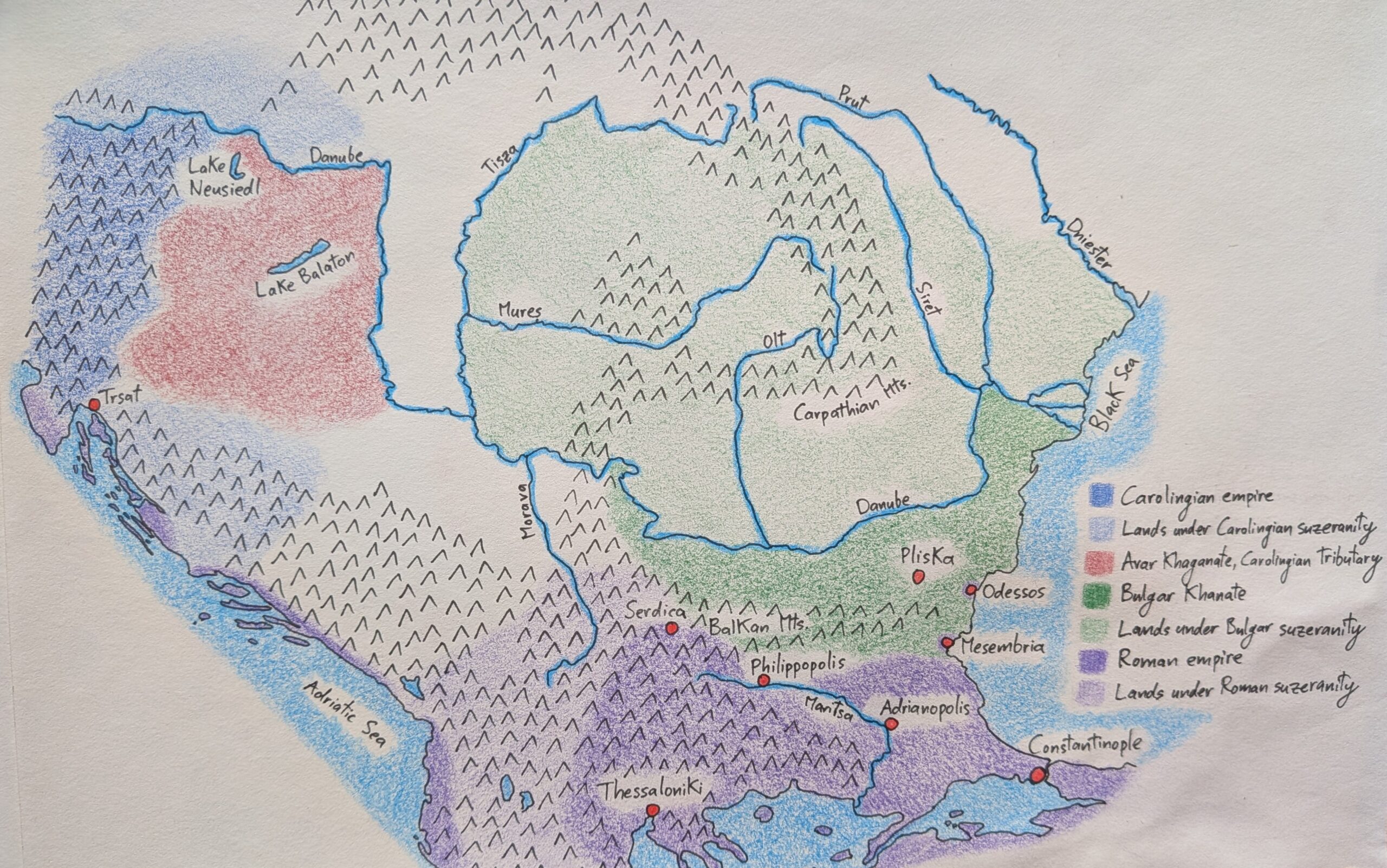
The Carpathian Basin had been politically united by the Avars for nearly two hundred and fifty years before Charlemagne invaded the khaganate and broke it apart. During that war, a high-ranking Avar noble, called the tudun, submitted to Charlemagne and was granted the lands west of the Danube as his fief, while another noble, the kapkhan, fled east beyond the Tisza to live independently.
A few years after the end of hostilities, the tudun rebelled against Frankish rule, hoping to regain independence for his people. He was defeated, however, and Charlemagne set to reorganizing the Avar lands he had conquered. In 805, he reconstituted the khaganate and appointed a new khagan loyal to him personally, who was tasked with providing tribute and protecting the eastern borders. This reforged khaganate was much smaller than the original, covering only the lands from the Alps to the Danube. To the north lived the Moravians, and to the south, the Croats, both of which also had to pay tribute to Charlemagne.
While Charlemagne clashed with the tudun, the Bulgar khan Krum took the opportunity to attack the kapkhan living in the Carpathian Mountains. His aim was to extinguish the last remaining independent Avar principality and to create a buffer between himself and the expansionist Charlemagne. Krum marched up the Olt and along the Mureș, defeated the kapkhan‘s forces, and demanded the submission of the communities he encountered.
Krum’s campaign into the Carpathians more than doubled the lands under Bulgar influence, but it’s important to note that the Bulgars only directly controlled the lands between the Balkan Mountains and the Danube. The communities north of the Danube—up to the Tisza in the west and the Dniester in the east—recognized Krum as their overlord, but otherwise enjoyed complete autonomy in their internal affairs. The Romanians, Slavs, and Gepids of the region continued to live much as they had for generations, tilling their own lands, adjudicating their own disputes, and celebrating their own festivals as they saw fit.
To the south of the Bulgar khanate lay the Roman empire, which had made considerable efforts in the last decades of the eighth century to expand its influence in the Balkans. Successive emperors had brought farmers from Anatolia to bolster the tax and recruitment base of the Balkan provinces, had fortified towns and built forts, and had sent armies into the interior to force the Slavic communities of the area to recognize Roman supremacy.
As such, at the beginning of the ninth century, the Carpathian Basin and the Balkans were divided between three powers: Charlemagne’s empire, the Bulgar khanate, and the Roman empire, each with core areas where they exerted direct authority and with more peripheral regions where their suzerainty was recognized by subject peoples. In between these three powers, communities lived without overlords, without the need to pay tribute to anyone nor to fight on anyone else’s behalf. Hundreds of Romanian and Slavic communities thus continued to live in independent villages as they had done for generations.
Transcript
Hello and welcome to A history of Romania.
Season 2, episode 16: A skull cup
Last time, Charlemagne invaded the khaganate, and the khagan was unable to oppose him. Avar nobles soon lost faith in their leader and sought to save themselves. One noble, called the tudun, submitted to Charlemagne and was granted the lands west of the Danube as his fief, whereas another noble, the kapkhan, fled east beyond the Tisza to live independently.
Charlemagne didn’t want to embark on a campaign in those faraway eastern lands, since there was little gain in doing so; he was content with extending his authority up to the Danube. But to make those gains permanent, he needed to actually integrate the Avars into his realm. The first step in doing so was to convert them to Christianity.
The clergy was keen on conversion for sincere, though condescending, reasons: they sought to save these ignorant heathens from damnation and to offer them eternal life in heaven. Their political rulers, on the other hand, saw conversion as a way to pacify the Avars, as they would henceforth adhere to the laws of the realm and respect Charlemagne as their rightful overlord appointed by God.
And so, when the Franks marched into the khaganate, they brought clerics with them to convert the conquered peoples. To their surprise, they encountered some Christians already living in the khaganate, who were led by “clericis illiteratis,” meaning illiterate clerics. I’ve actually already alluded to this event in episode five when we talked about the continuity of Christian communities north of the Danube. As I said in that earlier episode, local priests had lost the ability to read and write after the retreat of the Roman empire from the region, since texts naturally deteriorated and they didn’t have the resources to duplicate them. Instead, priests passed on their knowledge to the next generation verbally, teaching them the tenets and rituals of Christianity through practice and repetition, generation after generation. As such, these priests maintained the Christian faith even outside of the official church hierarchy in the empire. But their memory wasn’t perfect, and they forgot some of the precise formulations which accompany rituals.
So, in 796, when Frankish clerics encountered these priests, they wondered whether the baptisms they performed were valid in the eyes of God, since they didn’t follow the rules to the letter. The Franks held a synod on the banks of the Danube and concluded that such baptisms were still valid, because they were performed with water and done in the name of the Trinity. In effect, even though the details differed, the local priests maintained the basic tenets of the religion and continued to carry out the sacraments in the way they were intended.
The question then is: Who were these Christians which the Franks encountered? Well, throughout our story, we’ve seen three groups practise Christianity beyond the borders of the empire north of the Danube; the first were Goths who had been converted by Roman missionaries in the fourth century, most famous of which was Ulfilas, the bishop of Gothia; the second were the Gepids who converted to Christianity sometime in the fifth century and who, in the sixth, chose a bishop of their own to oversee their kingdom; and the third were Roman descendants—often supplemented by prisoners of war—who had continued to live in the region for generations and who had maintained their customs into the seventh century.
So, to which one of these groups did these Christians belong? Well, the Goths had long since left the Carpathian Basin, which only leaves the Gepids or Roman descendants as possibilities. Crucially, the Franks encountered these Christians on their way to the Danube, meaning to its west. We know that most Gepids lived east of the river, since their former kingdom basically overlapped with the Roman province of Dacia; on the other hand, there were some Roman descendants west of the river, for example, on the shores of Lake Balaton. Given the geographic context, it’s highly unlikely that these Christians were Gepids; the most plausible option is that they were Roman descendants.
Beyond that, we can’t be much more precise about their identity. Some Roman descendants outside of the empire had become Romanians by this time, but we can’t assume that all Roman descendants beyond the borders identified as such; the Carpathian Basin is huge, and there might’ve been other Romance groups which had different identities and of which we have no record. In any case, whether they were Romanian or part of another Romance group, these Christians are a tangible record of enduring Roman traditions north of the Danube.
Yet Frankish clerics weren’t much interested in common farmers and artisans; they wanted to convert the Avar elite to ensure they would become proper vassals. But the Avars weren’t receptive to their message. Though the tudun had been baptized when he had received his fief, his conversion was a political act, not a religious one; there’s no indication that he adopted Christian ways, and he probably saw the baptism as a strange Frankish ritual he needed to undergo to become a subject. Once the ritual was completed, he was free to rule his people as he saw fit. At least, that’s what he thought. Now, Frankish holy men were walking across his lands, telling him how to behave and even what to believe.
After three years of such constant proselytizing, it seems the tudun had had enough. If he were to maintain his people’s traditional way of life—and his own autonomy—these interlopers had to be expelled. He thus gathered his warriors in secret and came up with a plan to free himself from the Franks. Frankish authority in the former khaganate was enforced by two brothers: Ericus, the duke of Friuli, and Gerold, Charlemagne’s brother-in-law and prefect of the eastern territories. Details are scarce, but we know that the Avars, aided by a substantial number of Slavic allies, launched a surprise attack against Frankish forces in the area in the summer of 799. After some initial clashes, the tudun seems to have targeted Gerold personally. In September of that year, the prefect was assassinated by two companions while inspecting his troops. The Frankish annals don’t give the reasons behind the murder, but Gerold’s two companions could’ve very well taken a bribe from the tudun. Only a few weeks later, in the autumn, Ericus was killed while besieging the hillfort of Trsat, a Slavic settlement on the coast of the Adriatic built amidst an ancient Roman town.
The loss of Ericus and Gerold severely weakened Frankish authority in the former khaganate, and the tudun was emboldened in his quest for independence. The sources give very few details about his revolt, but we know that the Franks were unable to defeat him and that fighting continued for the next few years. By 802, the Frankish position in the East had become tenuous. The Avars and Slavs surrounded two high-ranking counts in a castle and killed them, along with many of their followers. By this point, the tudun styled himself “princeps Pannoniae,” meaning the prince of Pannonia. That title had never been used by any Avar; by adopting it, the tudun positioned himself as the leader of an independent and entirely new Avar principality which was different from the khaganate of old.
The situation was dire enough for the Franks that Charlemagne himself had to get involved. The following year, in 803, the newly-minted emperor went to Regensburg, the capital of Bavaria, and sent an army into the tudun’s lands. The sources are scant on the details, but the Frankish army seems to have found the tudun, defeated his forces, and captured him, along with many of his Avar and Slavic followers. The princeps Pannoniae was then brought back to Regensburg, where he again submitted to Charlemagne in person.
The Frankish emperor now set to rearranging his eastern territories, but before he could finalize the structure, another Avar noble came to him seeking aid: the kapkhan who had fled east to live independently. You see, far away on the other side of the Carpathian Mountains, the Bulgars had been closely following events in the former khaganate. When they heard of the tudun’s defeat, they feared that the Franks would go after the kapkhan next, which would bring them right to their borders. Instead of letting Charlemagne come any closer, the Bulgar khan, named Krum, decided to create a buffer between their two states—meaning that he would go after the kapkhan himself.
In the year 804, an army of Bulgar riders accompanied by Slavic warriors crossed the Carpathian Mountains, heading north. I imagine them following the overgrown Roman roads of the ancient province of Dacia, demanding the submission of the local communities they encountered, and asking them the way to the kapkhan’s residence. We have no details about this campaign either, but the kapkhan may have settled his followers near the salt mines of the Carpathian Mountains, where Avar garrisons had lived for almost a century. In any case, the sources tell us that the Bulgars eventually found the kapkhan, “annihilated” his army, and took numerous prisoners.
But the kapkhan himself escaped and fled westwards towards the Frankish emperor looking to submit to him and save himself. The Bulgar army followed close behind, probably travelling along the Mureș River, which was a regular route used to transport salt westwards. The Bulgar host made it to the Tisza, but did not venture further, since khan Krum didn’t want to start a war with the Franks.
And so, the fleeing kapkhan made it safely to Charlemagne’s palace in Aachen, and personally submitted to him. He shared the plight of his people and convinced the Frankish emperor to grant him a fief around Lake Neusiedl in the foothills of the Alps. By the way, I’ve included a map in this episode’s description to help you visualize all these locations.
The kapkhan brought his remaining followers to their new land, yet he died soon afterwards in 805. He was succeeded by a noble from his entourage, but interestingly, this successor didn’t take the title of kapkhan; instead, he took the even higher one of khagan, the supreme Avar rank which had vanished with the dissolution of the khaganate nine years earlier.
This self-styled khagan went to Charlemagne to convince him to support his ambitions. His argument was simple: “If you recognize me as the leader of the Avars, I’ll keep the rebellious tudun in line, protect your borders, and send you tribute.” Charlemagne was open to the idea. Unlike the unruly tudun, this new man had no local power base, since he came from the East; he would be entirely dependent on the Franks to maintain his position, and so would be less likely to revolt.
Accordingly, in 805, this new khagan was baptized, took the name of Abraham, and was put in charge of a re-established khaganate, created as a tributary state. Though this Frankish Avaria was part of Charlemagne’s realm, it was clearly demarcated from his other territories. A customs post was established on the Enns River, which marked the old boundary between Bavaria and the khaganate, and the garrison was explicitly told not to allow any weapons to cross the border. It seems that Charlemagne was weary of another rebellion, and so kept the Avars on a tight rein.
The Carpathian Basin was thus divided into two at the beginning of the ninth century: the western half was under the suzerainty of the Franks, and the eastern half, under that of the Bulgars. But khan Krum dealt with his conquered territories very differently from Charlemagne. He didn’t install an Avar subject to administer them, nor did he send an army to enforce his rule. In fact, there’s no written or archeological evidence that he exercised direct control over the communities of the region; instead, he seems to have granted them considerable autonomy. We have to remember that Krum didn’t subjugate all the communities east of the Tisza. During his expedition, he had defeated the kapkhan and forced the Avar warriors which he’d captured to join his army; and he had threatened the communities he’d encountered to recognize him as their overlord and to send him the tribute they had previously given to the kapkhan. But during their campaign, the Bulgar army probably travelled along the region’s ancient roads and major riverways, meaning that it didn’t encounter the hundreds of villages scattered in the surrounding forests and valleys. For these Romanian, Slavic, and Gepid communities, Krum’s passage didn’t drastically alter their lives. They must’ve heard of the kapkhan’s fall through word of mouth and understood that they no longer had to send tribute to the Avars. But otherwise, life went on much as before. These communities continued to govern themselves, work their own lands, settle their disputes amongst themselves, and celebrate their festivals without much outside interference.
Indeed, Krum wasn’t interested in the long and tedious task of integrating them into his state. No, he was energized by his victory over the Avars and dreamt of even more wealth and glory, and the best place to get that was south—in the Roman empire.
Relations between the Bulgars and Romans were tense at this point. As we’ve seen in episode thirteen, the two groups had fought a decades-long war in the latter half of the eighth century, as the emperor at the time, Konstantinos V, had tried to expulse the Bulgars beyond the Danube. But the Bulgars resisted and repelled his attacks, and eventually, both sides agreed to stop fighting, having reached a point of exhaustion. Yet the resulting peace didn’t resolve the tensions between them, and both sides knew that the other could strike at any time.
And well, that moment now came, as Krum felt ready to take on the Romans. In the autumn of 808, the khan led his warriors across the border into Thrace and completely surprised the Roman garrisons of the area. The local imperial commander mustered his forces, but his army was routed, and he himself was killed, along with a great number of officers and soldiers. The khan’s forces captured the imperial army’s baggage and payroll, then retreated back behind the border for the winter.
Yet they didn’t remain there long. Early in the spring of the following year, Bulgar riders and Slavic warriors crossed into imperial territory once more and surrounded the city of Serdica, located near the western end of the Balkan Mountains. Since he didn’t have siege equipment, Krum offered the garrison safe conduct out of the city if they surrendered. The defenders agreed, laid down their weapons, and marched out of the gates—at which point the Bulgar army mercilessly attacked them. Six thousand unarmed soldiers were murdered that day, along with numerous civilians once the besiegers entered the city. The Bulgars and Slavs thoroughly plundered Serdica, and thereafter dismantled part of its walls to make it impossible for the Romans to defend. The point wasn’t to capture Serdica, but to cripple a key imperial border city and spread terror throughout the Balkans.
When the Roman emperor, Nikephoros, heard of the fall of Serdica, he quickly marched out to retake the city and rebuild its defenses. The Bulgar army retreated before his advance and returned to the khanate; although they had won two significant victories through surprise and guile, they had to tread carefully now that the emperor turned his full attention in their direction.
Yet Nikephoros didn’t rush into action; he wanted to reinforce his frontier before going on the offensive. And so, in the autumn of 809, he forced farmers in Anatolia to sell their lands and move to new plots in the Balkans. At the same time, he redirected all available soldiers to Constantinople to assemble an overpowering army. It took a year and a half for his preparations to be completed, and then, in the spring of 811, Nikephoros set out for the khanate with his son alongside him. Chroniclers are scant on the details, but we know that the Bulgar army sought to block the Roman advance—and was twice defeated in battle. Within a short while, the Romans made it to the Bulgar capital of Pliska and found it completely defenseless. The sources give no reason for this lack of resistance, so we can only speculate. Perhaps, after two battlefield defeats, Krum felt he’d be unlikely to win another direct engagement; and maybe he figured that Pliska’s walls wouldn’t be able to hold out very long, especially given the Romans’ siege engines. And so, he may have decided to sacrifice his capital to gain time and reorganize his troops.
Whatever Krum’s motivations may have been, the Bulgars deserted their capital, and Nikephoros entered the khan’s residence. He captured Krum’s treasures and wines, then ordered the whole settlement to be burned to the ground, which some sources say was in retaliation for the slaughter of Serdica. Nikephoros thus achieved in a single campaign season what Konstantinos V had been unable to do in two decades of warfare: namely to rout the Bulgar army and capture their capital. Nikephoros now planned to reincorporate the khanate’s lands into the empire and build a new city on Pliska’s burnt soil. But that couldn’t be accomplished in a single year; the Roman army needed to return home, deposit its plunder, and come back the next year to subdue the rest of the khanate and consolidate its victory.
Krum sent envoys to sign a peace treaty before the next campaign season, telling Nikephoros: “Behold, you have won. So take what you wish, and go in peace.” But the emperor dismissed his overtures; he would decide when peace would come and on what terms. As the Romans slowly made their way south, they dispensed the same cruelty they had shown at Pliska to all the communities they encountered along the way. Sources report that Nikephoros’ forces plundered villages, burned their crops, and murdered their inhabitants—adults as well as children. Chronicles give no reason for this sadistic behaviour; it might be that the emperor wanted to demoralize and exhaust the people of the khanate before coming back the following year to finish the war.
By late July, the Romans reached the foothills of the Balkan Mountains, the last stretch before returning to imperial territory. Yet as they entered a mountain pass, there came a surprise: the way was blocked by a palisade. The Roman column of soldiers, livestock, carts, and captives couldn’t just turn around and take another route through the mountains; they had to stop and make camp for the night. What the Romans didn’t know is that, over the previous two days, Krum had ordered his army to block all the entrances and exits of the mountain passes with wooden fortifications. Now, in the early hours of July 26, 811, the khan looked down on the Roman camp and eyed the imperial tent where Nikephoros was sleeping. As dawn rose, he ordered his warriors to storm down the valley and crush the Romans. Imperial troops were taken completely by surprise; many of them were still asleep, and their sentries were quickly overwhelmed. The emperor didn’t even have time to rally his troops; Bulgar and Slavic warriors headed straight for Nikephoros’ tent—and killed him.
Panic surged through the Roman camp, and soldiers ran to save their lives. Some fled southwards, hoping to make it out of the mountain pass, but they soon came upon a river, and many died trying to ford it. Those who survived eventually encountered a palisade, and some managed to climb it, only to find a drop on the other side. Still, there was no choice but to go on, and so they jumped, with some breaking limbs, and others, dying. Some soldiers set fire to the logs to clear the way, but this only led to burning wood falling on those who had survived the jump. Meanwhile, the Bulgars and Slavs were chasing the remnants of the Roman army, and very few made it out of the mountains alive. Almost all of Nikephoros’ army perished in the Balkan Mountains—thousands of soldiers along with several generals and high-ranking advisers.
When the slaughter came to an end, Krum found Nikephoros’ body, cut off its head, and paraded it on a stake for several days, after which he had the emperor’s skull coated in silver and made his Slavic chieftains drink from it. News of the defeat shocked the empire and terrified its citizens. The last time an emperor had died in battle was more than four centuries ago in 378, when Valens was killed by the Goths. Now, the Roman leadership was once again decapitated—and the citizens of the Balkans were left defenseless.
The khan wasted no time in pushing his advantage. If Nikephoros had wanted to destroy the Bulgar khanate, Krum now resolved to take revenge. His forces streamed into Thrace and Macedonia, and citizens from the cities of Anchialos, Beroia, Philippopolis, and Strymonos fled before their advance.
Meanwhile, the court in Constantinople was paralyzed. Nikephoros’ son had succeeded him as emperor, but his spine had been severed during the battle, immobilizing him from the waist down. The Roman elite wondered how long he’d survive, and after a few months, a consensus emerged that the empire needed a more capable leader. That leader turned out to be Nikephoros’ son-in-law, Michael Rhangabes, who orchestrated a coup and gained the throne for himself.
But by the time he was crowned, autumn had arrived and the campaign season was over. Michael had to wait until the following summer in 812 to confront Krum. Yet when he ordered his soldiers to march, they refused to fight; the khan’s terrifying reputation had overtaken everyone, and no one wanted to face him. Sensing his superior position, Krum sent envoys to negotiate a peace based on the treaty of 716, which had bound the Bulgars and Romans through trade and collaboration. Such a pact would recognize the Bulgar’s territorial gains, exchange prisoners and refugees, regulate trade, and grant the khan an annual tribute. Interestingly, one of Krum’s ambassadors during these talks was a Slav named Dragomir, which is the first time we witness a Slav in the khan’s inner circle. We’ve already seen that, in the eighth century, Slavic chieftains gained more influence in the army; it seems that now, some of them had begun to marry into the Bulgar aristocracy, thus gaining noble status and access to the khan’s court.
Dragomir’s efforts, however, did not bear fruit. Michael felt the treaty gave the Bulgars too much, and that if he agreed to the terms, he’d be overthrown; so, he decided to fight on. Yet Krum was now in a better position than ever. Having captured a considerable number of Roman soldiers, he ordered them to build and operate siege engines. In November of 812, he marched his army to Mesembria, a city on the Black Sea coast which existed as a Roman exclave surrounded by Bulgar territory. Krum deployed his new catapults and rams and quickly captured the city, which marks the first time the Bulgar army had used siege weapons. The fall of Mesembria was a great loss to the empire; the city was a key port which connected Constantinople with the Danube and Crimea. Now, Krum plundered its stocks of gold, silver, and luxuries, and sent them to Pliska where he planned to rebuild his burnt capital. At the same time, he ordered the inhabitants of Mesembria to renounce their Christian faith—and killed those who refused. For Krum, Christians were implicitly loyal to the emperor, since he was the viceroy of the Christian god; he didn’t want any of them in his realm, and was willing to resort to murder to keep them out.
It was only next year, in the summer of 813, that the Romans felt ready to risk a battle. The emperor assembled his forces and camped them near Hadrianopolis, and the khan came to meet them soon after. Though the Romans vastly outnumbered the Bulgars and Slavs, they were internally divided; some commanders wanted to attack while others wanted to wait for the enemy to do so. The armies camped opposite each other for thirteen days in the scorching sun before the commander of the Roman right wing turned to the emperor and said: “How much are we going to wait and die? I will attack first in the name of God and you will follow me bravely. And victory shall be ours because we are ten times more than them.” The commander then led the charge towards the enemy, and his soldiers followed close behind—but his fellow generals did not. His force was left to face the entire Bulgar army by themselves, and most of them were killed in the fighting. Their comrades saw the slaughter and withdrew from the field, but the Bulgars and Slavs rushed after them, turning their retreat into a rout. The emperor’s army thus dispersed and abandoned their camp. The Balkans were now, once again, defenseless. This defeat outside of Hadrianopolis permanently tarnished Michael’s reputation; less than three weeks after the battle, a prominent general, known as Leon the Armenian, forced him to abdicate and took the crown for himself.
Only five days after Leon’s coronation, Krum appeared before the walls of Constantinople. He set up camp without any trouble and sacrificed animals and people to Tengri in full view of the garrison. These gruesome acts weren’t the prelude to an assault; rather, the sacrifices were meant to intimidate the inhabitants of the city and to humiliate the new emperor, who couldn’t do anything to stop him. Once he made his supremacy clear, Krum sent envoys to the Romans to negotiate a peace.
Emperor Leon accepted the overture, and a meeting was set on the shores of the Golden Horn, just outside the city walls. What the khan didn’t know was that Leon had decided to kill him at their meeting; with a single strike, he would decapitate the Bulgar army, put an end to its ravages, and secure his position as the protector of the empire. In July of 813, the two men met face to face, each with a few unarmed followers accompanying them. The two leaders got to talking, and at some point during the discussion, three men leapt towards Krum—aiming to murder him. But the khan’s followers wrested them away, and he managed to gallop to safety—though he was wounded by arrows as he escaped.
Krum was furious at Leon’s treachery and vowed vengeance. He thus ordered his warriors to completely ruin the Balkans. From the outskirts of Constantinople to the towns of Thrace, the Bulgars and Slavs plundered churches, ravaged monasteries, ransacked villas, burned villages, stole livestock, killed those who resisted, and took thousands of captives. The last time the citizens of the Balkans had endured such loss and suffering was back when the Avars and Slavs had first breached the Danubian defenses in the early seventh century. Ordinary Romans lost their homes, their fields, their belongings, and saw their loved ones captured, maimed, and murdered. Those who escaped were left to deal with the devastation; those who were captured found themselves destitute in a foreign land; and all of them had to live with the trauma of what they’d seen and experienced.
On his way back from that treacherous meeting, Krum joined his brother at the siege of Hadrianopolis. Without any hope of reinforcements, the city’s garrison succumbed to starvation and had to surrender. Krum entered the city and sought out its highest-ranking Roman: the bishop of Hadrianopolis. The khan threw him on the ground and put his foot on his neck as a symbolic humiliation of the emperor and his people.
After the siege, Krum organized the cities and forts he had conquered into three military districts, going from West to East. Interestingly, the three Bulgar commanders of these frontier districts were assisted by five generals of Roman origin, which suggests that Krum was looking for local collaborators to help him keep his newly-won territories. Indeed, the khan sought to completely reorganize the Balkans. After taking Hadrianopolis, he gathered its inhabitants—allegedly numbering ten thousand men, without counting the women and children—and sent them across the Danube. We don’t know where exactly they were settled, but the best guess is that it was near the bend of the Carpathians Mountains. Krum’s aim was to depopulate the Roman Balkans and to strengthen his own holdings with farmers and artisans, while keeping these captives well away from their compatriots.
By the following year, in 814, Krum’s ambitions had grown considerably beyond conquering the Balkans, as he now sought to seize Constantinople itself. The khan had seen the city’s remarkable defenses himself, and planned accordingly; he assembled all his forces—Bulgar, Slavic, and Avar—and had his Roman engineers build catapults, towers, rams, and armoured carts, which altogether numbered five thousand siege engines. Emperor Leon set about reinforcing the walls, bringing in more soldiers, and stockpiling supplies, yet even so, he was unsure he’d be able to repel the huge army massing beyond the fortifications. He thus sent ambassadors to the Frankish emperor to seek an alliance. And then, on April 13 of that year, the sources tell us that “streams of blood had poured out of [Krum’s] mouth, nose, and ears”; the khan died of a sudden cerebral hemorrhage, and all his plans collapsed.
Krum’s death immediately halted the Bulgar advance, as his leading supporters went from fighting the Romans to maneuvering against each other in their bid to succeed the great conqueror. Leon soon exploited the chaos; he left the confines of Constantinople and marched an army to Mesembria, where he ambushed a Bulgar force at night, killing a great number of warriors and dispersing the rest. Hearing the news, the Bulgar elite began to seriously consider opening peace negotiations. It’s not that the defeat at Mesembria was particularly catastrophic, but rather that, in their disunity, the Bulgars had allowed the Romans to find their footing; if the war continued much longer, the imperial army might reverse some of their conquests. Plus, news had reached them that the Roman emperor had sent envoys to the Frankish one seeking an alliance, which could prove a mortal threat to the khanate. And finally, it was simply untenable to continue the war indefinitely; the Bulgars had made tremendous gains, and it was now time to consolidate them while they had the upper hand. And so, in 816, the Bulgar nobles rallied behind Krum’s son, Omurtag. They recognized him as the legitimate ruler and sent envoys to the Romans to end this bloodshed.
Next time, we’ll explore the resulting peace and see what Omurtag does with his inherited lands and his new Avar, Roman, and Romanian subjects.
Leave a Reply