The Carpathian Basin had been politically united by the Avars for nearly two hundred and fifty years before Charlemagne invaded the khaganate and broke it apart. Following the collapse of the Avar realm, new players arose in the region, looking to remake it in their interests.
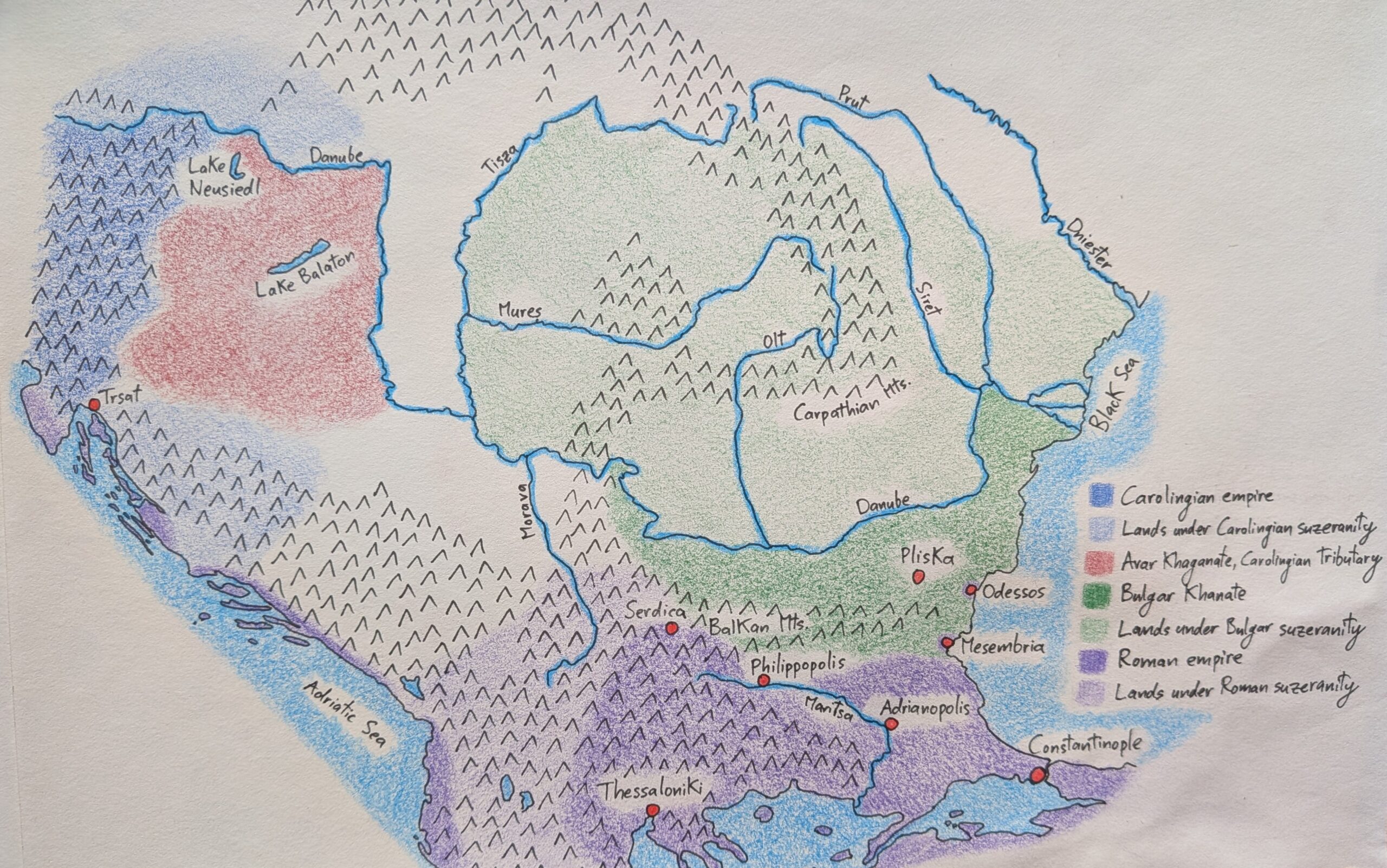
During Charlemagne’s invasion of the khaganate, a high-ranking Avar noble, called the tudun, submitted to him and was granted the lands west of the Danube as his fief, while another noble, the kapkhan, fled east beyond the Tisza to live independently.
A few years after the end of hostilities, the tudun rebelled against Frankish rule, hoping to regain independence for his people. He was defeated, however, and Charlemagne set to reorganizing the Avar lands he had conquered. In 805, he reconstituted the khaganate and appointed a new khagan loyal to him personally, who was tasked with providing tribute and protecting the eastern borders. This reforged khaganate was much smaller than the original, covering only the lands from the Alps to the Danube. To the north lived the Moravians, and to the south, the Croats, both of which also had to pay tribute to Charlemagne.
While Charlemagne clashed with the tudun, the Bulgar khan Krum took the opportunity to attack the kapkhan living in the Carpathian Mountains. His aim was to extinguish the last remaining independent Avar principality and to create a buffer between himself and the expansionist Charlemagne. Krum marched up the Olt and along the Mureș, defeated the kapkhan‘s forces, and demanded the submission of the communities he encountered.
Krum’s campaign into the Carpathians more than doubled the lands under Bulgar influence, but it’s important to note that the Bulgars only directly controlled the lands between the Balkan Mountains and the Danube. The communities north of the Danube—up to the Tisza in the west and the Dniester in the east—recognized Krum as their overlord, but otherwise enjoyed complete autonomy in their internal affairs. The Romanians, Slavs, and Gepids of the region continued to live much as they had for generations, tilling their own lands, adjudicating their own disputes, and celebrating their own festivals as they saw fit.
To the south of the Bulgar khanate lay the Roman empire, which had made considerable efforts in the last decades of the eighth century to expand its influence in the Balkans. Successive emperors had brought farmers from Anatolia to bolster the tax and recruitment base of the Balkan provinces, had fortified towns and built forts, and had sent armies into the interior to force the Slavic communities of the area to recognize Roman supremacy.
As such, at the beginning of the ninth century, the Carpathian Basin and the Balkans were divided between three powers: Charlemagne’s empire, the Bulgar khanate, and the Roman empire, each with core areas where they exerted direct authority and with more peripheral regions where their suzerainty was recognized by subject peoples. In between these three powers, communities lived without overlords, without the need to pay tribute to anyone nor to fight on anyone else’s behalf. Hundreds of Romanian and Slavic communities thus continued to live in independent villages as they had done for generations.
Leave a Reply